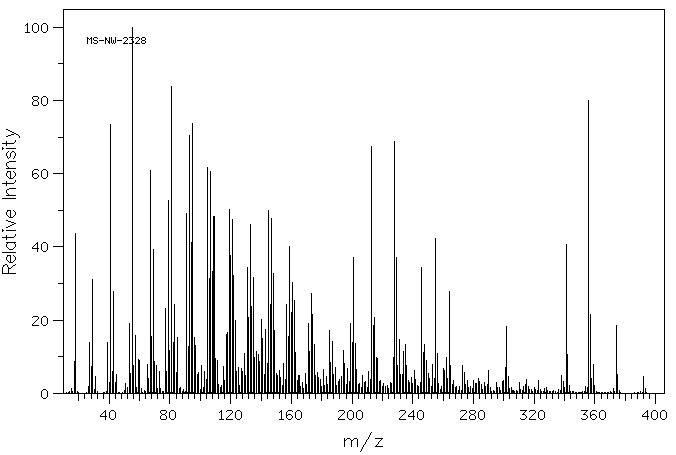
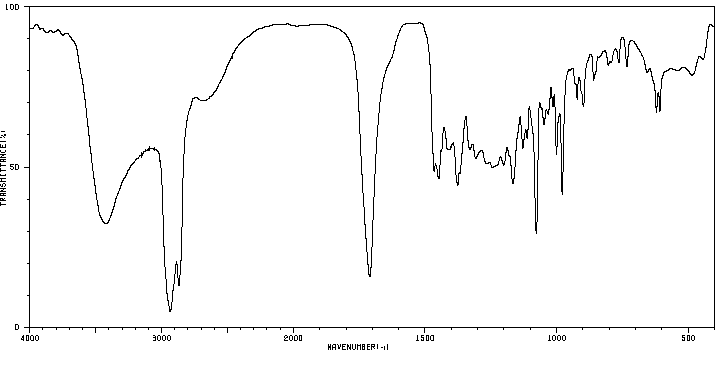
Chenodiol is well absorbed from the small intestine and taken up by the liver where it is converted to its taurine and glycine conjugates and secreted in bile. At steady-state, an amount of chenodiol near the daily dose escapes to the colon and is converted by bacterial action to lithocholic acid. About 80% of the lithocholate is excreted in the feces; the remainder is absorbed and converted in the liver to its poorly absorbed sulfolithocholyl conjugates. During chenodiol therapy there is only a minor increase in biliary lithocholate, while fecal bile acids are increased three- to fourfold.
In multiple clinical trials of chenodiol therapy for dissolution of gallstones, serum aminotransferase elevations occurred in up to 30% of patients. The elevations generally arose within 2 months of starting therapy and were typically mild, transient and not accompanied by symptoms or jaundice. Liver biopsies done during chenodiol therapy generally showed mild, nonspecific changes. Clinically apparent liver injury with jaundice was not reported. The liver enzyme elevations were generally dose related and usually did not recur on restarting chenodiol at lower doses. While the serum enzyme abnormalities that occurred on chenodiol therapy generated considerable concern, they appeared to be relatively benign. Since the approval of chenodiol and its more widespread use, at least four instances of liver injury with jaundice have been reported to the sponsor, but the clinical features and outcomes of these cases have not been published. Nevertheless, the product label for chenodiol includes a boxed warning about hepatotoxicity although it does not provide advice on the frequency or how to respond to abnormalities. Thus, the reliability of reports of clinically apparent liver injury with chenodiol therapy remains unclear. Once ursodiol was found to be equally as effective as chenodiol, even at lower doses, and was rarely associated with serum enzyme elevations, it rapidly replaced chenodiol as medical therapy for gallstones.
[EN] CATHEPSIN INHIBITORS<br/>[FR] INHIBITEURS DE LA CATHEPSINE
申请人:ACADEMISCH ZIEKENHUIS LEIDEN
公开号:WO2019112426A1
公开(公告)日:2019-06-13
This invention relates to compounds that are useful as inhibitors, in particular as inhibitors of Cathepsin K (CatK), and to a method of inhibiting cathepsin activity, comprising administering a compound or formulation comprising a compound according to the invention.
Pharmaceutical compositions of drug-oligomer conjugates and methods of treating diseases therewith
申请人:——
公开号:US20030069170A1
公开(公告)日:2003-04-10
Pharmaceutical compositions that include a drug-oligomer conjugate, a fatty acid component, and a bile salt component are described. The drug is covalently coupled to an oligomeric moiety. The fatty acid component and the bile salt component are present in a weight-to-weight ratio of between 1:5 and 5:1. Methods of treating diseases in a subject in need of such treatment using such pharmaceutical compositions are also provided, as are methods of providing such pharmaceutical compositions.
Aus Litho-, Desoxy- und Chenodesoxycholsäure (1a – c) wurden über die Homosäuren 5a – c die tert.-C25-Carbinole 7a – c dargestellt. Cholesterin ließ sich in das Ecdyson-analoge Produkt 18b umwandeln. Hyodesoxy- und Homohyodesoxycholsäure wurden in die Tetrole 33a, b übergeführt. Aus 34a – d wurden die Steroide 37a – d mit diosphenolischer Struktur gewonnen.
AUS Litho-,Desoxy- UNDChenodesoxycholsäure(1A - C ^)wurden黚死Homosäuren 5A - Ç模具叔-C 25 -Carbinole 7A - Ç dargestellt。位于Das Ecdyson-Analoge Produkt 18b umwandeln中的胆固醇。Hyodesoxy- UNDHomohyodesoxycholsäurewurden裸片Tetrole部33a,b übergeführt。Aus 34a – d沸腾的硬脂酸酯37a – d mit diosphenolischer Struktur gewonnen。
[EN] FARNESOID X RECEPTOR AGONISTS AND USES THEREOF<br/>[FR] AGONISTES DU RÉCEPTEUR FARNÉSOÏDE X ET LEURS UTILISATIONS
申请人:METACRINE INC
公开号:WO2018170166A1
公开(公告)日:2018-09-20
Described herein are compounds that are farnesoid X receptor agonists, methods of making such compounds, pharmaceutical compositions and medicaments comprising such compounds, and methods of using such compounds in the treatment of conditions, diseases, or disorders associated with farnesoid X receptor activity.
[EN] 2'-SUBSTITUTED NUCLEOSIDE DERIVATIVES AND METHODS OF USE THEREOF FOR THE TREATMENT OF VIRAL DISEASES<br/>[FR] DÉRIVÉS DE NUCLÉOSIDE 2'-SUBSTITUÉS ET PROCÉDÉS D'UTILISATION DE CEUX-CI POUR LE TRAITEMENT DE MALADIES VIRALES
申请人:MERCK SHARP & DOHME
公开号:WO2012142085A1
公开(公告)日:2012-10-18
The present invention relates to 2'-Substituted Nucleoside Derivatives of Formula (I): and pharmaceutically acceptable salts thereof, wherein A, B, X, R1, R2 and R3 are as defined herein. The present invention also relates to compositions comprising at least one 2'-Substituted Nucleoside Derivative, and methods of using the 2'-Substituted Nucleoside Derivatives for treating or preventing HCV infection in a patient.