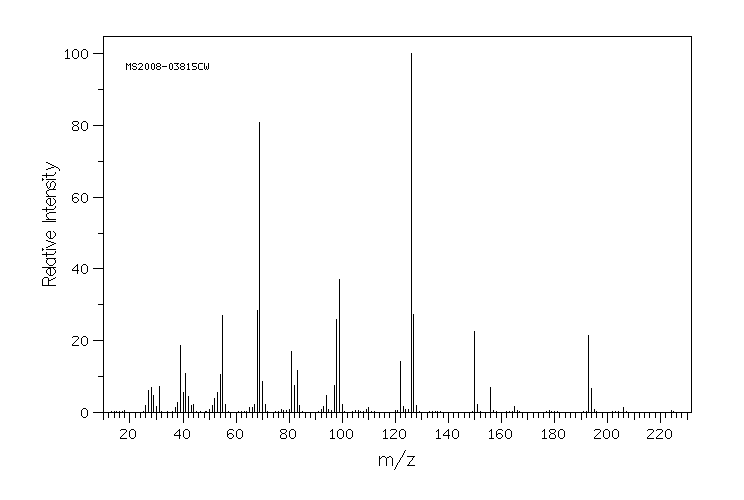
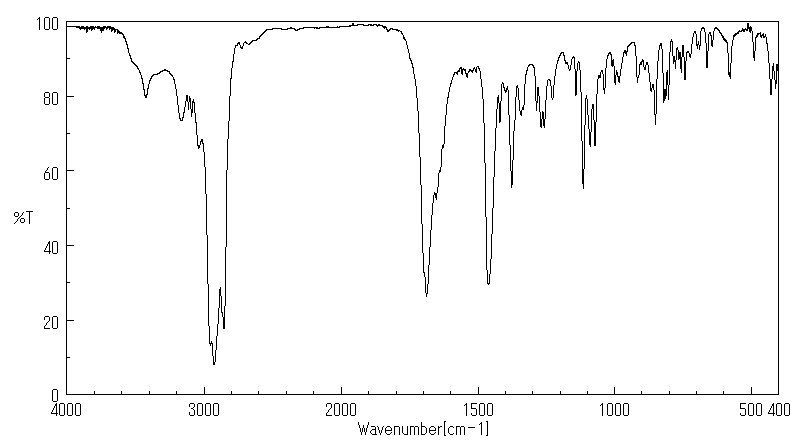
The metabolic fate of stavudine has not been elucidated in humans. Intracellularly, in both virus-infected and uninfected cells, stavudine is converted to stavudine monophosphate by cellular thymidine kinase. The monophosphate is subsequently converted to stavudine diphosphate and then to stavudine triphosphate, presumably by the same cellular kinases involved in the metabolism of zidovudine. Intracellular (host cell) conversion of stavudine to the triphosphate derivative is necessary for the antiviral activity of the drug.
Stavudine inhibits the activity of HIV-1 reverse transcriptase (RT) both by competing with the natural substrate dGTP and by its incorporation into viral DNA.
Stavudine is a well known cause of liver injury and is regularly listed in case series of drug induced liver injury and acute liver failure. Mild and transient elevations in liver enzymes occur in up to half of patients on stavudine, but elevations above 5 times normal occur in only 5% to 13% of treated patients. Clinically apparent hepatotoxicity due to stavudine is well described and is usually marked by lactic acidosis, marked hepatic steatosis (microvesicular fat), and progressive hepatic synthetic dysfunction (LASH). This form of liver injury typically arises only after 2 to 6 months of therapy and is preceded by nonspecific prodromal symptoms of anorexia, nausea, vomiting, diarrhea, and weakness which is followed by dyspnea, jaundice and confusion. Lactic acidosis often accompanies the hepatic injury and may be the predominant clinical feature. Jaundice arises late and serum enzymes are unusually only mildly or moderated elevated, the pattern being mixed or actually cholestatic. Pancreatitis, myopathy and neuropathy may also occur. Lipodystrophy is frequently present. Liver histology during the early course of injury demonstrates marked microvesicular fat with little hepatocyte injury. Subsequently, cholestasis arises and the fatty change may evolve to a macrovesicular pattern. Late changes include ballooning cell degeneration, Mallory bodies and fibrosis. The hepatotoxicity associated with stavudine can be rapidly fatal, but is potentially reversable with intensive support and early withdrawal of therapy (Case 1). Monitoring of patients on stavudine demonstrates that asymptomatic elevations of serum lactate (hyperlactatemia) usually precedes the appearance of clinical symptoms and acidosis. Once lactic acidosis is present, however, the mortality rate is high (33% to 50%) (Case 2). Preexisting liver injury, female sex, older age, obesity, alcohol use and concurrent therapy with didanosine, ribavirin and tenofovir appear to increase the risk of this syndrome in patients taking stavudine.
Stavudine and other first generation nucleoside analogues used to treat HIV infection have also been linked to cases of chronic liver injury, marked by appearance of signs and symptoms of portal hypertension and liver nodularity without significant fibrosis or cirrhosis after long term use. Nodular regenerative hyperplasia or “noncirrhotic portal hypertension” arise after long term therapy with antiretroviral therapies most typically with didanosine. In some cases, the first complications of portal hypertension arise months or years after the implicated agent is stopped and while other, less hepatotoxic agents are being used. Nodular regenerative hyperplasia is typically characterized by the appearance of signs and symptoms of portal hypertension and advanced liver disease, such as ascites or variceal hemorrhage, with no obvious cause (absence of hepatitis B or C and no history of alcohol abuse or nonalcoholic steatohepatitis). Serum enzymes are only modestly elevated and bilirubin levels can be normal. Liver biopsy can look deceptively benign, with little or no fibrosis and nodularity that is only obvious with reticulum stains that highlight the altered architecture. These patients have typically been receiving multiple antiretroviral agents and the attribution to stavudine alone cannot always be made. Didanosine is most frequently implicated in causing nodular regenerative hyperplasia but isolated instances have also been linked to stavudine, zidovudine and in rare instances tenofovir. The signs and symptoms of portal hypertension tend to improve once the nucleoside analogues are stopped and medical therapy of ascites and portal hypertension is begun.
Likelihood score: A (uncommon well established cause of acute and chronic forms of liver disease).
Stavudine is rapidly absorbed following oral administration, and peak plasma concentrations of the drug are attained within 1 hour after the dose. Oral bioavailability of stavudine is reported to be about 86% in adults and 77% in pediatric patients 5 weeks to 15 years of age.
Data from single- and multiple-dose studies indicate that peak plasma concentrations and AUC of stavudine increase in proportion to dose over the dosage range 0.03 -4 mg/kg; there is no evidence that accumulation occurs following multiple doses.
[EN] SPIROCYCLIC HETEROCYCLE COMPOUNDS USEFUL AS HIV INTEGRASE INHIBITORS<br/>[FR] COMPOSÉS HÉTÉROCYCLIQUES SPIROCYCLIQUES UTILES COMME INHIBITEURS DU VIH
申请人:MERCK SHARP & DOHME
公开号:WO2016094198A1
公开(公告)日:2016-06-16
The present invention relates to Spirocyclic Heterocycle Compounds of Formula (I): (I) and pharmaceutically acceptable salts thereof, wherein A, B, X, R1, R2, R3 and R4 are as defined herein. The present invention also relates to compositions comprising at least one Spirocyclic Heterocycle Compound, and methods of using the Spirocyclic Heterocycle Compounds for treating or preventing HIV infection in a subject.
3-Aminocyclopentanecarboxamides as modulators of chemokine receptors
申请人:Xue Chu-Biao
公开号:US20060004018A1
公开(公告)日:2006-01-05
The present invention is directed to compounds of Formula I:
which are modulators of chemokine receptors. The compounds of the invention, and compositions thereof, are useful in the treatment of diseases related to chemokine receptor expression and/or activity.
[EN] DERIVATIVES OF AMANITA TOXINS AND THEIR CONJUGATION TO A CELL BINDING MOLECULE<br/>[FR] DÉRIVÉS DE TOXINES D'AMANITES ET LEUR CONJUGAISON À UNE MOLÉCULE DE LIAISON CELLULAIRE
申请人:HANGZHOU DAC BIOTECH CO LTD
公开号:WO2017046658A1
公开(公告)日:2017-03-23
Derivatives of Amernita toxins of Formula (I), wherein, formula (a) R 1, R 2, R 3, R 4, R 5, R 6, R 7, R 8, R 9, R 10, X, L, m, n and Q are defined herein. The preparation of the derivatives. The therapeutic use of the derivatives in the targeted treatment of cancers, autoimmune disorders, and infectious diseases.
[EN] A CONJUGATE OF A CYTOTOXIC AGENT TO A CELL BINDING MOLECULE WITH BRANCHED LINKERS<br/>[FR] CONJUGUÉ D'UN AGENT CYTOTOXIQUE À UNE MOLÉCULE DE LIAISON CELLULAIRE AVEC DES LIEURS RAMIFIÉS
申请人:HANGZHOU DAC BIOTECH CO LTD
公开号:WO2020257998A1
公开(公告)日:2020-12-30
Provided is a conjugation of cytotoxic drug to a cell-binding molecule with a side-chain linker. It provides side-chain linkage methods of making a conjugate of a cytotoxic molecule to a cell-binding ligand, as well as methods of using the conjugate in targeted treatment of cancer, infection and immunological disorders.