... The metabolism of ergosterol by cytochrome P450scc /is demonstrated/ in either a reconstituted system or isolated adrenal mitochondria. The major reaction product was identified as 17alpha,24-dihydroxyergosterol. Purified P450scc also generated hydroxyergosterol as a minor product, which is probably an intermediate in the synthesis of 17alpha,24-dihydroxyergosterol. In contrast to cholesterol and 7-dehydrocholesterol, cleavage of the ergosterol side chain was not observed. NMR analysis clearly located one hydroxyl group to C24, with evidence that the second hydroxyl group is at C17. 17alpha,24-Dihydroxyergosterol inhibited cell proliferation of HaCaT keratinocytes and melanoma cells. Thus, in comparison with cholesterol and 7-dehydrocholesterol, the 24-methyl group and the C22-C23 double bond of ergosterol prevent side chain cleavage by P450scc and change the enzyme's hydroxylase activity from C22 and C20, to C24 and C17, generating bioactive product.
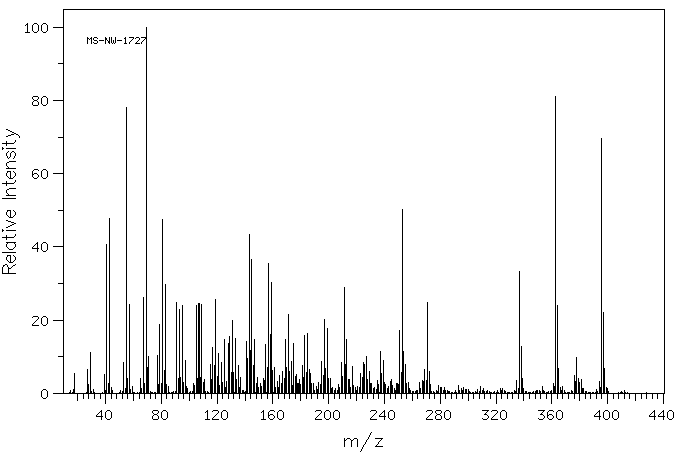
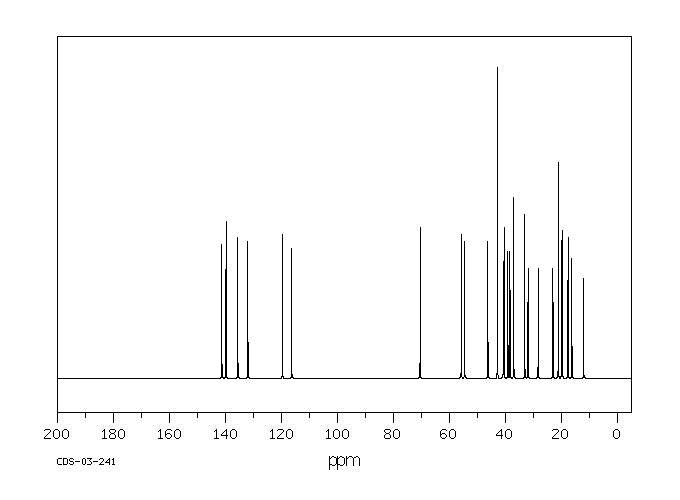
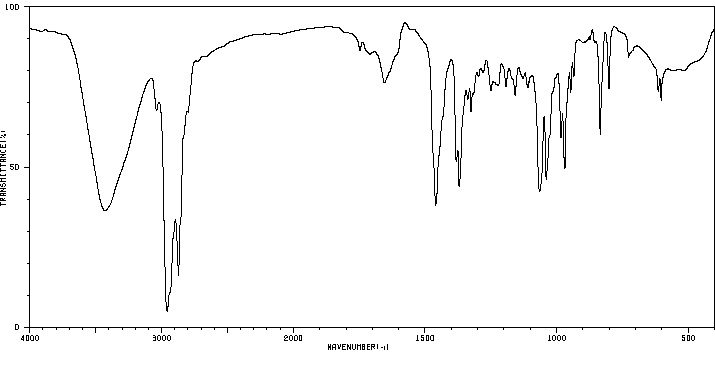
In order to investigate the effect of the different stereochemistry of C-24 on the microbial C-26 oxidation of sterol side-chain the genetically modified Mycobacterium sp. BCS 396 strain was used to transform erogsterol. Ergosterol was converted to 3-oxo-4,22-ergostadien-26-oic acid methyl ester, 3-oxo-1,4,22-ergostatrien-26-oic acid methyl ester, and 3-oxo-1,4,22-ergostatrien-26-oic acid, the structures of which have been determined by IR, 1H NMR, 13C NMR, and mass spectroscopy. The X-ray structure of 3-oxo-4,22-ergostadien-26-oic acid methyl ester revealed that oxidation at C-26 of the ergostane side-chain generates a chiral center with S-configuration at C-25 as a result of chiral induction of the C-24 center.
The results of experiments on rats given the ergosterol-containing diet for a long time indicate that ergosterol was incorporated in liver tissues in trace amounts which are not comparable with ergosterol concentrations exerting an effect in model experiments. Ergosterol was not detected in the liver after 3-day experiments. At the same time it was established that the proportion of unchanged ergosterol in rat feces was about 16% of the amount administered per os. The products of a possible ergosterol transformation (dehydroneoergosterol-24-methyl-1,3,5 (10), 6,8 (9), 22-hexaen-3 beta-ol; 24-methylcholesta-7,24 (28)-dien-3 beta-ol; 4-cholesta-7,22,25 (?)-trien-3 beta-ol; 4-methylcholesta-7,22 (?)-dien-3 beta-ol, and so forth were identified in feces.
Metabolism of orally administered ergosterol (Erg) ... in rats and ... vitamin D biological activity were investigated. Most of orally administered Erg ... /was/ excreted in feces and the remaining sterols were absorbed through intestine. The absorbed sterols were not transported in skin as the intact forms but metabolized into brassicasterol and cholesterol, respectively, within 25 hr. Neither increment of intestinal calcium absorption nor plasma calcium concentrations were observed by oral administration of Erg ... to vitamin D-deficient rats...
The chick-oviduct assay was used to investigate the effects of dietary ergosterol on the response to oral progestogens and estrogens. Progestogens alone had no effect on the oviduct but the hypertrophy due to estrogen was greatly enhanced by simultaneous treatment with progestogen at all dose levels tested. Ergosterol had no effect on any of the responses of the oviduct studied.
MURINE LEUKEMIA CELLS (L1210) GROWN IN MEDIUM CONTAINING ERGOSTEROL (40 UG/ML) THEN EXPOSED BRIEFLY TO AMPHOTERICIN B (0-10 UG/ML) WERE MORE SENSITIVE TO THE ANTIBIOTIC THAN WERE CONTROLS.
AFTER 4-HR GROWTH PERIOD IN PRESENCE OF 5X10⁻⁹ MOLES KETOCONAZOLE, ACETATE INCORPORATION INTO ERGOSTEROL BY CANDIDA ALBICANS WAS INHIBITED APPROXIMATELY 50%.
INHIBITION OF ERGOSTEROL BIOSYNTHESIS IN CANDIDA ALBICANS BY THE ANTIFUNGAL AGENT MICONAZOLE NITRATE WAS INVESTIGATED AFTER IN VITRO CONTACT WITH THE DRUG FOR 1, 4, 16, & 24 HR.
The functions and biosynthesis of sterols have been effective targets for fungal control in different areas, including pharmaceutical and agricultural applications. Fungi are among the organisms that synthesize sterols, principally ergosterol. In this paper, the effect of dibutyryl-cAMP (db-cAMP) on ergosterol level and the interaction of drugs that would change the concentration of cAMP with antifungal drugs have been investigated. Sterols were extracted from Candida albicans, and ergosterol was measured using the gas chromatography method. The interaction of different agents was measured by the broth dilution method. It was found that phosphodiesterase inhibitors reverse the inhibitory activity of azole antifungal drugs. Evaluating the ergosterol level of C. albicans incubated with db-cAMP revealed that it increased ergosterol level. Further experiments provided evidence attributing the observed interaction between azoles and phosphodiesterase inhibitors to the relationship between ergosterol and cAMP. The possible significance of this interaction includes potentiation of antifungal activity of drugs by manipulating the cAMP level.
/SRP:/ Immediate first aid: Ensure that adequate decontamination has been carried out. If patient is not breathing, start artificial respiration, preferably with a demand valve resuscitator, bag-valve-mask device, or pocket mask, as trained. Perform CPR if necessary. Immediately flush contaminated eyes with gently flowing water. Do not induce vomiting. If vomiting occurs, lean patient forward or place on the left side (head-down position, if possible) to maintain an open airway and prevent aspiration. Keep patient quiet and maintain normal body temperature. Obtain medical attention. /Poisons A and B/
Vitamin D is excreted into breast milk in limited amounts. A direct relationship exists between maternal serum levels of vitamin D & the concn in breast milk. Chronic maternal ingestion of large doses may lead to greater than normal vitamin D activity in the milk & resulting hypercalcemia in the infant. /Vitamin D/
The results of experiments on rats given the ergosterol-containing diet for a long time indicate that ergosterol was incorporated in liver tissues in trace amounts which are not comparable with ergosterol concentrations exerting an effect in model experiments. Ergosterol was not detected in the liver after 3-day experiments. At the same time it was established that the proportion of unchanged ergosterol in rat feces was about 16% of the amount administered per os. The products of a possible ergosterol transformation (dehydroneoergosterol-24-methyl-1,3,5 (10), 6,8 (9), 22-hexaen-3 beta-ol; 24-methylcholesta-7,24 (28)-dien-3 beta-ol; 4-cholesta-7,22,25 (?)-trien-3 beta-ol; 4-methylcholesta-7,22 (?)-dien-3 beta-ol, and so forth were identified in feces.
Novel thienylpyridylcarboxamides of the formula (I)
The present application is also directed to a plurality of processes for preparing these compounds and their use for controlling unwanted microorganisms, and also novel intermediates and their preparation.
N-ARYLAMIDINE-SUBSTITUTED TRIFLUOROETHYL SULFIDE DERIVATIVES AS ACARICIDES AND INSECTICIDES
申请人:BAYER CROPSCIENCE AG
公开号:US20140315898A1
公开(公告)日:2014-10-23
The present invention relates to novel N-arylamide-substituted trifluoroethyl sulfide derivatives of the formula (I)
in which X
1
, X
2
, X
3
, X
4
, R
1
, R
2
, R
3
, n have the meanings given in the description—to their use as acaricides and insecticides for controlling animal pests and to processes and intermediates for their preparation
2-OXO-2- (2-PHENYL-5,6,7,8-TETRAHYDRO-INDOLIZIN-3-YL) -ACETAMIDE DERIVATIVES AND RELATED COMPOUNDS AS ANTIFUNGAL AGENTS
申请人:Payne Lloyd James
公开号:US20110009390A1
公开(公告)日:2011-01-13
The invention provides compounds of formula (I), and pharmaceutically and agriculturally acceptable salts thereof: wherein: R1, R2, R3, R4, R5, R6, R7, R8, A1, L1 and n are as defined herein. These compounds and their pharmaceutically acceptable salts are useful in the manufacture of medicaments for use in the prevention or treatment of a fungal disease. Compounds of formula (I), and agriculturally acceptable salts thereof, may also be used as agricultural fungicides.
The invention provides inhibitors of a sterol C14-demethylase, a new series of 4- aminopyridyl-based lead inhibitors targeting Trypanosoma cruzi CYP51 (TcCYP51) developed using structure-based drug design as well as structure -property relationship (SPR) analyses. The screening hit starting point, LP 10 (KD < 42 nM; EC50 of 0.65 μΜ), has been optimized to give the potential leads that have low nanomolar binding affinity to TcCYP51 and significant activity against T. cruzi amastigotes cultured in human myoblasts. Many of the optimized compounds have improved microsome stability, and most are selective against the T. cruzi CYP51 relative to human CYPs 1A2, 2D6 and 3A4 (<50% inhibition at 1 μΜ). A rationale for the improvement of microsome stability and selectivity of inhibitors against human metabolic CYP enzymes is presented. In addition, the binding mode of several compounds of the invention with the T. brucei CYP51 (TbCYP51) ortholog has been characterized by x-ray structure analysis. Orally active compounds and their cyclodextrin complexes have been shown to be effective against Chagas-infected mice.
Novel sterol/stanol phosphorylnitroderivatives and use thereof in treating or preventing cardiovascular disease, its underlying conditions and other disorders
申请人:Orchansky Liliana Patricia
公开号:US20070232688A1
公开(公告)日:2007-10-04
Sterol and stanol phosphorylnitro derivatives and their use in treating or preventing cardiovascular disease, its underlying conditions and other disorders are disclosed. The disclosed compounds include a phosphate linker, at least one moiety that releases nitric oxide (NO), and a sterol or stanol moiety. Some compounds additionally include an ascorbyl moiety to make the compound more readily soluble in aqueous and non-aqueous media.