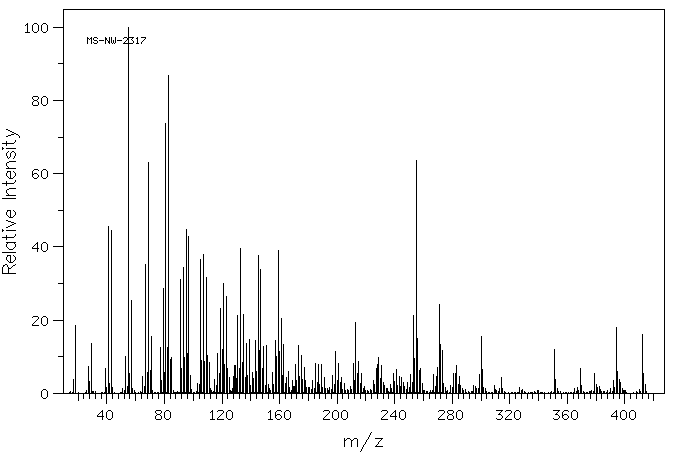
Metabolism of phytosterols was investigated using rat feces and liver microsomes. Feces were collected after phytosterols (a well characterized mixture of beta-sitosterol 40%, campesterol 30% and dihydrobrasicasterol) were administered orally (0.5 g/kg) to rats. Metabolites of phytosterols were identified using GC/MS. Three peaks were eluted at 12.47, 12.65, 12.87 min and had characteristic molecular ions m/z 428, 430, 432, respectively. Three fecal metabolites were identified as androstadienedione, androstenedione, and androstanedione. No metabolites could be detected in the rat liver microsomal reaction mixture. The results suggest that the metabolites of phytosterols in rat feces are formed by oxidation at 3- position, saturation at 5- and 6- position, and 17- side chain cleavage in the rat large intestine.
Plant sterols are an essential component of the membranes of all eukaryotic organisms. They are either synthesized de novo or taken up from the environment. Their function appears to be to control membrane fluidity and permeability, although some plant sterols have a specific function in signal transduction. The phytosterols are products of the isoprenoid pathway. The dedicated pathway to sterol synthesis in photosynthetic plants occurs at the squalene stage through the activity of squalene synthetase. Although the activity of 3-hydroxymethyl-3-glutaryl coenzyme A (HGMR) is rate-limiting in the synthesis of cholesterol, this does not appear to be the case with the plant sterols. Up-regulation of HGMR appears to increase the biosynthesis of cycloartenol but not the delta5-sterols. A decline in sterol synthesis is associated with a suppression of squalene synthetase activity, which is probably a critical point in controlling carbon flow and end-product formation. The major post-squalene biosynthetic pathway is regulated by critical rate-limiting steps such as the methylation of cycloartenol into cycloeucalenol. Little is known about the factors controlling the biosynthesis of the end-point sterol esters or stanols.
/SRP:/ Immediate first aid: Ensure that adequate decontamination has been carried out. If patient is not breathing, start artificial respiration, preferably with a demand valve resuscitator, bag-valve-mask device, or pocket mask, as trained. Perform CPR if necessary. Immediately flush contaminated eyes with gently flowing water. Do not induce vomiting. If vomiting occurs, lean patient forward or place on the left side (head-down position, if possible) to maintain an open airway and prevent aspiration. Keep patient quiet and maintain normal body temperature. Obtain medical attention. /Poisons A and B/
/SRP:/ Basic treatment: Establish a patent airway (oropharyngeal or nasopharyngeal airway, if needed). Suction if necessary. Watch for signs of respiratory insufficiency and assist ventilations if needed. Administer oxygen by nonrebreather mask at 10 to 15 L/min. Monitor for pulmonary edema and treat if necessary ... . Monitor for shock and treat if necessary ... . Anticipate seizures and treat if necessary ... . For eye contamination, flush eyes immediately with water. Irrigate each eye continuously with 0.9% saline (NS) during transport ... . Do not use emetics. For ingestion, rinse mouth and administer 5 mL/kg up to 200 mL of water for dilution if the patient can swallow, has a strong gag reflex, and does not drool ... . Cover skin burns with dry sterile dressings after decontamination ... . /Poisons A and B/
/SRP:/ Advanced treatment: Consider orotracheal or nasotracheal intubation for airway control in the patient who is unconscious, has severe pulmonary edema, or is in severe respiratory distress. Positive-pressure ventilation techniques with a bag valve mask device may be beneficial. Consider drug therapy for pulmonary edema ... . Consider administering a beta agonist such as albuterol for severe bronchospasm ... . Monitor cardiac rhythm and treat arrhythmias as necessary ... . Start IV administration of D5W /SRP: "To keep open", minimal flow rate/. Use 0.9% saline (NS) or lactated Ringer's if signs of hypovolemia are present. For hypotension with signs of hypovolemia, administer fluid cautiously. Watch for signs of fluid overload ... . Treat seizures with diazepam or lorazepam ... . Use proparacaine hydrochloride to assist eye irrigation ... . /Poisons A and B/
/HUMAN EXPOSURE STUDIES/ A study was conducted in 12 healthy males and 12 females (mean age 36 years) to assess the impact of a margarine enriched with phytosterol esters on fecal concentrations of bile acids and sterols. During the run-in period, volunteers consumed 40 g of a control margarine for 21 consecutive days if male, and for 28 days if female. Half of the volunteers were then randomly allocated to consume the control margarine for another 21 or 28 days, respectively. The remaining subjects consumed 40 g of a margarine containing 8.6 g vegetable oil phytosterol (46% (w/w) beta-sitosterol, 26% campesterol, 20% stigmasterol). Throughout the total study subjects consumed the same diet adjusted for individual energy requirements. The phytosterol ester-enriched spread significantly enhanced fecal neutral sterol concentrations from about 40 mg/g to 190 mg/g dry weight faeces. Fecal neutral sterol metabolites increased from about 30 mg/g to about 50 mg/g. The major parent sterols excreted were cholesterol, sitosterol, campesterol and stigmasterol. Sitosterol, campesterol and stigmasterol comprised 28%, 15% and 12% of the total fecal neutral sterols, reflecting the composition of the sterol enriched margarine. The major sterol metabolites excreted were metabolites formed by, predominantly, oxidation at the 3-position and metabolites saturated at the 5,6 position in a beta-configuration. Fecal secondary bile acid concentration was reduced by vegetable oil sterols from 7.6 mg/g dry faeces to 6.0 mg/g. Consumption of vegetable oil phytosterols slightly but significantly increased the fecal concentration of 4-cholesten-3-one. However, 4-cholesten-3-one concentration remained very low (less than 2 mg/g) and in line with values reported in the literature for subjects fed high or low fat diets. No sterol oxides could be detected in the feces...
/HUMAN EXPOSURE STUDIES/ ... To compare effects on plasma total-, LDL-, and HDL-cholesterol concentrations of margarines enriched with different vegetable oil sterols or sitostanol-ester.... A randomized double-blind placebo-controlled balanced incomplete Latin square design /study/ with five treatments and four periods of 3.5 weeks /was conducted/. Margarines enriched with sterols from soybean, sheanut or ricebran oil or with sitostanol-ester were compared to a non-enriched control margarine. Sterol intake was between 1.5-3.3 g/d. Two thirds of the soybean oil sterols were esterified to fatty acids. ... One hundred healthy non-obese normocholesterolaemic and mildly hypercholesterolemic volunteers aged 45+/-12.8 y, with plasma total cholesterol levels below 8 mmol/L at entry /were recruited/. Plasma lipid, carotenoid and sterol concentrations, blood clinical chemistry and hematology, fatty acid composition of plasma cholesterylesters and food intake /were measured/. Ninety-five volunteers completed the study. None of the margarines induced adverse changes in blood clinical chemistry, serum total bile acids or haematology. Plasma total- and LDL-cholesterol concentrations were significantly reduced by 8-13% (0.37-0.44 mmol/L) compared to control for margarines enriched in soybean oil sterol-esters or sitostanol-ester. No effect on HDL-cholesterol concentrations occurred. The LDL- to HDL-cholesterol ratio was reduced by 0.37 and 0.33 units for these margarines, respectively. Effects on blood lipids did not differ between normocholesterolemic and mildly hypercholesterolemic subjects. Plasma sitosterol and campesterol levels were significantly higher for the soybean oil sterol margarine and significantly lower for the sitostanol-ester margarine compared to control. Dietary intake was very similar across treatments. The fatty acid composition of plasma cholesterylesters confirmed the good compliance to the treatment. All sterol enriched margarines reduced lipid-standardized plasma alpha- plus beta-carotene levels. Plasma lycopene levels were also reduced but this effect was not significant for all products. ...
... Metabolism of plant sterols and squalene administered intravenously in the form of lipid emulsion mimicking chylomicrons (CM) /was studied/. The CM-like lipid emulsion was prepared by dissolving squalene in commercially available Intralipid. The emulsion was given as an intravenous bolus injection