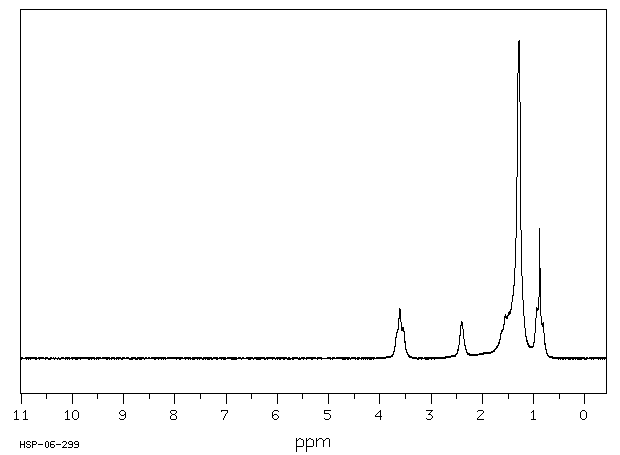
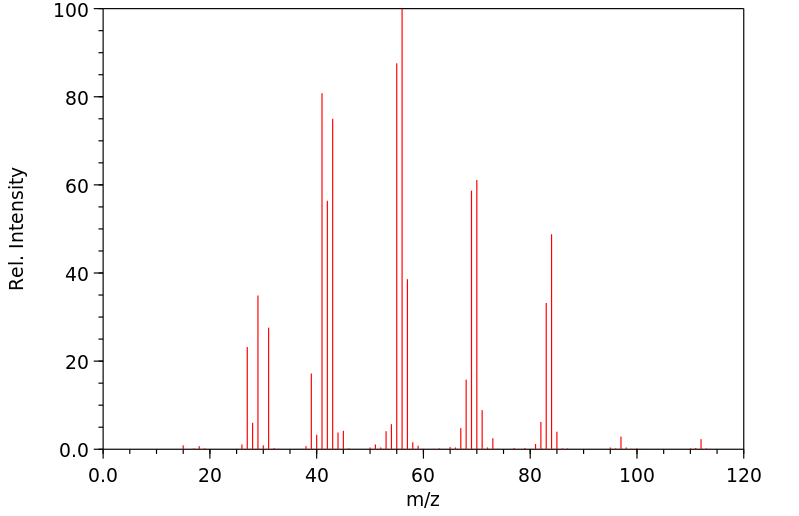
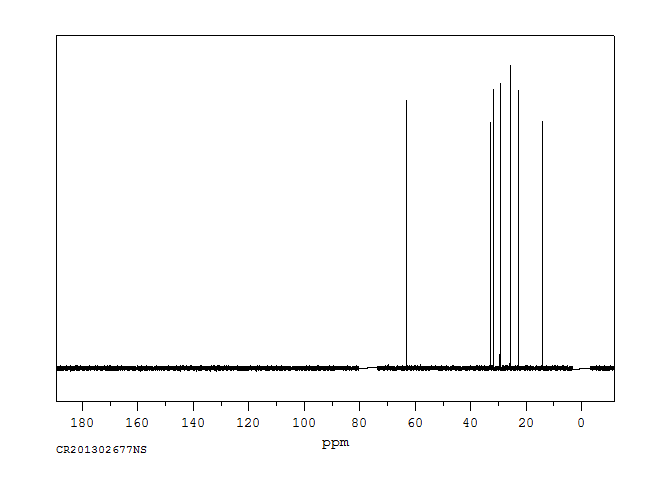
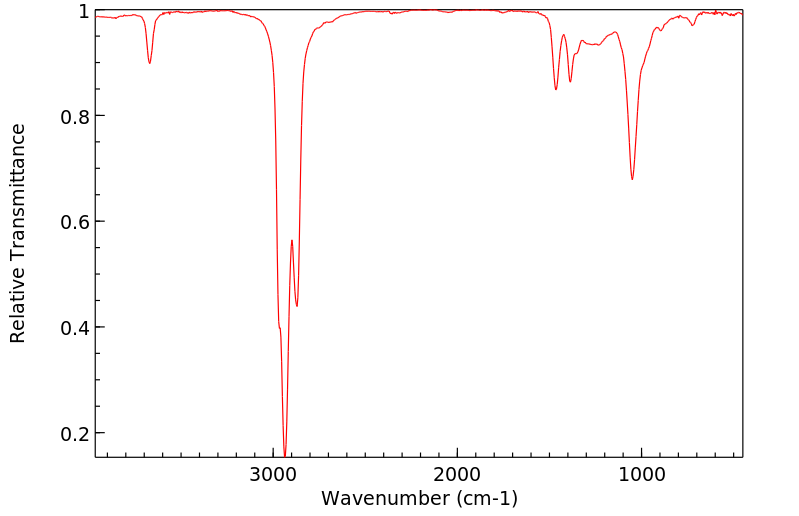
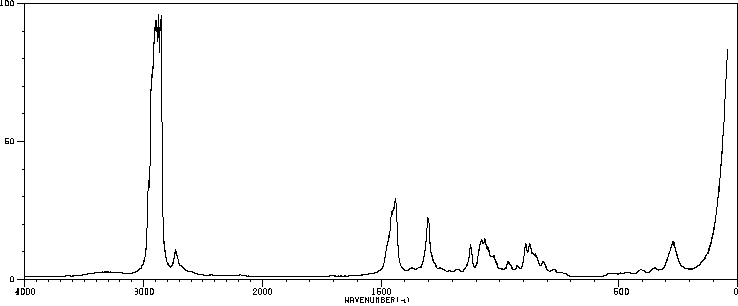
Octanol appears as a clear colorless liquid with a penetrating aromatic odor. Insoluble in water and floats on water. Vapors heavier than air. Vapors may irritate the eyes, nose, and respiratory system.
颜色/状态:
Colorless liquid
气味:
Fresh orange rose odor
味道:
OILY, SWEET, SLIGHTLY HERBACEOUS TASTE
蒸汽密度:
4.5 (AIR= 1)
蒸汽压力:
7.94X10⁻² mm Hg at 25 °C (est)
亨利常数:
2.45e-05 atm-m3/mole
大气OH速率常数:
1.44e-11 cm3/molecule*sec
自燃温度:
253 °C
粘度:
7.288 mPa.s at 25 °C
汽化热:
70.98 kJ/mol at 25 °C
表面张力:
27.53 DYNES/CM AT 20 °C (IN CONTACT WITH AIR)
气味阈值:
The odor and taste threshold for 1-octanol was reported at about 24 ppm.
The primary aliphatic alcohols undergo two general reactions in vivo, namely oxidation to carboxylic acids and direct conjugation with glucuronic acid. The first reaction proceeds with the intermediate formation of an aldehyde, and the carboxylic acid from the aldehyde may be either oxidized completely to carbon dioxide or excreted as such or combined with glucuronic acid as an ester glucuronide. The extent to which an alcohol undergoes the second reaction, i.e. direct conjugation to an ether glucuronide, appears to depend upon the speed of the first reaction. Alcohols which are rapidly oxidized form very little ether glucuronide unless given in high doses.
The urinary metabolites of n-octane in Fischer 344 rats given the hydrocarbon by gavage included 2-octanol, 3-octanol, 5-oxohexanoic acid, and 6-oxoheptanoic acid. The sex of the animals influenced the relative amounts of metabolites formed. Analyses were performed by gas-liquid chromatography (GC) and gas-liquid chromatography/mass spectrometry (GC/MS). This is the first reported finding of keto acids in hydrocarbon oxidative metabolism. No kidney damage was found as a result of n-octane dosing although the 2,2,4-trimethylpentane (iso-octane) isomer does cause kidney lesions in male rats. /n-Octane/
IDENTIFICATION AND USE: 1-Octanol is a colorless liquid used in the determination of partition coefficients, perfumery, cosmetics, organic synthesis, solvent manufacture of high-boiling esters, antifoaming agent, and as a flavoring agent. 1-octanol is registered for pesticide use in the USA but approved pesticide uses may change periodically and so federal, state and local authorities must be consulted for currently approved uses. It has been used as experimental medication to treat tremor in patients. HUMAN EXPOSURE AND TOXICITY: In a human patch test, 1-octanol in 2% petrolatum was neither a skin irritant nor a skin sensitizer. Octanol has caused transient injury of corneal epithelium, with recovery in 48 hr. Common signs of exposure to 1-octanol are CNS: headache, muscle weakness, giddiness, ataxia, confusion, delirium, coma. Gastrointestinal: nausea, vomiting, diarrhea (odor of the alcohol in excreta). Irritation of skin, eyes, throat from vapor or liquid with cough and dyspnea. The annoying odor of 1-octanol may mask sensory irritation and prevent subjects with enhanced chemical sensitivity from concentrating on performance in a demanding task. ANIMAL STUDIES: 1-Octanol was slightly irritating to the skin of rabbits and is considered an eye irritant using the EU criteria. n-Octanol (0.55 g/kg) produced the largest decrease in body temperature. No evidence of tumors in the lung adenoma study in which mice were injected intraperitoneally with 100 and 500 mg/kg 1-octanol three times a week for 8 weeks. Studies indicate that T-type calcium channels (T-channels) in the thalamus are cellular targets for general anesthetics. The study recorded T-currents and underlying low-threshold calcium spikes from neurons of nucleus reticularis thalami (nRT) in brain slices from young rats and investigated the mechanisms of their modulation by an anesthetic alcohol, 1-octanol. 1-Octanol inhibited native T-currents at subanesthetic concentrations with an IC(50) of approximately 4 uM. Inhibition of both native and recombinant T-currents was accompanied by a hyperpolarizing shift in steady-state inactivation, indicating that 1-octanol stabilized inactive states of the channel. In developmental studies in rats no treatment-related effects were observed in pregnant females, including frequency of resorptions, fetal weights, or skeletal/visceral malformations. 1-Octanol was negative in an Ames Salmonella assay with strains Ta 98, TA 100, TA 1535, TA 1537, and TA 1538 at concentrations ranging from 4 to 2500 ug/plate with and without metabolic activation.
来源:Hazardous Substances Data Bank (HSDB)
毒理性
暴露途径
这种物质可以通过吸入和摄入被身体吸收。
The substance can be absorbed into the body by inhalation and by ingestion.
来源:ILO-WHO International Chemical Safety Cards (ICSCs)
毒理性
吸入症状
咳嗽。喉咙痛。
Cough. Sore throat.
来源:ILO-WHO International Chemical Safety Cards (ICSCs)
毒理性
皮肤症状
干燥的皮肤。
Dry skin.
来源:ILO-WHO International Chemical Safety Cards (ICSCs)
毒理性
眼睛症状
红斑。疼痛。
Redness. Pain.
来源:ILO-WHO International Chemical Safety Cards (ICSCs)
吸收、分配和排泄
体外人皮肤(表皮)的经皮流量报告为0.008毫克/平方厘米/小时,这表明渗透率较低。
In vitro dermal flux in human skin (epidermis) was reported as 0.008 mg/sq cm/hr, suggesting a low rate of penetration.
1.周国泰,化学危险品安全技术全书,化学工业出版社,1997 2.国家环保局有毒化学品管理办公室、北京化工研究院合编,化学品毒性法规环境数据手册,中国环境科学出版社.1992 3.Canadian Centre for Occupational Health and Safety,CHEMINFO Database.1998 4.Canadian Centre for Occupational Health and Safety, RTECS Database, 1989
Ni-Catalyzed Carboxylation of Unactivated Primary Alkyl Bromides and Sulfonates with CO2
摘要:
A Ni-catalyzed carboxylation of unactivated primary alkyl bromides and sulfonates with CO2 at atmospheric pressure is described. The method is characterized by its mild conditions and remarkably wide scope without the need for air- or moisture-sensitive reagents, which make it a user-friendly and operationally simple protocol en route to carboxylic acids.
[EN] COMPOUNDS FOR USE AS PROTON CHANNELS AND METHODS THEREOF<br/>[FR] COMPOSÉS DESTINÉS À ÊTRE UTILISÉS EN TANT QUE CANAUX DE PROTONS ET PROCÉDÉS ASSOCIÉS
申请人:AGENCY SCIENCE TECH & RES
公开号:WO2020159441A1
公开(公告)日:2020-08-06
The present disclosure relates generally to compounds or a salt, solvate, stereoisomer and prodrug thereof for forming synthetic membrane channels. The present disclosure also relates to methods of synthesizing the compounds, methods of forming the synthetic membrane channels and methods of use thereof. In particular, the synthetic membrane channels are synthetic proton channels in a lipid membrane.
[EN] BICYCLYL-SUBSTITUTED ISOTHIAZOLINE COMPOUNDS<br/>[FR] COMPOSÉS ISOTHIAZOLINE SUBSTITUÉS PAR UN BICYCLYLE
申请人:BASF SE
公开号:WO2014206910A1
公开(公告)日:2014-12-31
The present invention relates to bicyclyl-substituted isothiazoline compounds of formula (I) wherein the variables are as defined in the claims and description. The compounds are useful for combating or controlling invertebrate pests, in particular arthropod pests and nematodes. The invention also relates to a method for controlling invertebrate pests by using these compounds and to plant propagation material and to an agricultural and a veterinary composition comprising said compounds.
The present invention relates to azoline compounds of formula (I) wherein A, B1, B2, B3, G1, G2, X1, R1, R3a, R3b, Rg1 and Rg2 are as defined in the claims and the description. The compounds are useful for combating or controlling invertebrate pests, in particular arthropod pests and nematodes. The invention also relates to a method for controlling invertebrate pests by using these compounds and to plant propagation material and to an agricultural and a veterinary composition comprising said compounds.
[EN] SUBSTITUTED QUINAZOLINES AS FUNGICIDES<br/>[FR] QUINAZOLINES SUBSTITUÉES, UTILISÉES EN TANT QUE FONGICIDES
申请人:SYNGENTA PARTICIPATIONS AG
公开号:WO2010136475A1
公开(公告)日:2010-12-02
The present invention relates to a compound of formula (I) wherein wherein the substituents have the definitions as defined in claim 1or a salt or a N-oxide thereof, their use and methods for the control and/or prevention of microbial infection, particularly fungal infection, in plants and to processes for the preparation of these compounds.