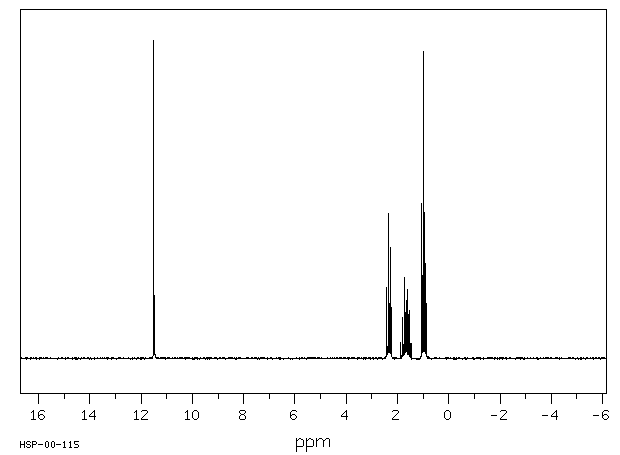
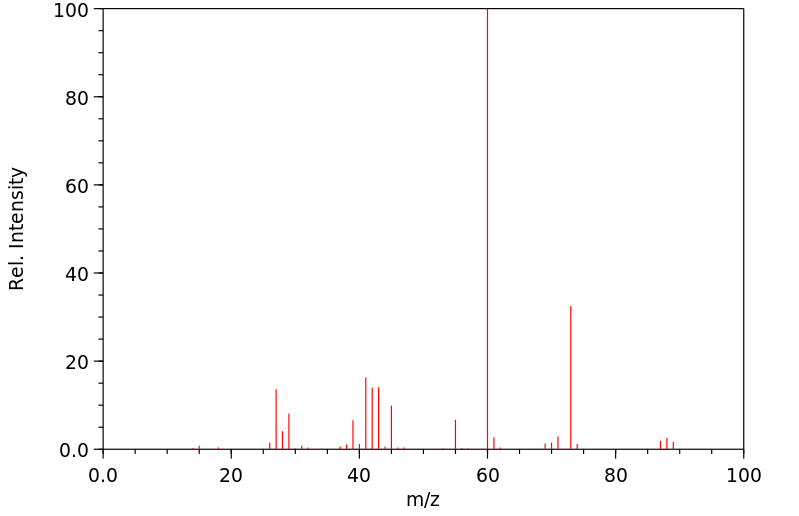
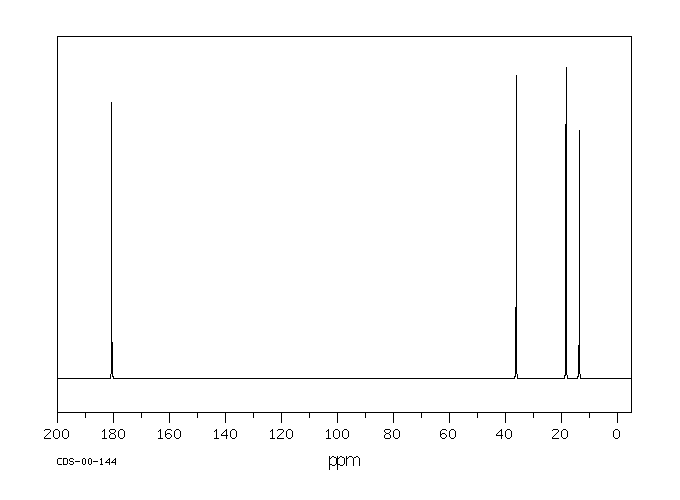
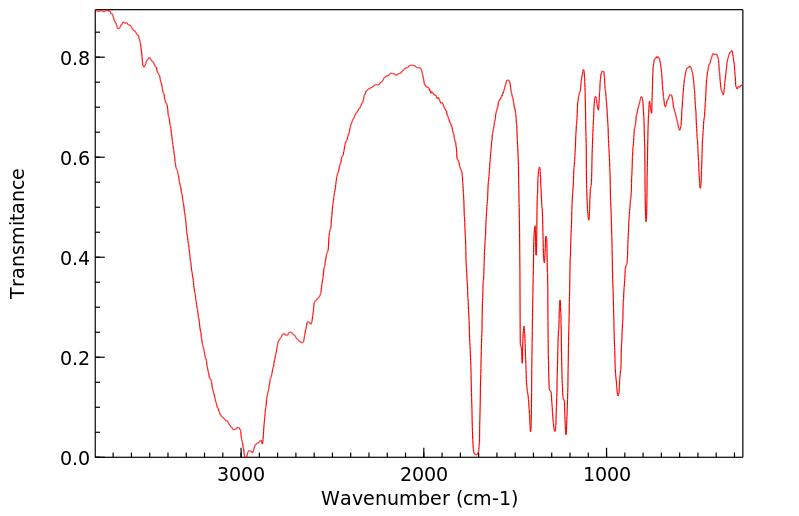
Butyric acid appears as a colorless liquid with a penetrating and unpleasant odor. Flash point 170°F. Corrosive to metals and tissue. Density 8.0 lb /gal.
Butyric acid is ... rapidly metabolized by the liver. In rats a considerable portion ... is metabolized to acetic acid. Butyric acid metabolism gives rise to ketone bodies (beta-hydroxybutyrate, acetoacetate, acetone) and acetic acid, which may be excreted in the urine or incorporated into normal processes of fat metabolism.
The metabolism of carboxyl-labeled butyric acid by liver tissue was investigated in vitro. It was shown that the test substance was converted to ketone bodies mainly by fission into 2-carbon chains with subsequent recombination, and to a lesser extent by direct beta-oxidation.
In isolated animal tissues butyric acid was oxidized to acetoacetic and beta-hydroxybutyric acid. The formation of carbohydrate and complete oxidation were also reported. Besides the formation of beta-hydroxybutyric acid the formation of ketone bodies represents possibly an alternative path after oxidation at the beta-carbon atom of butyric acid.
... Following butyraldehyde intake ... it is oxidized by aldehyde dehydrogenase, largely in the liver but also in other tissues. Butyric acid undergoes further oxidation via the Krebs cycle, or it may be conjugated with glutathione.
Paraoxonase (PON1) is a key enzyme in the metabolism of organophosphates. PON1 can inactivate some organophosphates through hydrolysis. PON1 hydrolyzes the active metabolites in several organophosphates insecticides as well as, nerve agents such as soman, sarin, and VX. The presence of PON1 polymorphisms causes there to be different enzyme levels and catalytic efficiency of this esterase, which in turn suggests that different individuals may be more susceptible to the toxic effect of OP exposure.
Butyric acid is a cholinesterase or acetylcholinesterase (AChE) inhibitor. A cholinesterase inhibitor (or 'anticholinesterase') suppresses the action of acetylcholinesterase. Because of its essential function, chemicals that interfere with the action of acetylcholinesterase are potent neurotoxins, causing excessive salivation and eye-watering in low doses, followed by muscle spasms and ultimately death. Nerve gases and many substances used in insecticides have been shown to act by binding a serine in the active site of acetylcholine esterase, inhibiting the enzyme completely. Acetylcholine esterase breaks down the neurotransmitter acetylcholine, which is released at nerve and muscle junctions, in order to allow the muscle or organ to relax. The result of acetylcholine esterase inhibition is that acetylcholine builds up and continues to act so that any nerve impulses are continually transmitted and muscle contractions do not stop. Among the most common acetylcholinesterase inhibitors are phosphorus-based compounds, which are designed to bind to the active site of the enzyme. The structural requirements are a phosphorus atom bearing two lipophilic groups, a leaving group (such as a halide or thiocyanate), and a terminal oxygen.
来源:Toxin and Toxin Target Database (T3DB)
毒理性
致癌物分类
对人类不具有致癌性(未被国际癌症研究机构IARC列名)。
No indication of carcinogenicity to humans (not listed by IARC).
来源:Toxin and Toxin Target Database (T3DB)
毒理性
健康影响
急性接触胆碱酯酶抑制剂可能会导致胆碱能危象,表现为严重的恶心/呕吐、流涎、出汗、心动过缓、低血压、崩溃和抽搐。肌肉无力可能性增加,如果呼吸肌受到影响,可能会导致死亡。在运动神经积累的乙酰胆碱会导致神经肌肉接头处尼古丁受体的过度刺激。当这种情况发生时,可以看到肌肉无力、疲劳、肌肉痉挛、肌束震颤和麻痹的症状。当自主神经节积累乙酰胆碱时,这会导致交感系统中尼古丁受体的过度刺激。与此相关的症状包括高血压和低血糖。由于乙酰胆碱积累,中枢神经系统中尼古丁乙酰胆碱受体的过度刺激会导致焦虑、头痛、抽搐、共济失调、呼吸和循环抑制、震颤、全身无力,甚至可能昏迷。当由于乙酰胆碱过量在毒蕈碱乙酰胆碱受体上出现毒蕈碱过度刺激时,可能会出现视力障碍、胸部紧绷、由于支气管收缩引起的喘息、支气管分泌物增加、唾液分泌增加、流泪、出汗、肠蠕动和排尿的症状。对于男性和女性,在生育、生长和发育方面,某些生殖效应已被特别与有机磷农药暴露联系起来。关于生殖效应的大部分研究都是在农村地区使用农药和杀虫剂的农民中进行的。在女性中,月经周期紊乱、怀孕时间延长、自然流产、死产以及后代的一些发育效应已被与有机磷农药暴露联系起来。产前暴露与胎儿生长和发育受损有关。神经毒性效应也与有机磷农药中毒有关,在人类中导致四种神经毒性效应:胆碱能综合征、中间综合征、有机磷诱导的迟发性多发性神经病(OPIDP)和慢性有机磷诱导的神经精神障碍(COPIND)。这些综合征在急性 and 慢性暴露于有机磷农药后出现。
Acute exposure to cholinesterase inhibitors can cause a cholinergic crisis characterized by severe nausea/vomiting, salivation, sweating, bradycardia, hypotension, collapse, and convulsions. Increasing muscle weakness is a possibility and may result in death if respiratory muscles are involved. Accumulation of ACh at motor nerves causes overstimulation of nicotinic expression at the neuromuscular junction. When this occurs symptoms such as muscle weakness, fatigue, muscle cramps, fasciculation, and paralysis can be seen. When there is an accumulation of ACh at autonomic ganglia this causes overstimulation of nicotinic expression in the sympathetic system. Symptoms associated with this are hypertension, and hypoglycemia. Overstimulation of nicotinic acetylcholine receptors in the central nervous system, due to accumulation of ACh, results in anxiety, headache, convulsions, ataxia, depression of respiration and circulation, tremor, general weakness, and potentially coma. When there is expression of muscarinic overstimulation due to excess acetylcholine at muscarinic acetylcholine receptors symptoms of visual disturbances, tightness in chest, wheezing due to bronchoconstriction, increased bronchial secretions, increased salivation, lacrimation, sweating, peristalsis, and urination can occur. Certain reproductive effects in fertility, growth, and development for males and females have been linked specifically to organophosphate pesticide exposure. Most of the research on reproductive effects has been conducted on farmers working with pesticides and insecticdes in rural areas. In females menstrual cycle disturbances, longer pregnancies, spontaneous abortions, stillbirths, and some developmental effects in offspring have been linked to organophosphate pesticide exposure. Prenatal exposure has been linked to impaired fetal growth and development. Neurotoxic effects have also been linked to poisoning with OP pesticides causing four neurotoxic effects in humans: cholinergic syndrome, intermediate syndrome, organophosphate-induced delayed polyneuropathy (OPIDP), and chronic organophosphate-induced neuropsychiatric disorder (COPIND). These syndromes result after acute and chronic exposure to OP pesticides.
来源:Toxin and Toxin Target Database (T3DB)
毒理性
暴露途径
该物质可以通过吸入其蒸气被身体吸收。
The substance can be absorbed into the body by inhalation of its vapour.
来源:ILO-WHO International Chemical Safety Cards (ICSCs)
Symptoms of low dose exposure include excessive salivation and eye-watering. Acute dose symptoms include severe nausea/vomiting, salivation, sweating, bradycardia, hypotension, collapse, and convulsions. Increasing muscle weakness is a possibility and may result in death if respiratory muscles are involved. Hypertension, hypoglycemia, anxiety, headache, tremor and ataxia may also result.
来源:Toxin and Toxin Target Database (T3DB)
吸收、分配和排泄
...但是酸很容易从胃肠道吸收...
Butyric acid is readily absorbed from the gastrointestinal tract ...
A pharmacokinetics study was performed by injecting butyric acid as sodium or arginine salts for possible antitumor therapies. In the case of 1-(14)C-labelled butyrate, the appearance of radioactivity in the blood of injected mice is rapid and some of it is maintained for relatively long periods in different organs, mainly the liver. However, no precision can be given about the structure of radioactive compounds in blood and tissues. Using GLC, the metabolism of butyrate in both animals and man were studied. In mice and rabbits, the half-life is less than 5 min. In man, the butyric acid elimination curve can be divided into two parts corresponding to two half-lives: for the first (0.5 min), the slope suggests an accelerated excretion, while for the following (13.7 min), a slow plateau is observed. The rapid elimination of butyrate is a limiting factor for practical applications. However, the lack of toxicity supports its use in human therapy.
Probing the Existence of a Metastable Binding Site at the β<sub>2</sub>-Adrenergic Receptor with Homobivalent Bitopic Ligands
作者:Birgit I. Gaiser、Mia Danielsen、Emil Marcher-Rørsted、Kira Røpke Jørgensen、Tomasz M. Wróbel、Mikael Frykman、Henrik Johansson、Hans Bräuner-Osborne、David E. Gloriam、Jesper Mosolff Mathiesen、Daniel Sejer Pedersen
DOI:10.1021/acs.jmedchem.9b00595
日期:2019.9.12
development of bitopicligands aimed at targeting the orthosteric binding site (OBS) and a metastable binding site (MBS) within the same receptor unit. Previous molecular dynamics studies on ligand binding to the β2-adrenergic receptor (β2AR) suggested that ligands pause at transient, less-conserved MBSs. We envisioned that MBSs can be regarded as allosteric binding sites and targeted by homobivalent bitopic
An Electrochemical Approach to Designer Peptide α-Amides Inspired by α-Amidating Monooxygenase Enzymes
作者:Yutong Lin、Lara R. Malins
DOI:10.1021/jacs.1c05718
日期:2021.8.4
amides are accessed in an efficient and epimerization-free approach by pairing an electrochemical oxidative decarboxylation with a tandem hydrolysis/reduction pathway. Resembling Nature’s dual enzymatic approach to bioactive primary α-amides, this method delivers secondary and tertiary amides bearing high-value functional motifs, including isotope labels and handles for bioconjugation. The protocol leverages
通过将电化学氧化脱羧与串联水解/还原途径配对,以一种有效且无差向异构化的方法获得设计者 C 末端肽酰胺。类似于 Nature 对生物活性伯 α-酰胺的双重酶促方法,该方法提供具有高价值功能基序的仲和叔酰胺,包括同位素标记和用于生物偶联的手柄。该协议利用了 C 末端羧酸盐的固有反应性,与绝大多数蛋白质功能组兼容,并且在没有差向异构化的情况下进行,从而解决了与传统基于耦合的方法相关的主要限制。该方法的实用性通过合成天然产物 acidiphilamide A来举例说明关键的非对映选择性还原,以及生物活性肽和相关类似物,包括抗 HIV 先导肽和重磅炸弹癌症治疗剂亮丙瑞林。
Ugi multicomponent reaction with hydroxylamines: an efficient route to hydroxamic acid derivatives
作者:Andrea Basso、Luca Banfi、Giuseppe Guanti、Renata Riva、Antonella Riu
DOI:10.1016/j.tetlet.2004.06.068
日期:2004.8
Ugi condensations with O-protected hydroxylamines have been successfully performed in THF using ZnCl2 as activating agent. This synthetic strategy opens up the route to a very convergent assemblage of `internal' hydroxamicacid derivatives (N-acyl-N-hydroxypeptides).
Synthesis and pharmacological investigation of novel 1-substituted-4-(4-substituted phenyl)-4<i>H</i>-[1,2,4]triazolo[4,3-<i>a</i>]quinazolin-5-ones as a new class of H1-antihistamine agents
作者:V Alagarsamy、Rajani Giridhar、M R Yadav
DOI:10.1211/jpp.58.9.0012
日期:2010.2.18
A series of novel 1-substituted-4-(4-substituted phenyl)-4H-[1,2,4]triazolo[4,3-a]quinazolin-5-ones was synthesized by the cyclization of 2-hydrazino-3-(4-substituted phenyl)-3H-quinazolin-4-one with various one-carbon donors. The starting material, 2-hydrazino-3-(4-substituted phenyl)-3H-quinazolin-4-one, was synthesized from 4-substituted aniline by a novel innovative route. When tested for in-vivo