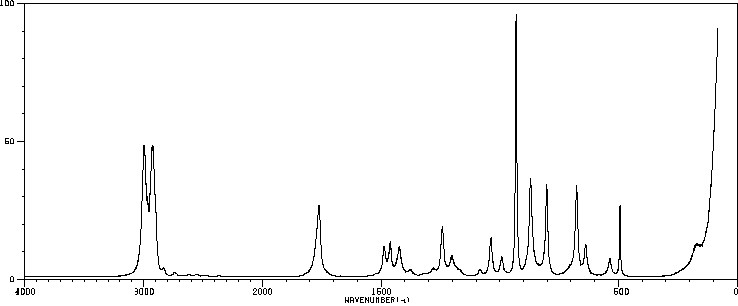
伽马-丁内酯通过乳酮酶迅速且定量地转化为伽马-羟基丁酸。已经在人血和鼠的血和肝脏中发现了乳酮酶,但在鼠的大脑、脾脏、肾脏、心脏、横膈膜、肺骨骼肌或胃肠道中并未发现。从人血浆中分离出的酶活性明显高于从鼠肝微粒体中分离出的酶。此外,人血清中的转化具有2.7 x 10^-2 M的米氏常数(Km值),因此比鼠血清中的转化(Km值为1.6 x 10^-2 M)更有效率。体外鼠血研究发现,伽马-丁内酯转化为伽马-羟基丁酸的半衰期不到一分钟。血清和血浆中发生水解,溶血的红细胞不活跃。在鼠血浆中,15分钟后水解率为92%,30分钟后达到100%,而在溶血的红细胞中,30分钟后的水解率仅为3%。在大鼠肝脏匀浆中,15分钟后水解百分比为87%,60分钟后为94%。在猫血中,伽马-丁内酯的水解速度比在鼠血中慢。兔子和豚鼠血清的样本也显示了伽马-丁内酯的水解(没有精确的细节)。各种培养基与1.3 x 10^-2 M伽马-丁内酯在37°C下孵化。
gamma-Butyrolactone undergoes rapid and quantitative conversion by lactonases, yielding gamma-hydroxybutyric acid. Lactonases have been identified in human blood and in the blood and liver of rats, but not in the rat brain, spleen, kidney, heart, diaphragm, lung skeletal muscle or gastrointestinal tract. The enzyme isolated from human plasma had a markedly higher activity than that isolated from rat liver microsomes. Moreover, conversion in human serum had a Km value of 2.7 x 10⁻² M and thus was more efficient than in rat serum (Km value 1.6 x 10⁻² M...). In vitro rat blood studies gave a half-life of less than one minute for the conversion of gamma-butyrolactone to gamma-hydroxybutyric acid. Hydrolysis took place in serum and plasma, hemolyzed erythrocytes being inactive. In rat plasma, hydrolysis was 92% after 15 minutes and 100% after 30 minutes, whereas in hemolyzed erythrocytes it was only 3% after 30 minutes. the percentage hydrolyzed in rat liver homogenate was 87% after 15 minutes and 94% after 60 minutes. In cat blood, hydrolysis of gamma-butyrolactone was slower than in rat blood. Samples of rabbit and guinea pig serum also showed hydrolysis of gamma-butyrolactone (no precise details). The various media were incubated with 1.3 x 10⁻² M gamma-butyrolactone at 37 °C.
... After IV administration to rats it is converted rapidly into gamma-hydroxybutyric acid which causes depression of CNS. It is also rapidly hydrolyzed to gamma-hydroxybutyric acid in blood and liver.
It was observed following oral administration of gamma-butyrolactone that gamma-hydroxybutyric acid can also be formed in the intestinal tract nonenzymatically by hydrolysis.
Four healthy subjects (2 male, 2 female) each drank 1 g gamma-butyrolactone (dissolved in water; 11:00 a.m.). Subsequently, hourly urine samples were collected for 4 hours and analyzed. Increases were observed in the excretion of S-3,4-dihydroxybutyrate, glycolic acid and gamma-hydroxybutyrate. A further metabolite was probably the tautomeric hydroxyepoxide of 4-hydroxy-3-oxobutyrate. According to the investigator, these results suggested that 4-hydroxybutyrate is metabolized by beta-oxidation.
Gamma-butyrolactone is rapidly converted to gamma-hydroxybutyrate. This may account for the subsequent central nervous system depressant. Gamma-butyrolactone is an anesthetic that causes a selective increase in brain dopamine by antagonizing transmitter release from nerve terminal. It is also an endogenous brain metabolite that may be derived from glutamate through gamma-aminobutyrate. GBL binds to the picrotoxin receptor (A566, A318).
Evaluation: There is inadequate evidence in humans for the carcinogenicity of 4-butyrolactone. There is evidence suggesting lack of carcinogenicity of 4-butyrolactone in experimental animals. Overall evaluation: 4-Butyrolactone is not classifiable as to its carcinogenicity to humans (Group 3).
IARC Monographs:Volume 11: (1976) Cadmium, Nickel, Some Epoxides, Miscellaneous Industrial Chemicals and General Considerations on Volatile Anaesthetics
Volume Sup 7: Overall Evaluations of Carcinogenicity: An Updating of IARC Monographs Volumes 1 to 42, 1987; 440 pages; ISBN 92-832-1411-0 (out of print)
Volume 71: (1999) Re-evaluation of Some Organic Chemicals, Hydrazine and Hydrogen Peroxide (Part 1, Part 2, Part 3)
来源:International Agency for Research on Cancer (IARC)
gamma-Butyrolactone appears to be readily absorbed through guinea pig skin. In rat, at least 10% of the applied dose penetrated the skin. Data describing the uptake of gamma-butyrolactone from the gastrointestinal or the respiratory system were not located in the literature. The biological degradation of gamma-butyrolactone in mammals is rapid. It is hydrolyzed to gamma-hydroxybutyric acid in the blood and liver. In rats, gamma-hydroxybutyric acid is excreted as CO2. gamma-Butyrolactone has a weak narcotic effect due to its fast metabolic conversion to gamma-hydroxybutyric acid, which has an effect on the central nervous system. ...
gamma-Butyrolactone ... is ... rapidly hydrolyzed to gamma-hydroxybutyric acid ... In rats, (1-(14)C)- or (4-(14)C)-hydroxybutyrate given by inhalation is excreted as (14)CO2; about 66% of activity was excreted in 6 hr and additional 10-20% within 18 hr.
Male Sprague-Dawley rats (weighing 200 to 250 g, 6 rats/experiment) received a single gamma-butyrolactone dose of 500 mg/kg bw by the oral, ip or iv route. The investigators analyzed the blood and brain for gamma-butyrolactone and gamma-hydroxybutyric acid, the chemical's primary metabolite, for a period of 60 minutes after administration. Blood levels of gamma-butyrolactone after oral administration were below the limit of detection of 18 ug/mL in 3 and 5 out of 6 animals, independently of the time of measurement, whereas the remaining animals had time-independent levels between 22.5 and 82.5 ug/mL. The levels observed for the primary metabolite, gamma-hydroxybutyric acid, reached a peak value of 611 ug/mL at 15 minutes and were still 466 ug/mL at 60 minutes. Following ip and iv administration, there was also very rapid hydrolysis of gamma-butyrolactone to gamma-hydroxybutyric acid. The blood gamma-butyrolactone levels was 63 ug/mL 5 minutes after ip injection, while it was 22.5 ug/mL at 60 minutes; however, only 2 out of 6 animals had levels above the limit of detection at 60 minutes. Upon iv injection, the 5-minute value was 85 ug/mL, whereas gamma-butyrolactone was no longer detectable after 15 minutes. The concentration levels of gamma-hydroxybutyric acid seen after ip dosing dropped from a maximum of 694 ug/mL (5-minute value) 521 ug/mL at 60 minutes, whereas iv injection led to a maximum level of 550 ug/mL (15-minute value) which dropped to 430 ug/mL at 609 minutes. In brain, oral dosing resulted in maximum gamma-butyrolactone levels of 170 ug/g were found after 3 minutes, and time-independent gamma-butyrolactone levels of 14.8 to 29.1 ug/g were detected 15 to 60 minutes after dosing; the concentration of gamma-hydroxybutyric acid reached its peak of 191.6 ug/g after 30 minutes and fell to 129.1 ug/g at 60 minutes (no brain levels were measured after iv administration... .The data permit the conclusion that gamma-butyrolactone is very rapidly and apparently completely absorbed from the gastrointestinal tract and undergoes very rapid metabolism to gamma-hydroxybutyric acid.
... Studies on the absorption of gamma-butyrolactone were carried out in at least 3, usually 4, male Sprague-Dawley rats (weighing 260 to 340 g; no precise details of the number of rats used)/dose and type of treatment. gamma-Butyrolactone (purity not specified) was administered orally by gastric intubation at dose levels of 1.58 and 6.34 mmol (approximately 136 and 546 mg)/kg bw, intracardially at 1.58 mmol or iv at 6.34 mmol/kg bw. Starting immediately after administration, the plasma was analyzed for gamma-butyrolactone over a total period of 3 to 8 hours. The analytical procedure did not distinguish between gamma-butyrolactone and gamma-hydroxybutyric acid, the primary metabolite of gamma-butyrolactone, as earlier studies by the investigators had detected only gamma-hydroxybutyric acid in rat blood after administration of gamma-butyrolactone. When gamma-butyrolactone was given intracardially at 136 mg/kg bw, the plasma levels was 500 ug/mL immediately upon dosing, about 400 ug/mL after 30 minutes and slightly more than 100 ug/mL after 2 hours but then dropped to below 50 ug/mL after 2.5 hours. After oral administration of 136 mg/kg bw, plasma levels reached their peak of approximately 350 ug/mL at 15 to 30 minutes before declining with an elimination half-life of 0.3 hours to approximately 25 ug/mL within 3 hours. Plasma levels after oral administration of gamma-butyrolactone at 546 mg/kg bw remained at > or =1000 ug/mL for approximately 3 hours, as they did after iv administration of the same dose. Four hours after oral dosing, the plasma concentration was about 800 ug/mL, while it was approximately 450 ug/mL after 6 hours and slightly above 100 ug/mL after 8 hours. Subsequent to iv injection, plasma levels dropped somewhat more rapidly, reaching approximately 55 ug/mL after 8 hours (the graphical representation does not permit a more accurate reading). In percutaneous absorption studies, male Sprague-Dawley rats (weighting 275 to 525 g) had undiluted gamma-butyrolactone applied to the mechanically or mechanically and chemically depilated skin at 6.34 mmol (approximately 546 mg)/kg bw for 4 hours. The rate of percutaneous absorption depended on the method employed to pretreat the rat skin. When the skin was only shaved, the plasma concentrations rose slowly, reaching maximum levels of approximately 150 ug/mL after 1.5 to 2 hours; when the skin was shaved an subsequently treated with a commercial depilating agent (a thioglycolic acid-based formulation), the maximum plasma concentration of approximately 175 ug/mL was reached only approximately 10 minutes after gamma-butyrolactone application. Based on the areas under the plasma concentration-time curves (AUC values) it was found that, relative to the value obtained after iv administration, the fractions of dose absorbed were 85 and 98% upon oral administration, and 7 and 11% upon dermal application onto the mechanically or mechanically and chemically depilated skin, respectively.
The invention relates to an innovative method for synthesis of cyclic amidines. The synthesis starts from a β-, γ- or δ-lactone which is twofold brominated. After esterification of the carboxyl function, the bromine atoms are nucleophilically substituted and the corresponding diamino compound is obtained. The ring closure to the cyclic amidine is accomplished subsequently by reaction with orthoester, imidate or thioimidate. Owing to interposing additional steps for recovery of the diamino compound in enantiomerically pure form, the enantiomers of the cyclic amidines can be stereoselectively synthesized.
[structure: see text] The totalsynthesis of (-)-21-isopentenylpaxilline (1) has been achieved. Key elements of the synthesis include the stereocontrolledconstruction of the advanced eastern hemisphere (-)-5, a highly efficient union of the eastern and western fragments (-)-5 and 4, respectively, exploiting our 2-substituted indole synthesis, and a new protocol for the construction of ring C.
Metal‐Free Synthesis of
<i>N</i>
‐Aryl Amides using Organocatalytic Ring‐Opening Aminolysis of Lactones
作者:Wusheng Guo、José Enrique Gómez、Luis Martínez‐Rodríguez、Nuno A. G. Bandeira、Carles Bo、Arjan W. Kleij
DOI:10.1002/cssc.201700415
日期:2017.5.9
Catalytic ring‐opening of bio‐sourced non‐strained lactones with aromatic amines can offer a straightforward, 100 % atom‐economical, and sustainable pathway towards relevant N‐aryl amide scaffolds. Herein, the first general, metal‐free, and highly efficient N‐aryl amide formation is reported from poorly reactive aromatic amines and non‐strained lactones under mild operating conditions using an organic
Reactions of methyl anthranilate with ethyl γ-bromobutyrate
作者:I. McCall、G. R. Proctor、L. Purdie
DOI:10.1039/j39700001126
日期:——
When methylanthranilate and ethylγ-bromobutyrate are heated together, various products are formed: above 125° the main product is a yellow compound for which a 7b,12b-diazabenz[e]aceanthrylene structure is postulated.
当邻氨基苯甲酸甲酯和γ-溴丁酸乙酯一起加热时,形成各种产物:在125°以上,主要产物是黄色化合物,假定该化合物具有7b,12b-二氮杂苯并[ e ]乙炔结构。
A facile two synthon approach to the camptothecin skeleton
作者:H.G.M. Walraven、U.K. Pandit
DOI:10.1016/0040-4020(80)80022-6
日期:1980.1
A synthesis of deethyldesoxycamptothecin via the reaction of two readily accessible synthons is described. One of the synthons constitutes the ABC ring system of camptothecin, while the second provides all the C atoms of the ringsD and E. The synthetic approach is suited for the total synthesis of camptothecin analogues.