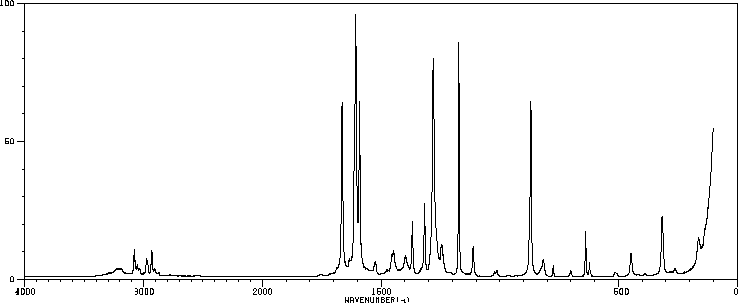
/Paraben/ ... esters are well absorbed and hydrolysis of ester linkage and metabolic conjugation constitute chief route of elimination /in dogs/. Similar metabolic scheme was observed in man. /Paraben esters/
Urine from cats who had received (14)C-labeled ethyl-p-hydroxybenzoate, orally contained 2 major metabolites, p-hydroxyhippuric acid and free p-hydroxybenzoic acid.
In mice, rats, rabbits, pigs, or dogs, ethyl paraben is excreted in the urine as unchanged benzoate, p-hydroxybenzoic acid, p-hydroxyhippuric acid (p-hydroxybenzoylglycine), ester glucuronides, ether glucuronides, or ether sulfates.
IDENTIFICATION AND USE: Ethylparaben forms small colorless crystals, or white powder. Ethylparaben inhibits the growth of fungi and bacteria and is used as a preservative for pharmaceuticals, adhesives, and various cosmetic preparations. HUMAN EXPOSURE AND TOXICITY: Ethylparaben was a skin irritant in man. It gave no evidence of sensitizing potential in a human study. The paraben esters as a generic class are rare sensitizers when applied to the intact skin of man. Application to the damaged skin is a more common cause of sensitization. A methyl:ethyl:propylparaben mixture has been shown on oral administration to exacerbate pre-existing skin complaints. ANIMAL STUDIES: Ethylparaben was an eye irritant in rabbits. A low acute oral toxicity has been demonstrated for ethylparaben in laboratory animals. Limited long-term studies in rats have also indicated a low toxicity and have generated no evidence of carcinogenic activity. Ethylparaben in the diet produced cell proliferation in the forestomach of rats. No evidence of mutagenicity was reported in limited Ames Bacterial tests. Ethylparaben did increase chromosomal aberrations in a Chinese Hamster ovary cell assay, but similar effects were not seen in rats treated with ethylparaben. Fetal toxicity at maternally toxic dose levels occurred in female rats treated orally during pregnancy. Ethylparaben was nonteratogenic in rats. In one in vitro study, sperm were not viabile at concentrations as low as 8 mg/mL for Ethylparaben, but an in vivo study of 0.1% or 1.0% for Ethylparaben in the diet of mice reported no spermatotoxic effects.
来源:Hazardous Substances Data Bank (HSDB)
毒理性
致癌物分类
对人类不具有致癌性(未被国际癌症研究机构IARC列名)。
No indication of carcinogenicity to humans (not listed by IARC).
来源:Toxin and Toxin Target Database (T3DB)
毒理性
副作用
皮肤致敏剂 - 一种可以诱导皮肤产生过敏反应的制剂。
Skin Sensitizer - An agent that can induce an allergic reaction in the skin.
来源:Haz-Map, Information on Hazardous Chemicals and Occupational Diseases
The biological fates of ethyl paraben after the simultaneous administration with salicylic acid were different from those of ethyl paraben alone as reported in the previous reports. The excretion of unconjugated p-hydroxybenzoic acid, which is a hydrolyzed product of ethyl paraben, increased and those of p-hydroxyhippuric acid, glycine conjugate of p-hydroxybenzoic acid, and p-hydroxybenzoyl glucuronide, its ester type glucuronide, decreased. The blood concentration patterns were considerably different from those of ethyl paraben alone, especially the elimination of every metabolite was delayed. Pharmacokinetic analyses on the data of blood concentration were carried out and the results also show the interaction of salicylic acid on the biological fate of ethyl paraben.
/SRP:/ Immediate first aid: Ensure that adequate decontamination has been carried out. If patient is not breathing, start artificial respiration, preferably with a demand valve resuscitator, bag-valve-mask device, or pocket mask, as trained. Perform CPR if necessary. Immediately flush contaminated eyes with gently flowing water. Do not induce vomiting. If vomiting occurs, lean patient forward or place on the left side (head-down position, if possible) to maintain an open airway and prevent aspiration. Keep patient quiet and maintain normal body temperature. Obtain medical attention. /Poisons A and B/
By the oral route, parabens are rapidly absorbed, metabolized, and excreted. The metabolic reactions and conversions in mammals vary with the chain length of the ester, the animal species, route of administration, and quantity tested. The metabolism of parabens in humans appears to be most closely related to that of dogs. The rate of metabolite excretion appears to decrease with increasing molecular weight of the ester. /4-Hydroxybenzoates (Parabens)/
... Deposition of parabens in dogs. Urine recoveries ranged from 50-95% except for butyl ester for which recoveries were 40%. /It/... was concluded that esters are well absorbed and that hydrolysis of ester linkage and metabolic conjugation constitute chief route of elimination. Similar metabolic scheme ... in man. /Parabens/
The permeation of methylparaben, ethylparaben, propylparaben, and butylparaben through untreated and lipid-depleted excised guinea pig dorsal skin, and the effects of 3 penetration enhancers, N-dodecyl-2-pyrrolidone (lauryl pyrrolidone), ethyl alcohol (ethanol), and a mixture of menthol (l-menthol) and ethyl alcohol, on the permeation of the parabens were studied; the relationship between the permeability and octyl alcohol (n-octanol)/water partition coefficients of the parabens, and the effect of the penetration enhancers on the fluidity of the lipid bilayer of liposomes containing stratum corneum lipids were also examined. Permeability coefficients of the parabens correlated with their octyl alcohol/water partition coefficients in untreated guinea pig skin. In lipid-depleted guinea pig skin, permeability coefficients of the parabens increased and did not correlate with their octyl alcohol/water partition coefficients. The effect of the penetration enhancers on the permeation of the parabens was variable. The penetration enhancers increased the fluidity of liposome lipid bilayers.
After ethyl paraben is intravenously infused into the dog, unhydrolyzed ethyl paraben is found only in the brain. In liver, kidney, and muscle, it is immediately hydrolyzed to p-hydroxybenzoic acid. Six hours after oral administration of 1.0 g/kg to dogs, the peak plasma concentration of free and total ethyl paraben (427 and 648 ug/cu cm, respectively) is reached. After 48 hr, all ethyl paraben is completely eliminated.
Phosphine-catalyzed formal vinylogous aldol reaction of γ-methyl allenoates with aldehydes: easy access to 1,3-dioxanes and dienols
摘要:
A phosphine-catalyzed formal vinylogous aldol reaction of gamma-methyl allenoates with aldehydes is herein reported, in which the gamma-methyl group is directly involved in the carbon carbon bond formation. Under the catalysis of triarylphosphine (20 mol %) and in the presence of a protic additive, gamma-methyl allenoates and aldehydes chemo- and stereoselectively produce functionalized 1,3-dioxanes or dienols in modest to good yields. These chemical transformations provide easy excess to oxy-functionalized enoates and dienoates under very mild conditions. (C) 2013 Elsevier Ltd. All rights reserved.
A series of new hypervalentiodinereagents based on the 1,3‐dihydro‐3,3‐dimethyl‐1,2‐benziodoxole and 1,2‐benziodoxol‐3‐(1H)‐one scaffolds, which contain a functionalized tetrafluoroethyl group, have been prepared, characterized, and used in synthetic applications. Their corresponding electrophilic fluoroalkylation reactions with various sulfur, oxygen, phosphorus, and carbon‐centered nucleophiles
[EN] HYPERVALENT IODINE CF2CF2X REAGENTS AND THEIR USE<br/>[FR] RÉACTIFS CF2CF2X À BASE D'IODE HYPERVALENT ET LEUR UTILISATION
申请人:ETH ZUERICH
公开号:WO2016019475A1
公开(公告)日:2016-02-11
A hypervalent iodine of formula (I) or formula (II) wherein R is a nucleophile and a method for their production is described. Such compounds can be used for fluoroethylation of compounds carrying a reactive group. A preferred compound carrying a reactive group is cystein in any environment such as peptide targets.
[EN] ALPHA-KETOAMIDE DERIVATIVE, AND PRODUCTION METHOD AND USE THEREOF<br/>[FR] DERIVE D'ALPHA-CETOAMIDE, SON PROCEDE DE PRODUCTION ET D'UTILISATION
申请人:SENJU PHARMA CO
公开号:WO2005056519A1
公开(公告)日:2005-06-23
The present invention provides a compound represented by the formula (I): (INSERT CHEMICAL FORMULA) (wherein R1 is a lower alkyl substituted by a lower alkoxy or a heterocyclic group, or a heterocyclic group; R2 is a lower alkyl optionally substituted by a phenyl; and R3 is a lower alkyl optionally substituted by a halogen, a lower alkoxy or a phenyl, or a fused polycyclic hydrocarbon group), which is well absorbed orally, exhibits durability of good blood level and has potent calpain inhibitory activity.
The present invention concerns novel compounds, their preparation and their uses, therapeutic uses in particular. More specifically it concerns derivative compounds having at least two aromatic cycles, their preparation and their uses, in particular in the area of human or animal health. These compounds have an affinity for the biological receptors of neuropeptide Y, NPY, present in the central and peripheral nervous systems. The compounds of the invention are preferably NPY antagonists, and more particularly antagonists of sub-type NPY Y1, and can therefore be used for the therapeutic or prophylactic treatment of any disorder involving NPY. The present invention also concerns pharmaceutical compositions containing said compounds, their preparation and their uses, as well as treatment methods using said compounds.
ACYL-HYDRAZONE AND OXADIAZOLE COMPOUNDS, PHARMACEUTICAL COMPOSITIONS CONTAINING THE SAME AND USES THEREOF
申请人:Universidade Federal de Santa Catarina
公开号:US20150191445A1
公开(公告)日:2015-07-09
The present invention relates to acyl-hydrazone compounds, in particular 3,4,5-trimethoxyphenyl-hydrazide derivatives, as well as the oxadiazole analogs thereof and other similar compounds, and to the pharmaceutical use of the same for the treatment of various diseases associated with cell proliferation, such as leukemias, including acute lymphoblastic leukemia (ALL), tumours and inflammation. Acyl-hydrazones have been obtained having activity similar to that of the compound used as a standard in experiments (colchicine). The greater selectivity of the compounds according to the invention is an important feature, associated with fewer side effects than the pharmaceuticals used at present in clinical treatments. The synthetised acyl-hydrazones, more particularly the compounds 02 and 07, exhibited important antileukemic activity, which suggests 02 and 07 as candidates to pharmaceutical prototypes, or to pharmaceuticals for the treatment of leukemias, in particular acute lymphoblastic leukemia (ALL), tumours and other proliferative diseases, such as inflammation. The action mechanism of the most active compounds was determined by using DNA microarrays and subsequent tests indicated by the chip, besides selectivity studies in healthy human lymphocytes.