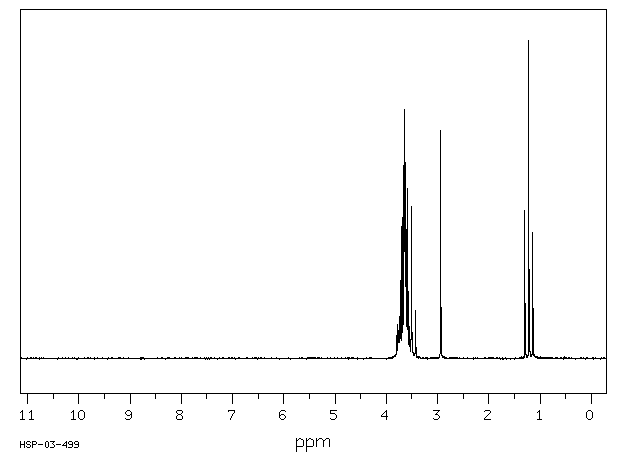
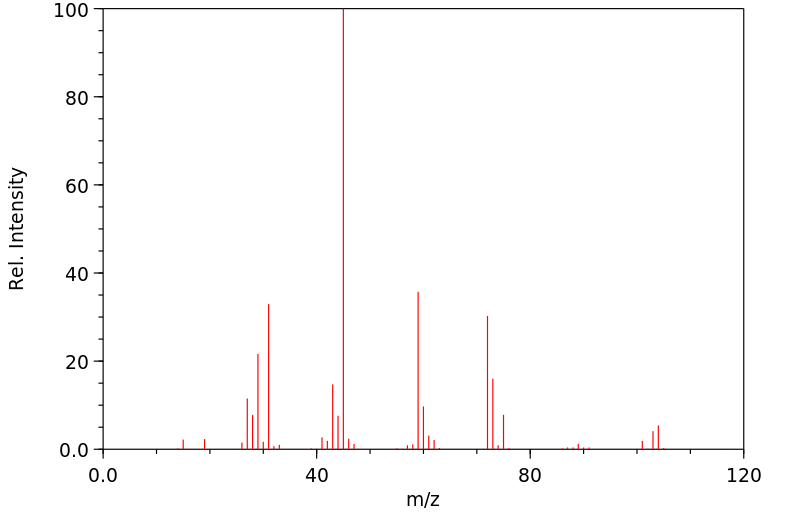
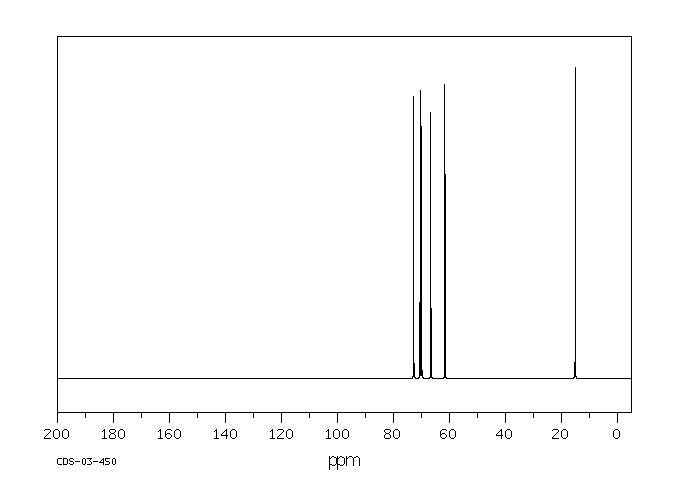
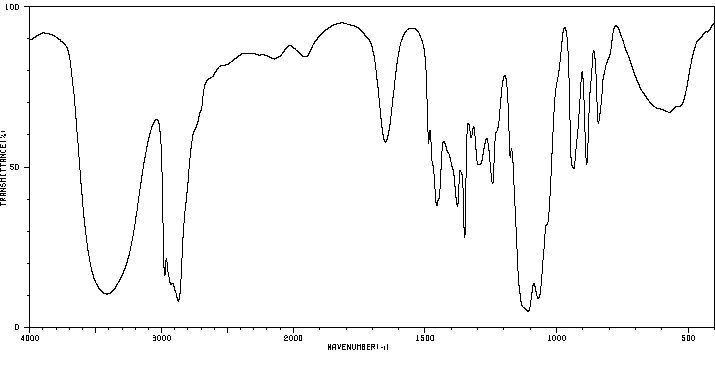
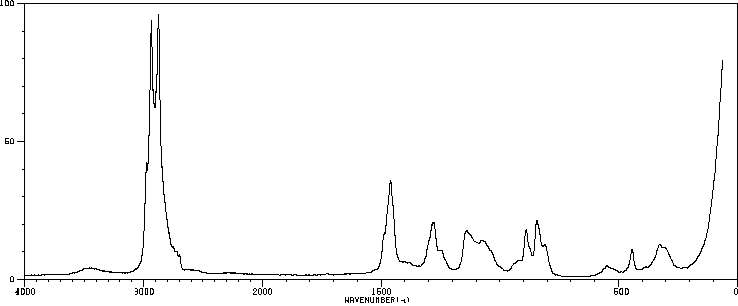
Diethylene glycol monoethyl ether appears as a colorless, slightly viscous liquid with a mild pleasant odor. Flash point near 190°F. Used to make soaps, dyes, and other chemicals.
颜色/状态:
Colorless liquid
气味:
Mild, pleasant odor
味道:
BITTER
蒸汽密度:
4.62 (NTP, 1992) (Relative to Air)
蒸汽压力:
0.126 mm Hg at 25 °C (est)
大气OH速率常数:
5.72e-11 cm3/molecule*sec
自燃温度:
400 °F (204 °C)
分解:
When heated to decomposition it emits acrid smoke and irritating fumes.
...Carbitol is largely destroyed in body or conjugated with glucuronic acid and excreted as the glucuronate. ...This metabolic peculiarity may explain its lesser toxicity when compared with that of diethyl, methyl and butyl cellosolve.
来源:Hazardous Substances Data Bank (HSDB)
毒理性
皮肤症状
干燥的皮肤。
Dry skin.
来源:ILO-WHO International Chemical Safety Cards (ICSCs)
毒理性
眼睛症状
Redness.
Redness.
来源:ILO-WHO International Chemical Safety Cards (ICSCs)
Neurotoxin - Acute solvent syndrome
Occupational hepatotoxin - Secondary hepatotoxins: the potential for toxic effect in the occupational setting is based on cases of poisoning by human ingestion or animal experimentation.
Nephrotoxin - The chemical is potentially toxic to the kidneys in the occupational setting.
Reproductive Toxin - A chemical that is toxic to the reproductive system, including defects in the progeny and injury to male or female reproductive function. Reproductive toxicity includes developmental effects. See Guidelines for Reproductive Toxicity Risk Assessment.
来源:Haz-Map, Information on Hazardous Chemicals and Occupational Diseases
毒理性
毒性数据
LC50 (大鼠) > 5240 毫克/立方米/4小时
LC50 (rat) > 5240 mg/m3/4H
来源:Haz-Map, Information on Hazardous Chemicals and Occupational Diseases
/HUMAN EXPOSURE STUDIES/ ... Human volunteers showed neither irritation nor signs of sensitization when the material was tested at a 20 percent level in petroleum for a 48 hour closed patch test.
To assist evaluation of the hazards of skin contact with selected undiluted glycol ethers, their absorption across isolated human abdominal epidermis was measured in vitro. Epidermal membranes were set up in glass diffusion cells and, following an initial determination of permeability to tritiated water, excess undiluted glycol ether was applied to the outer surface for 8 hr. The appearance of glycol ether in an aqueous receptor phase bathing the underside of the epidermis was quantified by a gas chromatographic technique. A final determination of tritiated water permeability was compared with initial values to establish any irreversible alterations in epidermal barrier function induced by contact with the glycol ethers. 2-methoxyethanol (EM) was most readily absorbed (mean steady rate 2.82 mg/sq cm/hr), and a relatively high absorption rate (1.17 mg/sq cm/hr) was also apparent for 1-methoxypropan-2-ol (PM). There was a trend of reducing absorption rate with increasing molecular weight or reducing volatility for monoethylene glycol ethers (EM, 2.82 mg/sq cm/hr; 2-ethoxyethanol, EE, 0.796 mg/sq cm/hr; 2-butoxyethanol, EB, 0.198 mg/sq cm/hr) and also within the diethylene glycol series: 2-(2-methoxyethoxy) ethanol (DM, 0.206 mg/sq cm/hr); 2-(2-ethoxyethoxy) ethanol (DE, 0.125 mg/sq cm/hr) and 2-(2-butoxyethoxy) ethanol (DB, 0.035 mg/sq cm/hr). The rate of absorption of 2-ethoxyethyl acetate (EEAc) was similar to that of the parent alcohol, EE. Absorption rates of diethylene glycol ethers were slower than their corresponding monoethylene glycol equivalents. Combination of intrinsic toxicity and ability to pass across skin contribute to assessment of hazards of contact with undiluted glycol ethers.
When a single /oral/ dose of diethylene glycol monoethyl ether (11.2 mmol) was given to an adult human volunteer (sex and age not specified) about 68% of the dose was excreted in the urine as (2-ethoxyethoxy)acetic acid within 12 hr.
The quantitative urinary excretion of diethylene glycol monoethyl ether was investigated in the rabbit after oral, intravenous, subcutaneous and percutaneous administration. After oral dosing of two animals at a level of 5 mL/kg bw, both animals died during the first day and total excretion was only 0.8% and 0.33%. After intravenous administration to 15 rabbits at dose levels of 0.5-3.4 mL/kg most of the dose was excreted during the first day (for 13/15 rabbits), the percentage excreted tending to increase with dose. After a single parenteral dose of 1.0-3.0 mL/kg, urinary excretion was monitored for up to 4 consecutive days. Excretion was high in the first 24 hr and the total percentage of the dose excreted in urine increased with dose. After repeated daily parenteral doses of 0.16, 0.32 or 0.63 mL/kg bw, total urinary excretion increased with dose and equalled 4.7, 5.0 and 11.6%, respectively.
The oral administration fo 1503 mg Diethylene glycol monoethyl ether to a normal man resulted in the excretion of 1140 mg of 2-ethoxyethoxyacetic acid, 69 % of the total dose, within 12 hr.
1.周国泰,化学危险品安全技术全书,化学工业出版社,1997 2.国家环保局有毒化学品管理办公室、北京化工研究院合编,化学品毒性法规环境数据手册,中国环境科学出版社.1992 3.Canadian Centre for Occupational Health and Safety,CHEMINFO Database.1998 4.Canadian Centre for Occupational Health and Safety, RTECS Database, 1989
Novel processes for the preparation of adenosine compounds and intermediates thereto
申请人:——
公开号:US20030069423A1
公开(公告)日:2003-04-10
Novel processes for the preparation of adenosine compounds and intermediates thereto. The adenosine compounds prepared by the present processes may be useful as cardiovascular agents, more particularly as antihypertensive and anti-ischemic agents, as cardioprotective agents which ameliorate ischemic injury or myocardial infarct size consequent to myocardial ischemia, and as an antilipolytic agents which reduce plasma lipid levels, serum triglyceride levels, and plasma cholesterol levels. The present processes may offer improved yields, purity, ease of preparation and/or isolation of intermediates and final product, and more industrially useful reaction conditions and workability.
[EN] S-NITROSOMERCAPTO COMPOUNDS AND RELATED DERIVATIVES<br/>[FR] COMPOSÉS DE S-NITROSOMERCAPTO ET DÉRIVÉS APPARENTÉS
申请人:GALLEON PHARMACEUTICALS INC
公开号:WO2009151744A1
公开(公告)日:2009-12-17
The present invention is directed to mercapto-based and S- nitrosomercapto-based SNO compounds and their derivatives, and their use in treating a lack of normal breathing control, including the treatment of apnea and hypoventilation associated with sleep, obesity, certain medicines and other medical conditions.
[EN] SUBSTITUTED QUINAZOLINES AS FUNGICIDES<br/>[FR] QUINAZOLINES SUBSTITUÉES, UTILISÉES EN TANT QUE FONGICIDES
申请人:SYNGENTA PARTICIPATIONS AG
公开号:WO2010136475A1
公开(公告)日:2010-12-02
The present invention relates to a compound of formula (I) wherein wherein the substituents have the definitions as defined in claim 1or a salt or a N-oxide thereof, their use and methods for the control and/or prevention of microbial infection, particularly fungal infection, in plants and to processes for the preparation of these compounds.
[EN] HORMONE RECEPTOR MODULATORS FOR TREATING METABOLIC MUTAGENIC AND FIBROTIC CONDITIONS AND DISORDERS<br/>[FR] MODULATEURS DU RÉCEPTEUR HORMONAL POUR LE TRAITEMENT D'ÉTATS ET DE TROUBLES MÉTABOLIQUES MUTAGÈNES ET FIBROTIQUES
申请人:ARDELYX INC
公开号:WO2019055808A1
公开(公告)日:2019-03-21
The invention relates to activators of FXR useful in the treatment of autoimmune disorders, liver disease, intestinal disease, kidney disease, cancer, and other diseases in which FXR plays a role, having the Formula (I): wherein L1, A, X1, X2, Y1, Y2, Y3, Y4, R1, R2, and R3 are described herein.