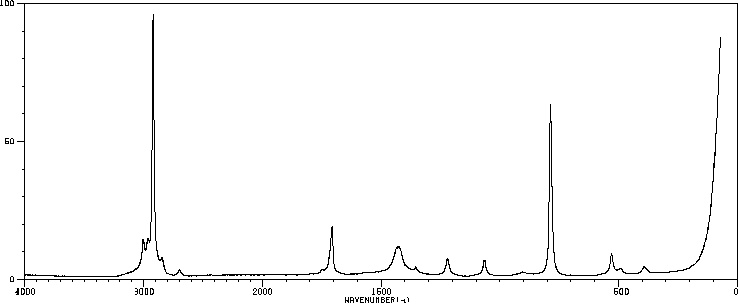
... The role of CYP2E1 in acetone catabolism /was assessed/ by measuring acetone levels at different time points in rats that had been treated with diallyl sulfide (DAS, a CYP2E1 inhibitor) at a variety of dose levels. The study noted DAS dose-dependent increases in the time to peak blood acetone level and in the time to return to pre-dose levels, suggesting an important role of CYP2E1 in acetone catabolism.
Acetone, one of the principal ketone bodies elevated during treatment with the ketogenic diet, exhibits anticonvulsant properties that may contribute to the seizure protection conferred by the diet. The anticonvulsant mechanism of acetone is unknown, but it is metabolized to several bioactive substances that could play a role. Acetone and its major metabolites-acetol, 1,2-propanediol, methylglyoxal, and pyruvic acid-were assessed for anticonvulsant activity in two mouse seizure models. Various doses of the substances administered intraperitoneally were characterized for their ability to elevate the threshold for clonic seizures induced by intravenous infusion of pentylenetetrazol (PTZ) and for protection against tonic seizures induced by subcutaneous bolus administration of 4-aminopyridine (4-AP). The inverted-screen test was used to assess acute neurological toxicity. Acetone (1-32 mmol/kg, i.p.), in a dose-dependent fashion, elevated the PTZ threshold and conferred protection against 4-AP seizures (ED(50), 26.3 mmol/kg). Effective doses of acetone (10-32 mmol/kg) did not cause motor impairment in the inverted-screen test (TD(50), 45.7 mmol/kg). In doses 10-fold greater than the minimally effective dose ofacetone (3.2 mmol/kg), the metabolites acetol, 1,2-propanediol, and pyruvic acid were inactive in the PTZ model. At higher doses that produced motor impairment, acetol and 1,2-propanediol (but not pyruvic acid) did elevate the PTZ threshold. Methylglyoxal had both proconvulsant and anticonvulsant actions, and had substantial toxicity, producing respiratory distress, motor impairment, and death. None of the acetone metabolites protected against 4-AP seizures. This study confirms the broad-spectrum anticonvulsant properties of acetone and indicates that the seizure protection conferred is unlikely to result from its major metabolic products.
Two pathways for the conversion of acetone to glucose are proposed, the methylglyoxal & the propanediol pathways. The methylglyoxal pathway is responsible for the conversion to acetol, acetol to methylglyoxal, & subsequent conversion of methylglyoxal to glucose. The propanediol pathway involves the conversion of acetol to L-1,2-propanediol by an as yet unknown process. L-1,2-propanediol is converted to L-lactaldehyde by alcohol dehydrogenase, & L-lactaldehyde is converted to L-lactic acid by aldehyde dehydrogenase. Expression of these metabolic pathways in rat appears to be dependent on the induction of /acetone/ oxygenase & acetol monooxygenase by acetone.
The metabolic fate of acetone is independent of route of administration and involves three separate gluconeogenic pathways, with ultimate incorporation of carbon atoms into glucose and other products and substrates of intermediary metabolism with generation of carbon dioxide. The primary (major) pathway involves hepatic metabolism of acetone to acetol and hepatic metabolism of acetol to methylglyoxal, while two secondary (minor) pathways are partially extrahepatic, involving the extrahepatic reduction of acetol to L-1,2-propanediol. Subsequent conversion of acetol to methylglyoxal in microsomes is catalyzed by acetol monooxygenase (also called acetol hydroxylase), an activity also associated with cytochrome P-450IIE1, and also requires oxygen and NADPH. Methylglyoxal can then be converted to D-glucose by an unidentified pathway, and/or possibly by catalysis by glyoxalase I and II and glutathione to D-lactate, which is converted to D-glucose. Some of exogenous acetone is unmetabolized and is excreted primarily in the expired air with little acetone excreted in urine. (N004)
IDENTIFICATION AND USE: Acetone is a colorless volatile liquid. It is a solvent for fats, oils, waxes, resins, rubber, plastics, lacquers, varnishes, rubber cements. It is a versatile reagent in organic synthesis. Acetone is used in manufacturing of coatings, plastics, pharmaceuticals and cosmetics. It is also used in production of other solvents and intermediates including: methyl isobutyl ketone, mesityl oxide, acetic acid (ketene process), diacetone alcohol, bisphenol A, methyl methacrylate, explosives, rayon, photographic films, isoprene. Acetone is not registered for current use in the U.S., but approved pesticide uses may change periodically and so federal, state and local authorities must be consulted for currently approved uses. Acetone has been identified as being used in hydraulic fracturing as a corrosion inhibitor. HUMAN EXPOSURE AND TOXICITY: Acetone is relatively less toxic than many other industrial solvents; however, at high concentrations, acetone vapor can cause CNS depression, cardiorespiratory failure and death. In children 2 to 3 mL/kg is considered to be toxic. Acute exposures of humans to atmospheric concentrations have been reported to produce either no gross toxic effects or minor transient effects, such as eye irritation. More severe transient effects (including vomiting and fainting) were reported for workers exposed to acetone vapor concentrations for about 4 hr. Acute exposures to acetone have also been reported to alter performances in neurobehavioral tests in humans. Females were reported to suffer menstrual irregularities. Acetone also occurs as a metabolic component in blood, urine and human breath. Acetone is one of three ketone bodies that occur naturally throughout the body. It can be formed endogenously in the mammalian body from fatty acid oxidation. Fasting, diabetes mellitus and strenuous exercise increase endogenous generation of acetone. Under normal conditions, the production of ketone bodies occurs almost entirely within the liver and to a smaller extent in the lung and kidney. Products are excreted in the blood and transported to all tissues and organs of the body where they can be used as a source of energy. ANIMAL STUDIES: Oral LD50 values in adult rats are in the range of 5800-7138 mg/kg. Mice were given 2,500, 5,000, 10,000, 20,000, or 50,000 ppm acetone (females) and 1,250, 2,500, 5,000, 10,000, or 20,000 ppm acetone (males) via drinking water for 13 weeks. Absolute liver weight and liver weight to body weight ratios were significantly increased and absolute spleen weight and spleen weight to body weight ratios were significantly decreased in the females (50,000 ppm). In other experiments, rats were assessed for liver oxidative balance and lipid content after treatments with acetone in water for 28 days. Compared with controls, acetone-treated rats had increased hepatic GSH, hepatic vitamin E, glycemia, cholesterolemia, and hepatic fat, which is similar to the features of non-alcoholic steatohepatitis. Acetone is not considered to be genotoxic or mutagenic. In a study of pregnant rats and mice exposed to acetone vapor during days 6-19 of gestation, slight developmental toxicity was observed. Reports of other reproductive effects of acetone include observations of testicular effects and changes of sperm quality in rats. Acetone has been used extensively as a solvent vehicle in skin carcinogenicity studies and is not considered carcinogenic when applied to the skin. The avoidance and escape behavior of female rats exposed to 3000, 6000, 12,000, or 16,000 ppm of acetone vapors for 10 days for 4 hr/day were studied. The 3000 ppm exposures had no effect on all exposure days, the 6000 ppm exposure initially inhibited the conditioned avoidance response but not the unconditioned escape response, and the two highest exposures inhibited both responses. Normal responses were obtained after three days of exposure to 6000 and 12,000 ppm, indicating that adaptive changes develop upon repeated exposure. ECOTOXICITY STUDIES: Acetone was tested with mallard eggs. Fertile eggs were immersed in 0, 10 or 100% acetone for 30 seconds at room temperature on days 3 or 8 of incubation. There were no significant effects with 10% acetone; however, 100% acetone caused a significant decrease in survival, embryonic weight and embryonic length for both exposure groups. It is unknown whether the mortality was due to the toxicity of acetone or to its solvent capabilities.
Since acetone is highly water soluble, it is readily taken up by the blood and widely distributed to body tissues. Acetone may interfere with the composition of the membranes, altering their permeability to ions. Systemically, acetone is moderately toxic to the liver and produces hematological effects. The renal toxicity may be due to the metabolite, formate, which is known to be nephrotoxic and is excreted by the kidneys. One of the major effects of acetone is the potentiation of the toxicity of other chemicals. Pretreatment with acetone has been shown to potentiate the hepatotoxicity and nephrotoxicity of carbon tetrachloride and chloroform by inducing particular forms of cytochrome P-450, especially cytochrome P-45OIIE1, and associated enzyme activities. (N004)
来源:Toxin and Toxin Target Database (T3DB)
毒理性
致癌性证据
癌症分类:D组 不可归类为人类致癌性
Cancer Classification: Group D Not Classifiable as to Human Carcinogenicity
CLASSIFICATION: D; not classifiable as to human carcinogenicity. BASIS FOR CLASSIFICATION: Based on lack of data concerning carcinogenicity in humans or animals. HUMAN CARCINOGENICITY DATA: None. ANIMAL CARCINOGENICITY DATA: None.
In rats receiving acetone in drinking water (7.5% v/v) for 11 consecutive days, plasma concentrations of acetone on day 1 were in the range of 315-800 ug/mL. The plasma concentration appeared to plateau at about 1,200 ug/mL by day 4.
Physiologically based toxicokinetic (PBTK) modeling of human experimental data suggests difficulties to simultaneously describe the time courses of inhaled polar solvents in blood and breath, especially if exposures occur during physical exercise. We attribute this to the washin-washout effect in the airways. The aim was to develop a PBTK-model that explains the behavior of acetone in blood and exhaled air at different levels of physical exercise. The model includes exchange of inhaled solvent vapor with the blood flow via the mucosa and separate compartments to describe working and resting muscles. The developed model was contrasted to a traditional PBTK-model where the conducting airways were regarded as an inert tube. Our model predictions agrees well with experimentally observed acetone levels in both arterial blood and end- and mixed-exhaled air from 26 inhalation experiments conducted with 18 human volunteers at 0, 50, 100 and 150 W workload. In contrast, the inert-tube model was unable to describe the data. The developed model is to our knowledge the first which explains the toxicokinetics of acetone at such various levels of physical exercise. It may be useful in breath monitoring and to obtain more accurate estimates of absorbed dose during inhalation of polar volatiles.
Acetone is one of the least hazardous industrial solvents, but is highly volatile and may be inhaled in large quantities. It may be absorbed into the blood through the lungs and diffused throughout the body. Small quantities may be absorbed through the skin.
来自药用真菌灵芝的多糖代表了治疗多种疾病的重要辅助治疗剂,包括白细胞减少症和造血损伤。然而,从灵芝多糖中合成长的、支链的、复杂的碳水化合物链仍然是化学合成中的一项具有挑战性的任务。在此,我们首次报道了以糖基原-(1-苯乙烯基)苯甲酸酯为基础,通过一锅立体选择性糖基化策略,从灵芝多糖GSPB70-S中模块化化学合成了具有多种生物活性的九十糖基序。不仅加速了碳水化合物的合成,还减少了化学废物,并避免了基于硫代糖苷的一锅糖基化固有的糖苷配基转移问题。该合成路线还强调了以下关键步骤:(1)基于预激活的一锅糖基化,用于高度立体选择性构建多个1,2-顺式糖苷键,包括三个α- d -GlcN-(1→4)键和一个α- d -Gal-(1→4)键通过试剂N-甲基-N-苯基甲酰胺调节; (2)通过糖基N-苯基三氟乙酰亚胺酯、糖基邻炔基苯甲酸酯和糖基邻-(1-苯基乙烯基)苯甲酸酯的策略组合,在各种直链和支链聚糖片段中正交一锅组装1
Organocatalyzed Kabbe condensation reaction for mild and expeditious synthesis of 2,2‐dialkyl and 2‐spiro‐4‐chromanones
作者:Naval P. Kapuriya、Jasmin J. Bhalodia、Mrunal A. Ambasana、Rashmi B. Patel、Atul H. Bapodra
DOI:10.1002/jhet.4054
日期:——
An expeditious Kabbe condensation reaction for the synthesis of 2,2‐dialkyl and 2‐spiro‐chroman‐4(1H)‐ones has been developed using pyrrolidine‐butanoic acid in DMSO as bifunctional organocatalyst. Unlike existing methods, this reaction proceeds at room temperature with high yields, rendering it an attractive method to synthesize a vast variety of privileged 4‐chromones.
Method development for the determination of 1,1-dimethylhydrazine by the high-performance liquid chromatography–mass spectrometry technique
作者:Igors Susinskis、Peteris Mekss、Juris Hmelnickis
DOI:10.1177/1469066718761437
日期:2018.8
Unsymmetrical dimethyl hydrazine is highly toxic, carcinogenic compound, widely used for organic synthesis and drug development. Therefore, due to its high reactivity, direct analysis is problematic. Current study proposes to use derivatization reaction to increase selectivity and sensitivity of high-performance liquid chromatography–mass spectrometry method. Different derivatization agents were tested
[EN] IMIDAZOLE DERIVATIVES USEFUL AS INHIBITORS OF FAAH<br/>[FR] DÉRIVÉS IMIDAZOLE UTILES COMME INHIBITEURS DE LA FAAH
申请人:MERCK & CO INC
公开号:WO2009152025A1
公开(公告)日:2009-12-17
The present invention is directed to certain imidazole derivatives which are useful as inhibitors of Fatty Acid Amide Hydrolase (FAAH). The invention is also concerned with pharmaceutical formulations comprising these compounds as active ingredients and the use of the compounds and their formulations in the treatment of certain disorders, including osteoarthritis, rheumatoid arthritis, diabetic neuropathy, postherpetic neuralgia, skeletomuscular pain, and fibromyalgia, as well as acute pain, migraine, sleep disorder, Alzeimer Disease, and Parkinson's Disease.
When heated in refluxing benzene or toluene, α-diazo β-ketophosphonates 2, prepared in three steps from aldehydes or ketones, gave rise to functionalized cyclobutenones 4 or phenolic compounds 5. These products are formed by electrocyclisation respectively of a vinyl or dienylketene, resulting from a Wolff rearrangement.