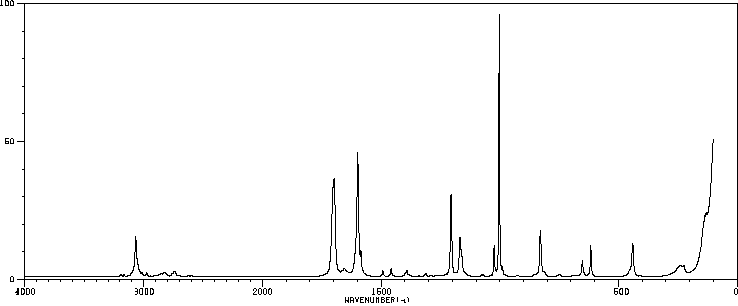
Benzaldehyde appears as a clear colorless to yellow liquid with a bitter almond odor. Flash point near 145°F. More denser than water and insoluble in water. Hence sinks in water. Vapors are heavier than air. The primary hazard is to the environment. Immediate steps should be taken to limit spread to the environment. Easily penetrates the soil to contaminate groundwater and nearby waterways. Used in flavoring and perfume making.
颜色/状态:
Strongly refractive liquid, becoming yellowish on keeping
Hepatic soluble fraction contains a number of aldehyde oxidases transforming aldehydes to the corresponding carboxylic acids. For example, molybdoflavoproteins aldehyde oxidase & xanthine oxidase catalyze metab of salicylaldehyde & benzaldehyde.
... Benzaldehyde, a cleavage product of amphetaminil, was rapidly converted to hippuric acid in the blood, brain, and adipose tissue of rats and then excreted in the urine ... .
Infusion of benzaldehyde to perfused rat liver increased hepatic ethane production. Results obtained with inhibitors of hepatic aldehyde metabolism suggest that the metabolism of benzaldehyde is required for ethane production. Radical scavenging by addition of cyanidanol or by pretreatment with vitamin E abolished ethane release, in agreement with lipid peroxidation as a source of alkane production during aldehyde metabolism.
IDENTIFICATION AND USE: Benzaldehyde is a strongly refractive liquid, becoming yellowish on keeping. It is used in cosmetics as a denaturant, a flavoring agent, and as a fragrance. Currently used in only seven cosmetic products, its highest reported concentration of use was 0.5% in perfumes. Substantial amounts are used in the production of derivatives that are also employed in the perfume and flavor industries. In the pharmaceutical industry benzaldehyde is used as an intermediate in the manufacture of chloramphenicol, ephedrine, ampicillin, diphenylhydantoin, and other products. HUMAN EXPOSURE AND TOXICITY: It may cause contact dermatitis. It was positive in sister chromatid exchange assay with human lymphocytes from healthy non-smoking donors. Benzaldehyde was found to induce formation of stable DNA-protein cross-links in cultured human lymphoma cells. Benzaldehyde was found to lack significant activity against most human tumor cells tested. ANIMAL STUDIES: It was was slightly irritating to the rabbit eye. Histological examination of the trachea and lungs showed a slight irritation of respiratory epithelium for nonsensitized guinea pigs. In the acute studies, benzaldehyde induced deaths and decreased body-weight gain in both sexes of rats given 800 or 1600 mg/kg/day and caused deaths in both sexes of mice given 1600 or 3200 mg/kg/day. In the 90-day studies, deaths occurred in both sexes of rats on 800 mg/kg/day and in male mice on 1200 mg/kg/day. Body-weight gain was depressed in male rats on 800 mg/kg/day, in male mice on 600 mg/kg/day and in female mice on 1200 mg/kg/day. Necrotic and degenerative lesions were seen in the cerebellar and hippocampal regions of the brain in both sexes of rats given 800 mg/kg/day, but not in mice. Renal tubular necrosis occurred in male and female rats on 800 mg/kg/day and in male mice on 1200 mg/kg/day. Mild epithelial hyperplasia or hyperkeratosis of the forestomach was seen in male and female rats on 800 mg/kg/day. In an inhalation study performed with rats, it was found that the principal histopathological change was the development of goblet cell metaplasia in the respiratory epithelium lining of the nasal septum. In 2 year studies, there was no evidence of carcinogenic activity of benzaldehyde for male or female rats receiving 200 or 400 mg/kg per day. There was some evidence of carcinogenic activity of benzaldehyde for male or female mice, as indicated by increased incidences of squamous cell papillomas and hyperplasia of the forestomach. Benzaldehyde was studied for mutagenicity using Salmonella typhimurium tester strains TA100, TA102 and TA104, with or without metabolic activation. It was non-mutagenic under all test conditions with dose ranges from 33 to 3333 ug/plate. No induction of chromosomal aberrations was observed in CHO cells treated with up to 500 ug/mL benzaldehyde without metabolic activation or with up to 1600 ug/mL with metabolic activation.
来源:Hazardous Substances Data Bank (HSDB)
毒理性
暴露途径
该物质可以通过吸入其蒸汽、透过皮肤和通过摄入被身体吸收。
The substance can be absorbed into the body by inhalation of its vapour, through the skin and by ingestion.
来源:ILO-WHO International Chemical Safety Cards (ICSCs)
毒理性
吸入症状
咳嗽。喉咙痛。
Cough. Sore throat.
来源:ILO-WHO International Chemical Safety Cards (ICSCs)
毒理性
皮肤症状
红色。
Redness.
来源:ILO-WHO International Chemical Safety Cards (ICSCs)
毒理性
眼睛症状
红肿。疼痛。
Redness. Pain.
来源:ILO-WHO International Chemical Safety Cards (ICSCs)
Benzaldehyde is absorbed through skin and by the lungs, distributes to all well-perfused organs, but does not accumulate in any specific tissue type. After being metabolized to benzoic acid, conjugates are formed with glycine or glucuronic acid, and excreted in the urine.
Infusion of the test substance to perfused rat liver leads to an increase in hepatic ethane production. The extra ethane release upon addition of the test substance was diminished by cyanamide, pargyline is able to depress the test substance-induced ethane evolution.
Daily monitoring indicated the urinary excretion of the following metabolites: hippuric acid (HA), free (FBA) and conjugated benzoic acid (benzoylglucuronic acid: BGA), benzyl glucuronide (BG) and benzyl mercapturic acid (BMA). Although the total amount of urinary metabolites excreted by the low-dose group (83.2% of the total dose) was not significantly different from that excreted by the high-dose group (82.3% of the total dose), some metabolites showed differences in their urinary output: HA, 69.9% in the low-dose group vs. 66.7% in the high-dose group; BGA, 8.8% in the low-dose group vs. 11.2% in the high-dose group; BG, 2.9% in the low-dose group vs. 3.0% in the high-dose group; FBA, 1.6% in the low-dose group vs. 1.4% in the high-dose group. In both treated groups, BMA was present in trace amounts (<0.01% of the total dose).
Overall there are signs of systemic absorption via oral and inhalation exposures, no evidence of target organs. After oral ingestion and inhalation, the test substance will be metabolized to hippuric acid. Experiments on the distribution and elimination in the rat and rabbit have shown no accumulation of the test substance in the body.
The test substance dissolved in physiological saline was administered by intraperitoneal route to female albino rats. The 24 hr-urine following injection was collected, and the amount of hippuric acid present in the rat urines was determined. It can be concluded that the test substance is converted to about 29.3% of the dose to hippuric acid in rats.
1.周国泰,化学危险品安全技术全书,化学工业出版社,1997 2.国家环保局有毒化学品管理办公室、北京化工研究院合编,化学品毒性法规环境数据手册,中国环境科学出版社.1992 3.Canadian Centre for Occupational Health and Safety,CHEMINFO Database.1998 4.Canadian Centre for Occupational Health and Safety, RTECS Database, 1989
Synthesis and calcium antagonistic activity of (+)-(R)- and (-)-(S)-3-acetyl-2-(5-methoxy-2-(4-(N-methyl-N-(3,4,5-trimethoxyphenethyl)amino)butoxy)phenyl)benzothiazoline hydrochloride.
SA2572 ((±)-1), 3-acetyl-2-[5-methoxy-2-[-[N-methyl-N-(3, 4, 5-trimethoxyphenethyl)amino]butoxy]phenyl]-benzothiazoline hydrocholoride is a newly synthesized Ca2+ antagonist having a inhibitory effect on the fast Na+ inward channel In order to clarify the absolute configurations and the pharmacological properties of both enantiomers, compounds ((+)-1 and (-)-1) were synthesized. The configurations of these compounds were assigned on the basis of an X-ray crystallographic analysis of synthetic precursor (5). The in vitro Ca2+ channel blocking activities of (+)-1 and (-)-1 were evaluated in terms of the inhibitory activities on depolarization-induced contraction of guinea pig taenia cecum and rabbit aorta. The in vivo efficacy of the enantiomers was evaluated with their hypotensive effects in spontaneously hypertensive rats. Compound (-)-1 showed more potent Ca2+ antagonistic activities on guinea pig taenia cecum and rabbit aorta and the hypotensive effect than those activities of (+)-1. In the electrophysiological study of Langendorff perfused rabbit hearts, compound (+)-1 showed more potent inhibitory effect on the fast Na+ inward channel than that of compound (-)-1, and an approximately equal potent inhibitory effect on the slow Ca2+ inward channel as compared (-)-1. Stereoselectivity of the pharmacological activity was found.
[EN] HYPERVALENT IODINE CF2CF2X REAGENTS AND THEIR USE<br/>[FR] RÉACTIFS CF2CF2X À BASE D'IODE HYPERVALENT ET LEUR UTILISATION
申请人:ETH ZUERICH
公开号:WO2016019475A1
公开(公告)日:2016-02-11
A hypervalent iodine of formula (I) or formula (II) wherein R is a nucleophile and a method for their production is described. Such compounds can be used for fluoroethylation of compounds carrying a reactive group. A preferred compound carrying a reactive group is cystein in any environment such as peptide targets.
bearing a sulfide at the 5 position] produced a reagent that gave up to 54% ee in the epoxidation process. The same system was applied to the preparation of terminal aziridines from imines. The optimum group on nitrogen was a sulfonyl group, although groups capable of chelation of zinc (o-methoxyphenyl) were also effective. Attempts to render the aziridination process asymmetric by using the above strategy
The invention relates to novel 3-amino pyrrolidine derivatives, as well as methods for modulating calcium channel activity and for treating conditions associated with calcium channel function. In particular, the compounds generally contain at least one benzhydril moiety, and are useful in treating conditions which benefit from blocking calcium ion channels.