紫云英苷 | 480-10-4
中文名称
紫云英苷
中文别名
黄芪苷紫云英甙莰非醇-3-O-葡萄糖苷山柰酚-3-葡萄糖苷百蕊草素Ⅱ;紫云英甙;山奈酚-3-葡萄糖苷;莰非醇-3-O-葡糖苷;紫芸英苷;黄芪苷;黄芪苷、莰非醇-3-O-葡萄糖苷、山柰酚-3-葡萄糖苷、百蕊草素Ⅱ;黄芪苷;紫云英甙;莰非醇-3-O-葡萄糖苷;山柰酚-3-葡萄糖苷;百蕊草素Ⅱ
英文名称
astragalin
英文别名
kaempferol 3-O-glucoside;kaempferol 3-O-β-d-glucopyranoside;kaempferol-3-glucoside;kaempferol-3-O-β-D-glucoside;astragaline;kaempferol 3-O-β-glucopyranoside;kaempferol 3-β-D-glucoside;kaempferol 3-O-β-glucoside;kaempferol-3-β-glucoside;kaempferol-3-O-glucopyranoside;kaempferol 3‐glucoside;5,7-dihydroxy-2-(4-hydroxyphenyl)-3-[(2S,3R,4S,5S,6R)-3,4,5-trihydroxy-6-(hydroxymethyl)oxan-2-yl]oxychromen-4-one

CAS
480-10-4
化学式
C21H20O11
mdl
MFCD00075932
分子量
448.383
InChiKey
JPUKWEQWGBDDQB-QSOFNFLRSA-N
BEILSTEIN
——
EINECS
——
-
物化性质
-
计算性质
-
ADMET
-
安全信息
-
SDS
-
制备方法与用途
-
上下游信息
-
文献信息
-
表征谱图
-
同类化合物
-
相关功能分类
-
相关结构分类
物化性质
-
熔点:223-229°C
-
沸点:823.2±65.0 °C(Predicted)
-
密度:1.79±0.1 g/cm3(Predicted)
-
溶解度:DMF:30mg/mL; DMSO:30mg/mL; DMSO:PBS (pH 7.2) (1:6):0.14 mg/mL
-
LogP:1.950 (est)
-
物理描述:Solid
计算性质
-
辛醇/水分配系数(LogP):0.7
-
重原子数:32
-
可旋转键数:4
-
环数:4.0
-
sp3杂化的碳原子比例:0.285
-
拓扑面积:186
-
氢给体数:7
-
氢受体数:11
安全信息
-
WGK Germany:3
-
RTECS号:DJ3080000
-
海关编码:29389090
-
安全说明:S22
-
危险性防范说明:P261,P305+P351+P338
-
危险性描述:H302,H315,H319,H335
-
储存条件:`-20°C`
SDS

SECTION 1: Identification of the substance/mixture and of the company/undertaking
Product identifiers
Product name : Kaempferol 3-glucoside
REACH No. : A registration number is not available for this substance as the substance
or its uses are exempted from registration, the annual tonnage does not
require a registration or the registration is envisaged for a later
registration deadline.
CAS-No. : 480-10-4
Relevant identified uses of the substance or mixture and uses advised against
Identified uses : Laboratory chemicals, Manufacture of substances
SECTION 2: Hazards identification
Classification of the substance or mixture
Not a hazardous substance or mixture according to Regulation (EC) No. 1272/2008.
This substance is not classified as dangerous according to Directive 67/548/EEC.
Label elements
The product does not need to be labelled in accordance with EC directives or respective national laws.
Other hazards - none
SECTION 3: Composition/information on ingredients
Substances
Formula : C21H20O11
Molecular Weight : 448,38 g/mol
CAS-No. : 480-10-4
No components need to be disclosed according to the applicable regulations.
SECTION 4: First aid measures
Description of first aid measures
If inhaled
If breathed in, move person into fresh air. If not breathing, give artificial respiration.
In case of skin contact
Wash off with soap and plenty of water.
In case of eye contact
Flush eyes with water as a precaution.
If swallowed
Never give anything by mouth to an unconscious person. Rinse mouth with water.
Most important symptoms and effects, both acute and delayed
The most important known symptoms and effects are described in the labelling (see section 2.2) and/or in
section 11
Indication of any immediate medical attention and special treatment needed
no data available
SECTION 5: Firefighting measures
Extinguishing media
Suitable extinguishing media
Use water spray, alcohol-resistant foam, dry chemical or carbon dioxide.
Special hazards arising from the substance or mixture
Carbon oxides
Advice for firefighters
Wear self contained breathing apparatus for fire fighting if necessary.
Further information
no data available
SECTION 6: Accidental release measures
Personal precautions, protective equipment and emergency procedures
Avoid dust formation. Avoid breathing vapours, mist or gas.
For personal protection see section 8.
Environmental precautions
Do not let product enter drains.
Methods and materials for containment and cleaning up
Sweep up and shovel. Keep in suitable, closed containers for disposal.
Reference to other sections
For disposal see section 13.
SECTION 7: Handling and storage
Precautions for safe handling
Provide appropriate exhaust ventilation at places where dust is formed.
For precautions see section 2.2.
Conditions for safe storage, including any incompatibilities
Store in cool place. Keep container tightly closed in a dry and well-ventilated place.
Recommended storage temperature: -20 °C
Specific end use(s)
Apart from the uses mentioned in section 1.2 no other specific uses are stipulated
SECTION 8: Exposure controls/personal protection
Control parameters
Components with workplace control parameters
Exposure controls
Appropriate engineering controls
General industrial hygiene practice.
Personal protective equipment
Eye/face protection
Use equipment for eye protection tested and approved under appropriate government standards
such as NIOSH (US) or EN 166(EU).
Skin protection
Handle with gloves. Gloves must be inspected prior to use. Use proper glove removal technique
(without touching glove's outer surface) to avoid skin contact with this product. Dispose of
contaminated gloves after use in accordance with applicable laws and good laboratory practices.
Wash and dry hands.
The selected protective gloves have to satisfy the specifications of EU Directive 89/686/EEC and
the standard EN 374 derived from it.
Full contact
Material: Nitrile rubber
Minimum layer thickness: 0,11 mm
Break through time: 480 min
Material tested:Dermatril® (KCL 740 / Z677272, Size M)
Splash contact
Material: Nitrile rubber
Minimum layer thickness: 0,11 mm
Break through time: 480 min
Material tested:Dermatril® (KCL 740 / Z677272, Size M)
data source: KCL GmbH, D-36124 Eichenzell, phone +49 (0)6659 87300, test method: EN374
If used in solution, or mixed with other substances, and under conditions which differ from EN 374,
contact the supplier of the CE approved gloves. This recommendation is advisory only and must
be evaluated by an industrial hygienist and safety officer familiar with the specific situation of
anticipated use by our customers. It should not be construed as offering an approval for any
specific use scenario.
Body Protection
Choose body protection in relation to its type, to the concentration and amount of dangerous
substances, and to the specific work-place., The type of protective equipment must be selected
according to the concentration and amount of the dangerous substance at the specific workplace.
Respiratory protection
Respiratory protection is not required. Where protection from nuisance levels of dusts are desired,
use type N95 (US) or type P1 (EN 143) dust masks. Use respirators and components tested and
approved under appropriate government standards such as NIOSH (US) or CEN (EU).
Control of environmental exposure
Do not let product enter drains.
SECTION 9: Physical and chemical properties
Information on basic physical and chemical properties
a) Appearance Form: crystalline
Colour: light yellow, white
b) Odour odourless
c) Odour Threshold no data available
d) pH no data available
e) Melting point/freezing 312,58 °C
point
f) Initial boiling point and no data available
boiling range
g) Flash point no data available
h) Evapouration rate no data available
i) Flammability (solid, gas) no data available
j) Upper/lower no data available
flammability or
explosive limits
k) Vapour pressure no data available
l) Vapour density no data available
m) Relative density no data available
n) Water solubility no data available
o) Partition coefficient: n- no data available
octanol/water
p) Auto-ignition no data available
temperature
q) Decomposition no data available
temperature
r) Viscosity no data available
s) Explosive properties no data available
t) Oxidizing properties no data available
Other safety information
no data available
SECTION 10: Stability and reactivity
Reactivity
no data available
Chemical stability
Stable under recommended storage conditions.
Possibility of hazardous reactions
no data available
Conditions to avoid
no data available
Incompatible materials
Strong oxidizing agents
Hazardous decomposition products
Other decomposition products - no data available
In the event of fire: see section 5
SECTION 11: Toxicological information
Information on toxicological effects
Acute toxicity
no data available
Skin corrosion/irritation
no data available
Serious eye damage/eye irritation
no data available
Respiratory or skin sensitisation
no data available
Germ cell mutagenicity
no data available
Ames test
S. typhimurium
Result: negative
Carcinogenicity
IARC: No component of this product present at levels greater than or equal to 0.1% is identified as
probable, possible or confirmed human carcinogen by IARC.
Reproductive toxicity
no data available
Specific target organ toxicity - single exposure
no data available
Specific target organ toxicity - repeated exposure
no data available
Aspiration hazard
no data available
Additional Information
RTECS: DJ3080000
To the best of our knowledge, the chemical, physical, and toxicological properties have not been
thoroughly investigated.
SECTION 12: Ecological information
Toxicity
no data available
Persistence and degradability
no data available
Bioaccumulative potential
no data available
Mobility in soil
no data available
Results of PBT and vPvB assessment
PBT/vPvB assessment not available as chemical safety assessment not required/not conducted
Other adverse effects
no data available
SECTION 13: Disposal considerations
Waste treatment methods
Product
Offer surplus and non-recyclable solutions to a licensed disposal company.
Contaminated packaging
Dispose of as unused product.
SECTION 14: Transport information
UN number
ADR/RID: - IMDG: - IATA: -
UN proper shipping name
ADR/RID: Not dangerous goods
IMDG: Not dangerous goods
IATA: Not dangerous goods
Transport hazard class(es)
ADR/RID: - IMDG: - IATA: -
Packaging group
ADR/RID: - IMDG: - IATA: -
Environmental hazards
ADR/RID: no IMDG Marine pollutant: no IATA: no
Special precautions for user
no data available
SECTION 15: Regulatory information
This safety datasheet complies with the requirements of Regulation (EC) No. 1907/2006.
Safety, health and environmental regulations/legislation specific for the substance or mixture
no data available
Chemical Safety Assessment
For this product a chemical safety assessment was not carried out
SECTION 16: Other information
Further information
Copyright 2014 Co. LLC. License granted to make unlimited paper copies for internal use
only.
The above information is believed to be correct but does not purport to be all inclusive and shall be
used only as a guide. The information in this document is based on the present state of our knowledge
and is applicable to the product with regard to appropriate safety precautions. It does not represent any
guarantee of the properties of the product. Corporation and its Affiliates shall not be held
liable for any damage resulting from handling or from contact with the above product. See
and/or the reverse side of invoice or packing slip for additional terms and conditions of sale.
制备方法与用途
根据您提供的信息,总结了紫云英苷的相关性质、提取与合成方法以及相关的参考资料。以下是对这些内容的详细概述:
化学性质和来源 提取方法- 超声波辅助提取荷叶紫云英苷的方法
一种酶促合成紫云英苷的方法包括以下步骤:
- 克隆、表达和纯化在合成途经中所需关键酶:糖原磷酸化酶GP、葡萄糖焦磷酸化酶GalU、黄烷酮-3-羟化酶F3H、黄烷酮合酶FLS1和类黄酮3-O-葡萄糖基转移酶UGT78K2。
- 肌糖原Gn在GP作用下合成葡萄糖-1-磷酸G-1-P。
- G-1-P在GalU作用下生成尿苷二磷酸葡萄糖UDPG。
- 柚皮素NRN在F3H作用下合成二氢山奈酚DHK。
- DHK在FLS1作用下转化成山奈酚KMF。
- KMF和UDPG在UGT78K2的作用下最终生成紫云英苷。
- 刘红菊等,“液相色谱-串联质谱测定大鼠血浆中紫云英苷的浓度及其药代动力学研究”,《南方医科大学学报》, 2013年第7期。
- 杨豪伟等,“紫云英苷对小鼠成骨细胞MC3T3-E1增殖与分化的影响” ,《中医药大学报》,2013年第4期。
- 纪晓花,“荷叶紫云英苷的超声辅助提取及其抑菌活性研究”,《食品工业》, 2014年第10期。
- 刘洋等,“RP-HPLC 测定百蕊草中紫云英苷的含量” ,《中国中药杂志》,2006年第21期。
- 张新跃等,“一种酶促合成紫云英苷的方法”,专利号:CN201610029307.3, 申请日2016年1月15日。
综上所述,紫云英苷是一种具有多种潜在生物活性的化合物,通过上述研究已经对其化学性质、提取与合成方法以及药理作用进行了深入探讨。
上下游信息
-
上游原料
中文名称 英文名称 CAS号 化学式 分子量 莰菲醇-3-O-芸香糖苷 kaempferol-3-rutinoside 17650-84-9 C27H30O15 594.526 —— phlomisflavoside B —— C26H28O15 580.499 3-[(2S,3R,4S,5S,6R)-4,5-二羟基-6-(羟基甲基)-3-[(2S,3R,4S,5R,6R)-3,4,5-三羟基-6-(羟基甲基)四氢吡喃-2-基]氧基四氢吡喃-2-基]氧基-5,7-二羟基-2-(4-羟基苯基)苯并吡喃-4-酮 kaempferol 3-O-[β-D-glucopyranosyl-(1->2)-β-D-glucopyranoside] 152390-63-1 C27H30O16 610.526 —— [(2R,3R,4S,5R,6S)-3,4,5-triacetyloxy-6-[5,7-dihydroxy-2-(4-hydroxyphenyl)-4-oxochromen-3-yl]oxyoxan-2-yl]methyl acetate 877621-21-1 C29H28O15 616.532 银锻苷 trans-tiliroside 20316-62-5 C30H26O13 594.529 —— kaempferol 3-O-(3'',6''-di-O-E-p-coumaroyl)-β-D-glucopyranoside 74712-68-8 C30H26O13 594.529 山柰酚-3-O-(2,6-二-O-反式-对香豆酰基)-beta-D-吡喃葡萄糖苷 kaempferol 3-O-[2'',6''-di-O-(trans-p-coumaroyl)]-β-D-glucopyranoside 121651-61-4 C39H32O15 740.674 山柰酚 3-O-(6-O-没食子酰)-beta-D-吡喃葡萄糖苷 6''-O-(3,4,5-trihydroxybenzoyl) 3-O-β-D-glucopyranosyloxy-4',5,7-trihydroxyflavone 56317-05-6 C28H24O15 600.49 4H-1-苯并吡喃-4-酮,5,7-二羟基-3-[[6-O-[[4-(1-羟基-1-甲基乙基)-1-环己烯-1-基]羰基]-b-D-吡喃半乳糖基]氧代]-2-(4-羟基苯基)-(9CI) resinoside A 144027-78-1 C31H34O13 614.603 —— kaempferol-3-O-(2''-O-galloyl)-β-D-glucopyranoside 76343-90-3 C28H24O15 600.49 —— 4',7-di-O-benzyl-kaempferol 30652-27-8 C29H22O6 466.49 5,7-二-(苄氧基)-2-(4-(苄氧基)苯基)-3-羟基-4H-苯并吡喃-4-酮 5,7-bis(benzyloxy)-2-(4-(benzyloxy)phenyl)-3-hydroxy-4H-chromen-4-one 23405-70-1 C36H28O6 556.615 山奈酚 kaempferol 520-18-3 C15H10O6 286.241 5,7-二-(苄氧基)-2-(4-(苄氧基)苯基)-4H-苯并吡喃-4-酮 5,7-bis(benzyloxy)-2-(4-(benzyloxy)phenyl)-4H-chromen-4-one 96333-59-4 C36H28O5 540.615 - 1
- 2
-
下游产品
中文名称 英文名称 CAS号 化学式 分子量 —— kaempferol 3-O-β-D-lactoside —— C27H30O16 610.526 —— astragalin heptaacetate 2636-51-3 C35H34O18 742.644 山奈酚 kaempferol 520-18-3 C15H10O6 286.241 槲皮素 quercetol 117-39-5 C15H10O7 302.24
反应信息
-
作为反应物:参考文献:名称:黄酮类化合物作为尿素酶在溶液中免受超声波灭活的有效保护剂摘要:在 7 种结构不同的黄酮类化合物的存在下,在 pH 5.4、36°C 和高频超声处理 (2.64 MHz,1.0 W/cm2) 的水溶液中,大豆脲酶的灭活显着降低。对这些黄酮类化合物对表征 25 nM 酶溶液的总(热和超声)灭活 ki、热灭活 k*i 和超声灭活 ki(US) 的有效一级速率常数的影响进行了比较动力学研究出去。获得了脲酶的三个失活速率常数对 10-11 至 10-4 M 范围内的黄酮类化合物浓度的依赖性。发现所用黄酮类化合物在防止尿素酶超声灭活方面的效率顺序如下:黄芪甲苷>水飞蓟宾>柚皮苷>橙皮苷>槲皮素> 山奈酚 > 桑椹素。结果证实了在 H2O 脲酶失活中的重要作用。和 HO2。在超声空化场中形成的自由基。DOI:10.1134/s1068162006040054
-
作为产物:描述:5,7-二-(苄氧基)-2-(4-(苄氧基)苯基)-4H-苯并吡喃-4-酮 在 甲醇 、 氢气 、 sodium methylate 、 二甲基二环氧乙烷 、 palladium(II) hydroxide 、 potassium carbonate 、 溶剂黄146 作用下, 以 四氢呋喃 、 甲醇 、 二氯甲烷 、 水 、 N,N-二甲基甲酰胺 、 丙酮 为溶剂, 反应 16.0h, 生成 紫云英苷参考文献:名称:Study of Kaempferol Glycoside as an Insulin Mimic Reveals Glycon To Be the Key Active Structure摘要:Diabetes mellitus is increasing in prevalence with patient numbers rising throughout the world. Current treatments for-diabetes mellitus focus on control of blood glucose levels. Certain kinds of flavonoids or their glycosides stimulate cells to improve glucose uptake and lower blood glucose levels. We synthesized kaempferol 3-O-neohesperidoside (1) a naturally occurring substance present in Cyathea phalerata Mart., reported to mimic the action of insulin. Synthetic 1 promoted glucose uptake in the cultured cell line, L6. Further studies to determine the core structure responsible for this activity using synthetic compounds revealed neohesperidose to be the primary pharmacophore. These findings support the use of certain saccharides as a potential novel treatment for diabetes mellitus by replacing or supporting insulin.DOI:10.1021/ml100171x
文献信息
-
Flavonoids from Salix caprea作者:M. Moohammadnor、X. Tursun、M. Qiong Ling、A. Sultan、K. A. EshbakovaDOI:10.1007/s10600-010-9747-6日期:2010.11and their derivatives [8], flavonoids chultenin [3], kaempferol, luteolin, apigenin, naringenin, quercetin, isorhamnetin [9], luteolin 7-O--D-glucopyranoside, baccoside, salicaprin [10-12], diosmetin, caperoside, salicaperoside [13, 14], astragalin, quercemeritrin, and quercetin 3,7-di-O-glucoside [15] were isolated from S. caprea. Ground air-dried flowers of S. caprea (1000 g) that were collectedSalix caprea L. (Salicaceae) 在民间医学中广泛用于治疗风湿性关节炎、疟疾、各种出血、痛风、神经痛和肠道疾病,作为解热、镇痛、抗炎、抗菌、止血、镇静和抗蠕虫剂[1]。 , 2]。碳水化合物 [3]、鞣剂 [4]、类固醇 [5]、酚糖苷 [6]、生物碱、维生素 [7]、酚羧酸及其衍生物 [8]、黄酮类化合物 chultenin [3]、山奈酚、木犀草素、芹菜素、柚皮素, 槲皮素, 异鼠李素 [9], 木犀草素 7-O--D-吡喃葡萄糖苷, baccoside, salicaprin [10-12], diosmetin, caperoside, salicaperoside [13, 14], astragalin, quercemeritrin, and 3,7-ercetin- O-葡萄糖苷 [15] 是从 S. caprea 中分离出来的。新疆和田地区采收的 S
-
Isolation of Camelliaside C from "Tea Seed Cake" and Inhibitory Effects of Its Derivatives on Arachidonate 5-Lipoxygenase.作者:Toshikazu SEKINE、Yasuo ARAI、Fumio IKEGAMI、Yuichi FUJII、Shoichiro SHINDO、Toshihiko YANAGISAWA、Yuko ISHIDA、Siriporn OKONOGI、Isamu MURAKOSHIDOI:10.1248/cpb.41.1185日期:——A new flavonol glycoside, camelliaside C, was isolated from "tea seed cake" prepared from the defatted seeds of Camellia sinensis O. KUNTZE. The structure was determined as kaempferol 3-O-β-D-galactopyranosyl-(1→2)-β-D-glucopyranoside by spectroscopic methods (FAB-MS, UV, IR, 1H- and 13C-NMR) and the enzymatic transformation of camelliaside C to astragalin. Camelliaside C showed an inhibitory effect on the arachidonate 5-lipoxygenase of RBL-1 cells (IC50 : 1.4×10⁻⁴ M) as did camelliaside A and B isolated from the same product.
-
Microbial Metabolism of Biologically Active Secondary Metabolites from Nerium oleander L.作者:Amany Ibrahim、Sherief Ibrahim Khalifa、Ishrak Khafagi、Diaa Tohamy Youssef、Shabana Khan、Mostafa Mesbah、Ikhlas KhanDOI:10.1248/cpb.56.1253日期:——Ursolic acid (1) and kaempferol (3) are two major constituents of the Mediterranean plant Nerium oleander L. Microbial metabolism of (1) with Aspergillus flavus (ATCC 9170) resulted in the formation of 3-oxo-ursolic acid derivative, ursonic acid (2). On the other hand, Cunninghamella blakesleeana (ATCC 8688A) was able to convert (3) into kaempferol 3-O-β-D-glucopyranoside (4) as well as the new natural product kaempferol 4′-sulfate (5). Incubation of kaempferol with Mucor ramannianus (ATCC 9628) led to the isolation of one metabolite identified as kaempferol 4′-O-α-L-rhamnopyranoside (6). Transformation of kaempferol to the new compound kaempferol 7-O-β-D-4-O-methylglucopyranoside (7) and herbacetin 8-O-β-D-glucopyranoside (8) was observed after fermentation with Beauveria bassiana (ATCC 13144). Cytotoxic as well as antioxidant activities of the isolated metabolites were determined.熊果酸(1)和山奈酚(3)是地中海植物夹竹桃(Nerium oleander L.)的两个主要成分。黄曲霉(Aspergillus flavus,ATCC 9170)对(1)进行微生物代谢后,生成了3-氧代熊果酸衍生物——乌索酸(2)。另一方面,布拉克须霉(Cunninghamella blakesleeana,ATCC 8688A)能够将(3)转化为山奈酚3-O-β-D-吡喃葡萄糖苷(4)以及新的天然产物山奈酚4'-磺酸(5)。将山奈酚与拉曼根霉(Mucor ramannianus,ATCC 9268)共培养,分离出一种代谢物,鉴定为山奈酚4'-O-α-L-吡喃鼠李糖苷(6)。在白僵菌(Beauveria bassiana,ATCC 13144)发酵过程中,观察到山奈酚转化为新化合物山奈酚7-O-β-D-4-O-甲基吡喃葡萄糖苷(7)和草棉素8-O-β-D-吡喃葡萄糖苷(8)。测定了分离代谢物的细胞毒性和抗氧化活性。
-
An Ambidextrous Polyphenol Glycosyltransferase <i>Pa</i>GT2 from <i>Phytolacca americana</i>作者:Rakesh Maharjan、Yohta Fukuda、Naomichi Shimomura、Taisuke Nakayama、Yuta Okimoto、Koki Kawakami、Toru Nakayama、Hiroki Hamada、Tsuyoshi Inoue、Shin-ichi OzakiDOI:10.1021/acs.biochem.0c00224日期:2020.7.14pharmaceutical industries. However, the ability of UGTs to accept and glycosylate a wide range of substrates is not clearly understood due to the existence of a large number of UGTs. PaGT2, a UGT from Phytolacca americana, can regioselectively glycosylate piceatannol but has low activity toward other stilbenoids. To elucidate the substrate specificity and catalytic mechanism, we determined the crystal structures尿苷二磷酸糖基转移酶(UGT)催化小的疏水化合物的糖基化。由于糖基化是改善疏水性化合物的稳定性和水溶性的宝贵工具,因此UGT在食品,化妆品和制药行业中的应用引起了人们的关注。然而,由于存在大量的UGT,尚未清楚地理解UGTs接受和糖基化多种底物的能力。Pa GT2,一种来自美国植物(Phytolacca americana)的UGT ,可以区域选择性地糖基化甲基吡啶(piceatannol),但对其他类胡萝卜素的活性较低。为了阐明底物特异性和催化机理,我们确定了Pa的晶体结构。GT2有无底物,并进行了分子对接研究。该结构揭示了与底物识别有关的关键残基,表明除了UGT(His18)中高度保守的催化组氨酸外,还存在非保守的催化残基(His81)。通过突变分析阐明了鉴定出的残基在底物识别和催化中的作用。此外,Cys142的结构指导突变为其他残基Ala,Phe和Gln可使Pa GT2以高区域选择性
-
Flavonoid glycosides from Astragalus galegiformis leaves作者:M. D. Alaniya、N. Sh. Kavtaradze、C. Bassarello、A. V. Skhirtladze、C. Pizza、I. KutateladzeDOI:10.1007/s10600-006-0251-y日期:2006.11New flavonoid oligosides, the structures of which were established by chemical transformations and UV, IR, PMR, and 13C NMR spectra, were isolated from Astragalus galegiformis leaves.
表征谱图
-
氢谱1HNMR
-
质谱MS
-
碳谱13CNMR
-
红外IR
-
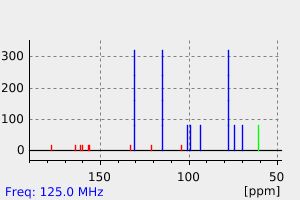
拉曼Raman
-
峰位数据
-
峰位匹配
-
表征信息
同类化合物
([2-(萘-2-基)-4-氧代-4H-色烯-8-基]乙酸)
龙血树脂红血树脂
鼠李素
鼠李柠檬素3-O-beta-D-鼠李三糖苷
鼠李柠檬素
鼠李亭3-O-beta-吡喃葡萄糖苷
黄酮醇-2-磺酸钠盐
黄酮胺
黄酮榕碱
黄酮地洛
黄酮哌酯
黄酮
黄诺马甙
黄苏木素
黄花夹竹桃黄酮
黄芪总皂甙
黄芩黄酮II
黄芩黄酮I
黄芩黄酮
黄芩苷甲酯
黄芩苷
黄芩素磷酸酯
黄芩素一水合物
黄芩素-7-甲醚
黄芩素 6-O-beta-D-吡喃葡萄糖苷
黄芩素
黄烷酮腙
黄烷酮-d5
黄烷酮
黄杞苷
黄宝石羽扇豆素
麗春花青苷
鳞叶甘草素B
高车前苷
高车前素-4'-O-Β-D-葡萄糖苷
高车前素
高良姜素-5-甲基醚
高良姜素-3-甲基醚
高良姜素
高圣草酚-7-O-(6''-O-乙酰基)吡喃葡萄糖苷
高圣草酚
高圣草素-7-O-Β-D-葡萄糖苷
高圣草素
骨碎补素
马里甙
马醉木素
马缨丹黄酮苷
马来酸2-乙酰基-10-[2-(二甲基氨)丙基]-10H-苯并噻嗪正离子
香风草甙
香蒲新苷
相关功能分类

联系我们


关注我们

公众号