接口广告
摩熵化学
数据开放平台 数据库官网
小程序
打开微信扫一扫
首页 分子通 化学资讯 化学百科 反应查询 关于我们
请输入关键词

正二十一烷 | 629-94-7

中文名称
正二十一烷
中文别名
二十一烷
英文名称
heneicosane
英文别名
n-heneicosane;henicosane
正二十一烷化学式
CAS
629-94-7
化学式
C21H44
mdl
——
分子量
296.58
InChiKey
FNAZRRHPUDJQCJ-UHFFFAOYSA-N
BEILSTEIN
——
EINECS
——
  • 物化性质
  • 计算性质
  • ADMET
  • 安全信息
  • SDS
  • 制备方法与用途
  • 上下游信息
  • 反应信息
  • 文献信息
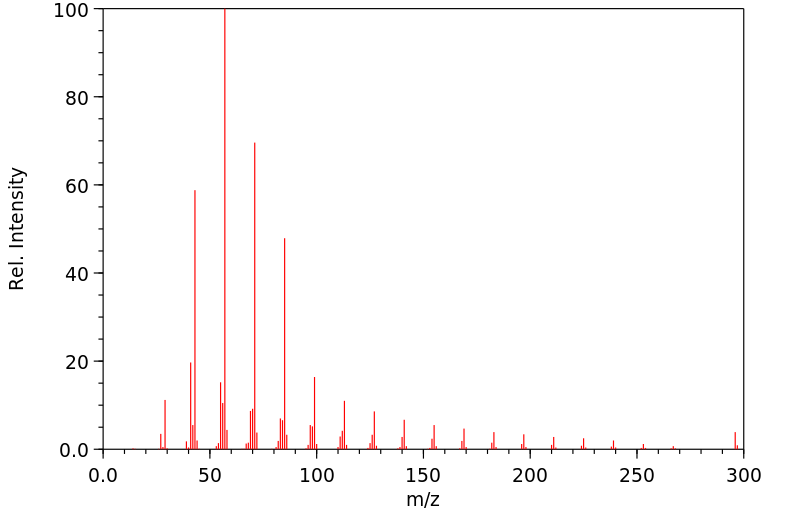
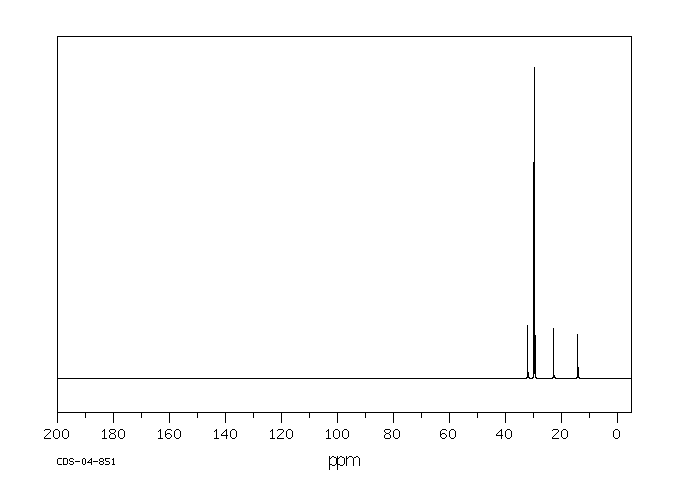
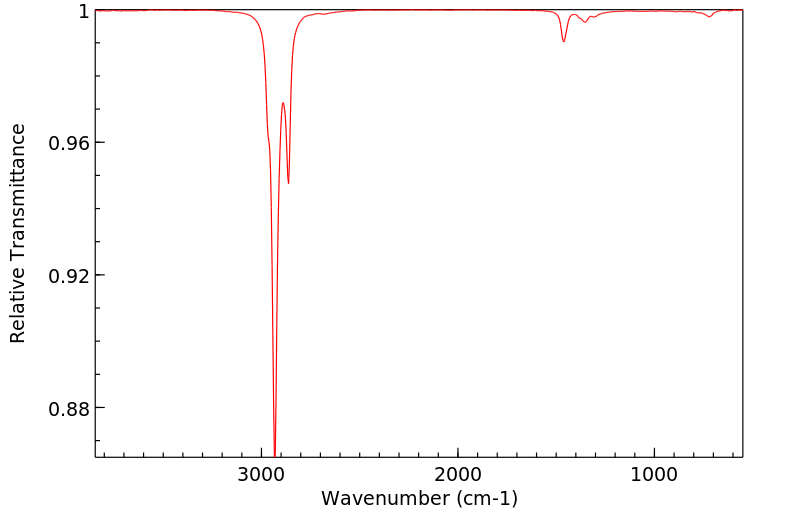
  • 表征谱图
  • 同类化合物
  • 相关功能分类
  • 相关结构分类

物化性质

  • 熔点:
    39-41 °C(lit.)
  • 沸点:
    100 °C2 mm Hg(lit.)
  • 密度:
    0,792 g/cm3
  • 蒸气密度:
    10.3 (vs air)
  • 闪点:
    >230 °F
  • 溶解度:
    可溶于氯仿、己烷
  • LogP:
    11.406 (est)
  • 物理描述:
    Crystals. (NTP, 1992)
  • 颜色/状态:
    Crystals from water
  • 气味:
    Odorless
  • 蒸汽压力:
    8.73X10⁻⁵ mm Hg at 25 °C (extrapolated)
  • 稳定性/保质期:
    • 远离氧化物。
    • 存在于烤烟烟叶、烟气中。
  • 折光率:
    Index of refraction: 1.4441 at 20 °C/D
  • 保留指数:
    2100

计算性质

  • 辛醇/水分配系数(LogP):
    11
  • 重原子数:
    21
  • 可旋转键数:
    18
  • 环数:
    0.0
  • sp3杂化的碳原子比例:
    1.0
  • 拓扑面积:
    0
  • 氢给体数:
    0
  • 氢受体数:
    0

ADMET

毒理性
  • 毒性总结
识别和使用:二十一烷是一种固体n-烷烃,含有21个碳原子(C21)。固体n-烷烃(石蜡)在多种应用中使用:作为裂解以生产汽油混合料、氧化和化反应的原料。人类暴露和毒性:没有数据可用。动物研究:二十一烷通过腹腔注射和皮肤途径的LD50在小鼠和雌雄大鼠中均大于5克/千克。在兔子的初级皮肤刺激性试验中没有观察到显著变化。在亚急性毒性研究中,即使每天以500毫克/千克的剂量连续给药90天,也未能在大鼠中产生毒性反应。建立的未见不良效应平(NOAEL)大于500毫克/千克。在大鼠中进行了发育研究。二十一烷以1克/千克的剂量在大鼠中既不具有胚胎毒性也不具有致畸性。
IDENTIFICATION AND USE: Heneicosane is a solid n-alkane containing 21 carbon atoms (C21). Solid n-alkanes (paraffin waxes) are used in a variety of applications: as feeds for cracking them to gasoline blendstock materials, oxidation, and chlorination reactions. HUMAN EXPOSURE AND TOXICITY: There are no data available. ANIMAL STUDIES: LD50 for heneicosane by i.p. and dermal routes was more than 5 g/kg in mice and rats of both sexes. In the primary skin irritation test in rabbits no significant changes were noted. In the sub-acute toxicity studies even 500 mg/kg dose was not able to produce toxic response in rats dosed daily for 90 days. The established no observed adverse effect level (NOAEL) was more than 500 mg/kg. Developmental studies were carried out in rats. Heneicosane at a dose of 1 g/kg was neither embryo toxic nor teratogenic in rats.
来源:Hazardous Substances Data Bank (HSDB)
毒理性
  • 解毒与急救
/SRP:/ 立即急救:确保已经进行了充分的中毒物清除。如果患者停止呼吸,开始人工呼吸,最好使用需求阀复苏器、袋阀面罩装置或口袋面罩,按训练操作。如有必要,执行心肺复苏。立即用缓慢流动的冲洗受污染的眼睛。不要催吐。如果发生呕吐,让患者前倾或置于左侧(如果可能的话,头部向下)以保持呼吸道畅通,防止吸入。保持患者安静,维持正常体温。寻求医疗帮助。 /脂肪烃及其相关化合物/
/SRP:/ Immediate first aid: Ensure that adequate decontamination has been carried out. If patient is not breathing, start artificial respiration, preferably with a demand valve resuscitator, bag-valve-mask device, or pocket mask, as trained. Perform CPR if necessary. Immediately flush contaminated eyes with gently flowing water. Do not induce vomiting. If vomiting occurs, lean patient forward or place on the left side (head-down position, if possible) to maintain an open airway and prevent aspiration. Keep patient quiet and maintain normal body temperature. Obtain medical attention. /Aliphatic hydrocarbons and related compounds/
来源:Hazardous Substances Data Bank (HSDB)
毒理性
  • 解毒与急救
/SRP:/ 基本治疗:建立专利气道(如有需要,使用口咽或鼻咽气道)。如有必要,进行吸痰。观察呼吸不足的迹象,如有必要,协助通气。通过非循环呼吸面罩以10至15升/分钟的速度给予氧气。监测肺肿,如有必要进行治疗……。预见并治疗癫痫发作……。对于眼睛污染,立即用冲洗眼睛。在运输过程中,用0.9%的生理盐(NS)连续冲洗每只眼睛……。不要使用催吐剂。对于摄入,如果患者能够吞咽、有强烈的干呕反射且不流口,则用冲洗口腔,并给予5毫升/千克,最多200毫升的进行稀释。给予活性炭……。用快速复温技术治疗冻伤……。/脂肪烃及其相关化合物/
/SRP:/ Basic treatment: Establish a patent airway (oropharyngeal or nasopharyngeal airway, if needed). Suction if necessary. Watch for signs of respiratory insufficiency and assist ventilations if necessary. Administer oxygen by nonrebreather mask at 10 to 15 L/min. Monitor for pulmonary edema and treat if necessary ... . Anticipate seizures and treat if necessary ... . For eye contamination, flush eyes immediately with water. Irrigate each eye continuously with 0.9% saline (NS) during transport ... . Do not use emetics. For ingestion, rinse mouth and administer 5 mL/kg up to 200 mL of water for dilution if the patient can swallow, has a strong gag reflex, and does not drool. Administer activated charcoal ... . Treat frostbite with rapid rewarming techniques ... ./Aliphatic hydrocarbons and related compounds/
来源:Hazardous Substances Data Bank (HSDB)
毒理性
  • 解毒与急救
/SRP:/ 高级治疗:对于无意识、严重肺肿或严重呼吸困难的病人,考虑进行口咽或鼻咽气管插管以控制气道。使用气囊阀面罩装置的正压通气技术可能有益。考虑使用药物治疗肺肿……监测心率和必要时治疗心律失常……开始静脉输注D5W /SRP: "保持开放",最小流量/。如果出现低血容量的迹象,使用0.9%生理盐(NS)或乳酸钠林格液(LR)。对于伴有低血容量迹象的低血压,谨慎给予液体。注意液体过载的迹象……用地西泮安定)或劳拉西泮安定)治疗癫痫……使用丙美卡因化物协助眼部冲洗……/脂肪烃及其相关化合物/
/SRP:/ Advanced treatment: Consider orotracheal or nasotracheal intubation for airway control in the patient who is unconscious, has severe pulmonary edema, or is in severe respiratory distress. Positive-pressure ventilation techniques with a bag-valve-mask device may be beneficial. Consider drug therapy for pulmonary edema ... . Monitor cardiac rhythm and treat arrhythmias as necessary ... . Start IV administration of D5W /SRP: "To keep open", minimal flow rate/. Use 0.9% saline (NS) or lactated Ringer's (LR) if signs of hypovolemia are present. For hypotension with signs of hypovolemia, administer fluid cautiously. Watch for signs of fluid overload ... . Treat seizures with diazepam (Valium) or lorazepam (Ativan) ... . Use proparacaine hydrochloride to assist eye irrigation ... . /Aliphatic hydrocarbons and related compounds/
来源:Hazardous Substances Data Bank (HSDB)
毒理性
  • 解毒与急救
紧急和支持性措施。1. 一般措施。为所有有症状的患者提供基本支持性护理。保持呼吸道通畅,必要时协助呼吸。给予补充氧气。监测动脉血气或血氧饱和度、胸部X光片、心电图,并将有症状的患者收入重症监护室。在有明显碳氢化合物中毒的患者中使用肾上腺素和其他β-肾上腺素能药物时要小心,因为可能会诱发心律失常。2. 肺吸入。观察4-6小时后仍然完全无症状的患者可以出院。相反,如果患者在到达时咳嗽,可能已经发生了吸入。如果发生支气管痉挛和低氧血症,给予补充氧气并治疗。不要使用类固醇或预防性抗生素。3. 吞入。在绝大多数儿童意外吞入的情况下,实际吞咽的量少于5-10毫升,系统性中毒是罕见的。治疗主要是支持性的。注射。对于注射到指尖或手部的情况,尤其是涉及高压喷枪的情况,应立即咨询整形外科或手外科医生,因为通常需要迅速广泛地暴露、冲洗和清创。/碳氢化合物/
Emergency and supportive measures. 1. General. Provide basic supportive care for all symptomatic patients. Maintain an open airway and assist ventilation if necessary. Administer supplemental oxygen. Monitor arterial blood gases or oximetry, chest radiographs, and ECG and admit symptomatic patients to an intensive care setting. Use epinephrine and other beta-adrenergic medications with caution in patients with significant hydrocarbon intoxication because arrhythmias may be induced. 2. Pulmonary aspiration. Patients who remain completely asymptomatic after 4-6 hours of observation may be discharged. In contrast, if the patient is coughing on arrival, aspiration probably has occurred. Administer supplemental oxygen and treat bronchospasm and hypoxia if they occur. Do not use steroids or prophylactic antibiotics. 3. Ingestion. In the vast majority of accidental childhood ingestions, less than 5-10 mL is actually swallowed and systemic toxicity is rare. Treatment is primarily supportive. Injection. For injections into the fingertip or hand, especially those involving a high-pressure paint gun, consult with a plastic or hand surgeon immediately, as prompt wide exposure, irrigation, and debridement are often required. /Hydrocarbons/
来源:Hazardous Substances Data Bank (HSDB)
吸收、分配和排泄
从阿拉伯海湾沿岸密集覆盖油沉积物的蓝绿色垫层中分离出的尼古丁节杆菌KCC B35,能够很好地以C10至C40的正构烷烃作为唯一的碳源和能源。在C20至C40的烷烃上的生长甚至比在C10至C18的烷烃上还要好。用n-二十八烷(C28)或n-二十九烷(C29)培养6小时的生物量样品,积累了这些化合物作为细胞烃组分的主要组成烷烃。在C28和C29培养细胞中,偶数链的十六烷C16和奇数链的十五烷C15是第二主要的组成烷烃。与未用烃类培养的对照细胞相比,用n-十六烷培养的细胞在其脂质中积累了更高比例的C16-脂肪酸。另一方面,C28和C29培养的细胞不含有等价链长的脂肪酸,但细胞脂质的脂肪酸模式表明,这些非常长链烷烃的中链氧化确实发生了。这种活性使得尼古丁节杆菌KCC B35有资格被用于混合物中,用于生物修复受重油沉积物污染的环境。
Arthrobacter nicotianae KCC B35 isolated from blue-green mats densely covering oil sediments along the Arabian Gulf coast grew well on C10 to C40 n-alkanes as sole sources of carbon and energy. Growth on C20 to C40 alkanes was even better than on C10 to C18 alkanes. Biomass samples incubated for 6 hr with n-octacosane (C28) or n-nonacosane (C29) accumulated these compounds as the predominant constituent alkanes of the cell hydrocarbon fractions. The even chain hexadecane C16 and the odd chain pentadecane C15 were the second dominant constituent alkanes in C28 and C29 incubated cells, respectively. n-Hexadecane-incubated cells accumulated in their lipids higher proportions of C16-fatty acids than control cells not incubated with hydrocarbons. On the other hand, C28 and C29-incubated cells did not contain any fatty acids with the equivalent chain lengths, but the fatty acid patterns of the cell lipids suggest that there should have been mid-chain oxidation of these very long chain alkanes. This activity qualifies A. nicotianae KCC B35 to be used in cocktails for bioremediating environments polluted with heavy oil sediments.
来源:Hazardous Substances Data Bank (HSDB)
吸收、分配和排泄
牛的肝脏、心脏、肾脏、肌肉和脂肪(包括腹膜和皮下)组织从6只动物身上收集用于分析其烃类组成。通过气相色谱和组合气相色谱-质谱法进行了定性和定量测定。尽管比例不同,但所有样本中都发现了一组同源的正构烷烃,范围从n-C12到n-C31。还鉴定出了异戊二烯烃——植烷和植烯(植-1-烯和植-2-烯)。(这些发现与食用受烃类污染的肉类的人类健康相关。) /正构烷烃/
Liver, heart, kidneys, muscle and adipose (perirenal and s.c.) /bovine/ tissues were collected from 6 animals for analysis of their hydrocarbon composition. Qualitative and quantitative determinations were carried out by gas chromatography and combined gas chromatography-mass spectrometry. Although differing in the proportions, a homologous series of n-alkanes ranging from n-C12-n-C31 was found in all samples. The isoprenoid hydrocarbons phytane and phytene (phyt-1-ene and phyt-2-ene) were also identified. (These findings have relevance to the health of humans consuming hydrocarbon-contaminated meats.) /n-Alkanes/
来源:Hazardous Substances Data Bank (HSDB)

安全信息

  • TSCA:
    Yes
  • 安全说明:
    S22,S24/25
  • WGK Germany:
    3
  • 海关编码:
    29011000
  • 危险品运输编号:
    NONH for all modes of transport
  • 危险性防范说明:
    P261,P305+P351+P338
  • 危险性描述:
    H302,H315,H319,H335
  • 储存条件:
    存放在密封容器中,并放置在阴凉、干燥处。储存地点须远离氧化剂。

SDS

SDS:c98ddb9db52217a1159f27d1a48c3436
查看
Name: n-Heneicosane 98% Material Safety Data Sheet
Synonym: None Known
CAS: 629-94-7
Section 1 - Chemical Product MSDS Name:n-Heneicosane 98% Material Safety Data Sheet
Synonym:None Known

Section 2 - COMPOSITION, INFORMATION ON INGREDIENTS
CAS# Chemical Name content EINECS#
629-94-7 n-Heneicosane 98% 211-118-9
Hazard Symbols: None Listed.
Risk Phrases: None Listed.

Section 3 - HAZARDS IDENTIFICATION
EMERGENCY OVERVIEW
The toxicological properties of this material have not been fully investigated.
Potential Health Effects
Eye:
May cause eye irritation.
Skin:
May cause skin irritation.
Ingestion:
May cause irritation of the digestive tract. The toxicological properties of this substance have not been fully investigated.
Inhalation:
May cause respiratory tract irritation. The toxicological properties of this substance have not been fully investigated.
Chronic:
No information found.

Section 4 - FIRST AID MEASURES
Eyes: Flush eyes with plenty of water for at least 15 minutes, occasionally lifting the upper and lower eyelids. Get medical aid.
Skin:
Get medical aid. Flush skin with plenty of water for at least 15 minutes while removing contaminated clothing and shoes. Wash clothing before reuse.
Ingestion:
Never give anything by mouth to an unconscious person. Get medical aid. Do NOT induce vomiting. If conscious and alert, rinse mouth and drink 2-4 cupfuls of milk or water. Wash mouth out with water.
Inhalation:
Remove from exposure and move to fresh air immediately. If not breathing, give artificial respiration. If breathing is difficult, give oxygen. Get medical aid.
Notes to Physician:
Treat symptomatically and supportively.

Section 5 - FIRE FIGHTING MEASURES
General Information:
As in any fire, wear a self-contained breathing apparatus in pressure-demand, MSHA/NIOSH (approved or equivalent), and full protective gear. During a fire, irritating and highly toxic gases may be generated by thermal decomposition or combustion.
Extinguishing Media:
Use water spray, dry chemical, carbon dioxide, or chemical foam.

Section 6 - ACCIDENTAL RELEASE MEASURES
General Information: Use proper personal protective equipment as indicated in Section 8.
Spills/Leaks:
Vacuum or sweep up material and place into a suitable disposal container. Clean up spills immediately, observing precautions in the Protective Equipment section. Avoid generating dusty conditions.
Provide ventilation.

Section 7 - HANDLING and STORAGE
Handling:
Wash thoroughly after handling. Use with adequate ventilation.
Minimize dust generation and accumulation. Avoid breathing dust, vapor, mist, or gas. Avoid contact with eyes, skin, and clothing.
Keep container tightly closed. Avoid ingestion and inhalation.
Storage:
Store in a tightly closed container. Store in a cool, dry, well-ventilated area away from incompatible substances.

Section 8 - EXPOSURE CONTROLS, PERSONAL PROTECTION
Engineering Controls:
Facilities storing or utilizing this material should be equipped with an eyewash facility and a safety shower. Use adequate ventilation to keep airborne concentrations low.
Exposure Limits CAS# 629-94-7: Personal Protective Equipment Eyes: Wear appropriate protective eyeglasses or chemical safety goggles as described by OSHA's eye and face protection regulations in 29 CFR 1910.133 or European Standard EN166.
Skin:
Wear appropriate protective gloves to prevent skin exposure.
Clothing:
Wear appropriate protective clothing to prevent skin exposure.
Respirators:
Follow the OSHA respirator regulations found in 29 CFR 1910.134 or European Standard EN 149. Use a NIOSH/MSHA or European Standard EN 149 approved respirator if exposure limits are exceeded or if irritation or other symptoms are experienced.

Section 9 - PHYSICAL AND CHEMICAL PROPERTIES

Physical State: Crystals
Color: white
Odor: Not available.
pH: Not available.
Vapor Pressure: Not available.
Viscosity: Not available.
Boiling Point: 100 deg C @ 2 mmHg
Freezing/Melting Point: 40 - 41 deg C
Autoignition Temperature: Not available.
Flash Point: > 110 deg C (> 230.00 deg F)
Explosion Limits, lower: Not available.
Explosion Limits, upper: Not available.
Decomposition Temperature:
Solubility in water: Insoluble.
Specific Gravity/Density:
Molecular Formula: C21H44
Molecular Weight: 296.58

Section 10 - STABILITY AND REACTIVITY
Chemical Stability:
Stable at room temperature in closed containers under normal storage and handling conditions.
Conditions to Avoid:
Incompatible materials, dust generation.
Incompatibilities with Other Materials:
Oxidizing agents.
Hazardous Decomposition Products:
Carbon monoxide, carbon dioxide.
Hazardous Polymerization: Has not been reported

Section 11 - TOXICOLOGICAL INFORMATION
RTECS#:
CAS# 629-94-7 unlisted.
LD50/LC50:
Not available.
Carcinogenicity:
n-Heneicosane - Not listed by ACGIH, IARC, or NTP.

Section 12 - ECOLOGICAL INFORMATION


Section 13 - DISPOSAL CONSIDERATIONS
Dispose of in a manner consistent with federal, state, and local regulations.

Section 14 - TRANSPORT INFORMATION

IATA
Shipping Name: Not regulated.
Hazard Class:
UN Number:
Packing Group:
IMO
Shipping Name: Not regulated.
Hazard Class:
UN Number:
Packing Group:
RID/ADR
Not regulated as a hazardous material.

Section 15 - REGULATORY INFORMATION

European/International Regulations
European Labeling in Accordance with EC Directives
Hazard Symbols: Not available.
Risk Phrases:
Safety Phrases:
S 24/25 Avoid contact with skin and eyes.
WGK (Water Danger/Protection)
CAS# 629-94-7: No information available.
Canada
CAS# 629-94-7 is listed on Canada's DSL List.
CAS# 629-94-7 is not listed on Canada's Ingredient Disclosure List.
US FEDERAL
TSCA
CAS# 629-94-7 is listed on the TSCA inventory.


SECTION 16 - ADDITIONAL INFORMATION
N/A

制备方法与用途

简介

正二十一烷主要来源于石油裂解制乙烯生产中的副产物,常被用作低附加值溶剂。因此,研究正二十一烷C-H键的催化选择氧化能够得到更高附加值且具有实际应用价值的含氧化合物。这些含氧化合物在进一步加工利用后,可在医药、有机化工、染料等多个行业发挥重要作用,故以正二十一烷为代表的烃类选择氧化研究具有巨大的科研价值和现实意义。

应用

正二十一烷是一种无色晶体,不溶于的正构烷烃。作为柴油、低温改进剂以及环保液体燃料组合物的关键组分之一,它已被广泛应用于工业中。同时,在地质、原油分析、大气颗粒物及有机物等领域,正构烷烃单体也发挥着极其重要的作用。

制备

一次性制备正二十一烷的方法如下:

  1. 正戊烷(1510.5g,10mol)与正十六烷(3053.5g,10mol)混合均匀,形成代烷混合液备用。
  2. 称取483g(21mol),切成小细条(面积约为1×3cm²),备用。
  3. 在反应釜中投入50g代烷混合物以及20g,搅拌升温至80℃。通过反应自身加热并维持反应温度在120℃,不断滴加剩余代烷混合液,并加入保持微回流状态。加料完毕后,在140℃下恒温2小时。
  4. 依次加入400克95%乙醇及1000ml,分出有机物并用洗至中性。用无硫酸干燥后进行蒸馏,收集260~280℃的馏分;该馏分加600g浓硫酸洗涤至酸层浅黄色,再洗有机相至中性,干燥并通过分馏柱收集500g96%正癸烷及600g98%正二十一烷。所得正构烷烃含量可达96%~98%。

所述的正戊烷正十六烷摩尔比为1:1,反应釜由搅拌器、分液漏斗和回流冷凝器组成。强氧化剂可选用浓硫酸或酸性高锰酸钾

生物活性

Heneicosane是从Streptomyces philanthi RL-1-178或Serapias cordigera中分离出来的一种香气成分,同时也是一种信息素,能够抑制黄曲霉毒素的产生。

上下游信息

  • 上游原料
    中文名称 英文名称 CAS号 化学式 分子量

反应信息

  • 作为反应物:
    描述:
    氨基甲酸甲酯硫酸1,3-二异丙烯基苯disodium;carbonate正十六烷正二十一烷 、 alpha,alpha,alpha',alpha'-Tetramethyl meta-xylene diisocyanate 、 Meta-isopropenyldimethylbenzene isocyanate 在 氨基甲酸甲酯 作用下, 60.0~265.0 ℃ 、533.24 kPa 条件下, 反应 9.0h, 以m-TMU were formed in 65% and 24%的产率得到alpha,alpha,alpha',alpha'-Tetramethyl-meta-xylene monourethane monoisocyanate
    参考文献:
    名称:
    Tertiary aralkyl urethanes and isocyanates derived therefrom
    摘要:
    在中等温度下,在酸催化剂的存在下,通过加成相应的烯烃和氨基甲酸酯形成相应的脲酮,然后通过热解制备三级芳基异氰酸酯,例如四甲基二异氰酸二乙烯基苯。
    公开号:
    US04439616A1
  • 作为产物:
    描述:
    十一烷酸盐酸 、 amalgamated zinc 、 硫酸sodium ethanolate 作用下, 115.0~120.0 ℃ 、2.67 kPa 条件下, 生成 正二十一烷
    参考文献:
    名称:
    Strating; Backer, Recueil des Travaux Chimiques des Pays-Bas, 1936, vol. 55, p. 903,914