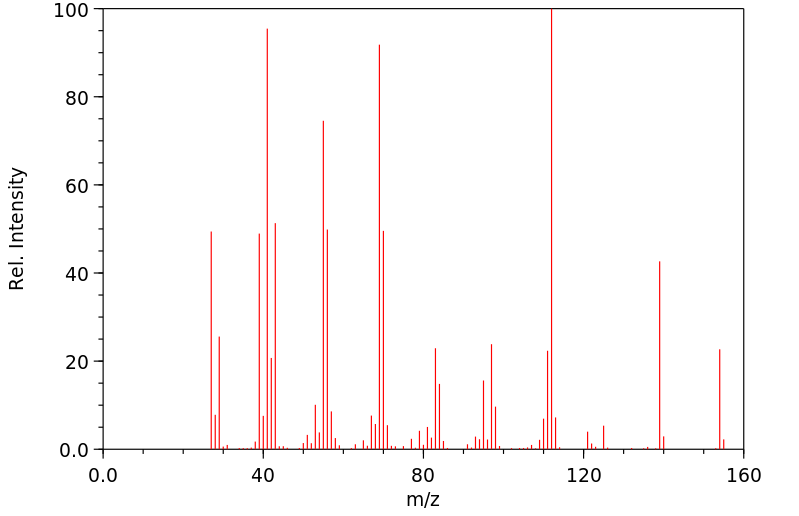
...KETONES (EG CARVONE & MENTHONE) ARE REDUCED TO SECONDARY ALCOHOLS WHICH ARE THEN EXCRETED AS GLUCURONIDES. MENTHONE, ASYMMETRIC REDUCTION /TO/ NEO-MENTHOL, GLUCURONIDE CONJUGATION /TO/ MENTHYL GLUCURONIDE.
来源:Hazardous Substances Data Bank (HSDB)
毒理性
副作用
神经毒素 - 其他中枢神经系统神经毒素
Neurotoxin - Other CNS neurotoxin
来源:Haz-Map, Information on Hazardous Chemicals and Occupational Diseases
Essential oils of four plants (two species of lavender, peppermint, and a eucalyptus) and some of their principal constituents, i.e., linalool, linalyl acetate, fenchone, menthone, menthol, and eucalyptol, were tested in vitro for their acaricidal activity against Tyrophagus longior, a mite species that is a pest in stored food. Two different procedures were carried out to test the activity of these compounds by direct contact and by inhalation. In the direct contact assays five different quantities of each undiluted substance (6, 2, 1, 0.5, and 0.25 ul) were spread on the internal surface of 6-cm petri dishes, each containing 10 mites. The activity by inhalation was tested using two petri dishes of different sizes: the smaller one (6 cm), containing 10 mites, was covered with a filter paper disk and enclosed in a bigger dish (9 cm) containing 6 oz 2 mul of each undiluted substance. At the highest doses, the essential oils of the two lavender species and of peppermint killed 100% of the mites, both by direct contact and by inhalation. Eucalyptus oil was the least active. Among the essential oil constituents, menthol showed the highest activity, killing 100% of the mites at the lowest dose (0.25 ul) by direct contact and at 6 ul by inhalation. However, linalool, fenchone, and menthone also showed good acaricidal activity. Eucalyptol, like the essential oil of which it is the principal constituent, had the lowest activity.
Menthone, a component of peppermint oil, was given p.o. to groups of 10 male and 10 female rats at dose levels of 0, 200, 400 and 800 mg/kg bw/day, respectively, for 28 days. After 19 days the dose was reduced to 400 mg/kg bw in the female group receiving the highest dose. Analyses of plasma showed a dose-dependent decrease in creatinine content and a dose-dependent increase in alkaline phosphatase activity and bilirubin. The relative weights of liver and spleen were increased. Cyst-like spaces were seen histopathologically in the white matter of the cerebellum of the two highest dose groups. The no-effect level for menthone in this study was lower than 200 mg/kg bw/day.
Menthone was a mild skin irritant and of low acute dermal toxicity in rabbits. No evidence of sensitizing potential was found in a volunteer study with a dilute solution. In rats, menthone demonstrated a moderate to low acute oral toxicity. On repeated oral administration, menthone produced increases in liver, kidney and spleen weights of rats. Mutagenic activity was reported in the bacterium Salmonella typhimurium (Ames test).
SECTION 1: Identification of the substance/mixture and of the company/undertaking Product identifiers Product name : (+)-Menthone REACH No. : A registration number is not available for this substance as the substance or its uses are exempted from registration, the annual tonnage does not require a registration or the registration is envisaged for a later registration deadline. CAS-No. : 3391-87-5 Relevant identified uses of the substance or mixture and uses advised against Identified uses : Laboratory chemicals, Manufacture of substances SECTION 2: Hazards identification Classification of the substance or mixture Not a hazardous substance or mixture according to Regulation (EC) No. 1272/2008. Not a hazardous substance or mixture according to EC-directives 67/548/EEC or 1999/45/EC. Label elements The product does not need to be labelled in accordance with EC directives or respective national laws. Other hazards - none SECTION 3: Composition/information on ingredients Substances Synonyms : (1S,4R)-p-Menthan-3-one (2R,5S)-2-Isopropyl-5-methylcyclohexanone Formula : C10H18O Molecular Weight : 154,25 g/mol CAS-No. : 3391-87-5 EC-No. : 222-227-6 No components need to be disclosed according to the applicable regulations. SECTION 4: First aid measures Description of first aid measures General advice Consult a physician. Show this safety data sheet to the doctor in attendance. If inhaled If breathed in, move person into fresh air. If not breathing, give artificial respiration. Consult a physician. In case of skin contact Wash off with soap and plenty of water. Consult a physician. In case of eye contact Flush eyes with water as a precaution. If swallowed Do NOT induce vomiting. Never give anything by mouth to an unconscious person. Rinse mouth with water. Consult a physician. Most important symptoms and effects, both acute and delayed The most important known symptoms and effects are described in the labelling (see section 2.2) and/or in section 11 Indication of any immediate medical attention and special treatment needed no data available SECTION 5: Firefighting measures Extinguishing media Suitable extinguishing media For small (incipient) fires, use media such as "alcohol" foam, dry chemical, or carbon dioxide. For large fires, apply water from as far as possible. Use very large quantities (flooding) of water applied as a mist or spray; solid streams of water may be ineffective. Cool all affected containers with flooding quantities of water. Special hazards arising from the substance or mixture Carbon oxides Advice for firefighters Wear self contained breathing apparatus for fire fighting if necessary. Further information Use water spray to cool unopened containers. SECTION 6: Accidental release measures Personal precautions, protective equipment and emergency procedures Avoid breathing vapours, mist or gas. Remove all sources of ignition. Beware of vapours accumulating to form explosive concentrations. Vapours can accumulate in low areas. For personal protection see section 8. Environmental precautions Prevent further leakage or spillage if safe to do so. Do not let product enter drains. Methods and materials for containment and cleaning up Contain spillage, and then collect with an electrically protected vacuum cleaner or by wet-brushing and place in container for disposal according to local regulations (see section 13). Keep in suitable, closed containers for disposal. Reference to other sections For disposal see section 13. SECTION 7: Handling and storage Precautions for safe handling Avoid inhalation of vapour or mist. Keep away from sources of ignition - No smoking.Take measures to prevent the build up of electrostatic charge. For precautions see section 2.2. Conditions for safe storage, including any incompatibilities Store in cool place. Keep container tightly closed in a dry and well-ventilated place. Containers which are opened must be carefully resealed and kept upright to prevent leakage. Recommended storage temperature: 2 - 8 °C Store under inert gas. Specific end use(s) A part from the uses mentioned in section 1.2 no other specific uses are stipulated SECTION 8: Exposure controls/personal protection Control parameters Components with workplace control parameters Exposure controls Appropriate engineering controls Handle in accordance with good industrial hygiene and safety practice. Wash hands before breaks and at the end of workday. Personal protective equipment Eye/face protection Safety glasses with side-shields conforming to EN166 Use equipment for eye protection tested and approved under appropriate government standards such as NIOSH (US) or EN 166(EU). Skin protection Handle with gloves. Gloves must be inspected prior to use. Use proper glove removal technique (without touching glove's outer surface) to avoid skin contact with this product. Dispose of contaminated gloves after use in accordance with applicable laws and good laboratory practices. Wash and dry hands. The selected protective gloves have to satisfy the specifications of EU Directive 89/686/EEC and the standard EN 374 derived from it. Body Protection impervious clothing, The type of protective equipment must be selected according to the concentration and amount of the dangerous substance at the specific workplace. Respiratory protection Where risk assessment shows air-purifying respirators are appropriate use a full-face respirator with multi-purpose combination (US) or type ABEK (EN 14387) respirator cartridges as a backup to engineering controls. If the respirator is the sole means of protection, use a full-face supplied air respirator. Use respirators and components tested and approved under appropriate government standards such as NIOSH (US) or CEN (EU). Control of environmental exposure Prevent further leakage or spillage if safe to do so. Do not let product enter drains. SECTION 9: Physical and chemical properties Information on basic physical and chemical properties a) Appearance Form: clear, liquid Colour: colourless b) Odour no data available c) Odour Threshold no data available d) pH no data available e) Melting point/freezing no data available point f) Initial boiling point and 209 - 210 °C - lit. boiling range g) Flash point 72 °C - closed cup h) Evapouration rate no data available i) Flammability (solid, gas) no data available j) Upper/lower no data available flammability or explosive limits k) Vapour pressure no data available l) Vapour density no data available m) Relative density 0,893 g/cm3 at 20 °C n) Water solubility no data available o) Partition coefficient: n- no data available octanol/water p) Auto-ignition no data available temperature q) Decomposition no data available temperature r) Viscosity no data available s) Explosive properties no data available t) Oxidizing properties no data available Other safety information no data available SECTION 10: Stability and reactivity Reactivity no data available Chemical stability Stable under recommended storage conditions. Possibility of hazardous reactions no data available Conditions to avoid Heat, flames and sparks. Incompatible materials Strong oxidizing agents Hazardous decomposition products Other decomposition products - no data available In the event of fire: see section 5 SECTION 11: Toxicological information Information on toxicological effects Acute toxicity no data available Skin corrosion/irritation no data available Serious eye damage/eye irritation no data available Respiratory or skin sensitisation no data available Germ cell mutagenicity no data available Carcinogenicity IARC: No component of this product present at levels greater than or equal to 0.1% is identified as probable, possible or confirmed human carcinogen by IARC. Reproductive toxicity no data available Specific target organ toxicity - single exposure no data available Specific target organ toxicity - repeated exposure no data available Aspiration hazard no data available Additional Information RTECS: Not available To the best of our knowledge, the chemical, physical, and toxicological properties have not been thoroughly investigated. SECTION 12: Ecological information Toxicity no data available Persistence and degradability no data available Bioaccumulative potential no data available Mobility in soil no data available Results of PBT and vPvB assessment PBT/vPvB assessment not available as chemical safety assessment not required/not conducted Other adverse effects no data available SECTION 13: Disposal considerations Waste treatment methods Product This combustible material may be burned in a chemical incinerator equipped with an afterburner and scrubber. Offer surplus and non-recyclable solutions to a licensed disposal company. Contact a licensed professional waste disposal service to dispose of this material. Contaminated packaging Dispose of as unused product. SECTION 14: Transport information UN number ADR/RID: - IMDG: - IATA: - UN proper shipping name ADR/RID: Not dangerous goods IMDG: Not dangerous goods IATA: Not dangerous goods Transport hazard class(es) ADR/RID: - IMDG: - IATA: - Packaging group ADR/RID: - IMDG: - IATA: - Environmental hazards ADR/RID: no IMDG Marine pollutant: no IATA: no Special precautions for user no data available SECTION 15 - REGULATORY INFORMATION N/A
Various primary and secondaryalcohols were smoothly oxidized to the corresponding aldehydes and ketones by using a new oxidizing agent, N-t-butylbenzenesulfinimidoyl chloride (4a), in the coexistence of DBU or zinc oxide. The present oxidation proceeded under mild conditions via five-membered intramolecular proton-transfer of an alkyl arenesulfinimidate intermediate.
Highly chemoselective palladium-catalyzed conjugate reduction of .alpha.,.beta.-unsaturated carbonyl compounds with silicon hydrides and zinc chloride cocatalyst
作者:Ehud. Keinan、Noam. Greenspoon
DOI:10.1021/ja00283a029
日期:1986.11
experiments and 'H NMR studies, a catalytic cycle is postulated in which the first step involves reversible coordination of the palladium complex to the electron-deficient olefin and oxidative addition of silicon hydride to form a hydridopalladium olefin complex. Migratory insertion of hydride into the coordinated olefin produces an intermediate palladium enolate which, via reductive elimination, collapses back
由可溶性钯催化剂、氢化硅烷和氯化锌组成的三组分体系能够有效地共轭还原α、不饱和酮和醛。最佳条件组包括二苯基硅烷作为最有效的氢化物供体,任何可溶于 0 或 I1 氧化态的钯配合物,当它被膦配体稳定时,以及作为最佳路易斯酸助催化剂的 ZnCl。该反应对于范围广泛的不饱和酮和醛非常普遍,并且对于这些迈克尔受体具有高度选择性,因为在这些条件下α,-不饱和羧酸衍生物的还原非常缓慢。当双氘代二苯基硅烷用于还原不饱和酮时,氘在底物的受阻较少的面上立体选择性地引入,并在 8 位上以区域选择性的方式引入。相反,当在痕量 D2O 存在下进行还原时,氘掺入发生在 a 位。在掺入氘的实验和 1 H NMR 研究的基础上,假定催化循环,其中第一步涉及钯配合物与缺电子烯烃的可逆配位和氢化硅的氧化加成以形成氢化钯烯烃配合物。氢化物迁移插入配位的烯烃产生中间体烯醇钯,通过还原消除,它塌缩回 Pd(0) 络合物和甲硅烷基烯
Chemoselective Hydrogenation of α,β-Unsaturated Carbonyls Catalyzed by Biomass-Derived Cobalt Nanoparticles in Water
作者:Tao Song、Zhiming Ma、Yong Yang
DOI:10.1002/cctc.201801987
日期:2019.2.20
selectivity for hydrogenation of C=C in α,β‐unsaturated carbonyls under mild conditions. A broad set of α,β‐aromatic and aliphatic unsaturated carbonyls were selectively reduced to their corresponding saturatedcarbonyls in up to 99 % yields with good tolerance of various functional groups. Meanwhile, a new straightforward one‐pot cascade synthesis of saturatedcarbonyls was realized with high activity and
Facile Protocol for Catalytic Frustrated Lewis Pair Hydrogenation and Reductive Deoxygenation of Ketones and Aldehydes
作者:Tayseer Mahdi、Douglas W. Stephan
DOI:10.1002/anie.201503087
日期:2015.7.13
A series of ketones and aldehydes are reduced in toluene under H2 in the presence of 5 mol % B(C6F5)3 and either cyclodextrin or molecular sieves affording a facile metal‐free protocol for reduction to alcohols. Similar treatment of arylketones resulted in metal‐free deoxygenation yielding aromatic hydrocarbons.
在H 2下,在5 mol%B(C 6 F 5)3的存在下,一系列甲苯中的酮和醛被还原,环糊精或分子筛提供了一种简便的无金属还原醇的方案。芳基酮的类似处理导致无金属脱氧,生成芳烃。
PROCESS FOR THE PREPARATION OF NITRO COMPOUNDS AND METHOD FOR THE REMOVAL OF NITROGEN DIOXIDE
申请人:Daicel Chemical Industries, Ltd.
公开号:EP1099684A1
公开(公告)日:2001-05-16
In the invented process for producing a nitro compound, an organic substrate and nitrogen dioxide are reacted in the presence of oxygen or are reacted in a molar ratio of nitrogen dioxide to the organic substrate of less than 1 to yield a corresponding nitro compound. The reaction may be performed in the presence of N-hydroxyphthalimide or other imide compounds. Such organic substrates include (a) aliphatic hydrocarbons, (b) alicyclic hydrocarbons, (c) non-aromatic heterocyclic compounds each having a carbon atom on a ring, which carbon atom is bonded to a hydrogen atom, (d) compounds each having a carbon-hydrogen bond at the adjacent position to an aromatic ring, and (e) compounds each having a carbon-hydrogen bond at the adjacent position to a carbonyl group. This process can efficiently nitrate an organic substrate even under relatively mild conditions.