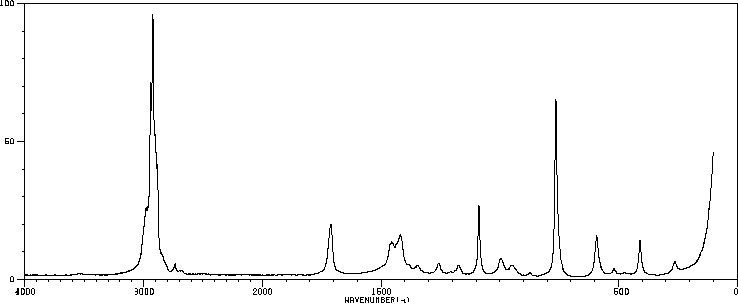
Methyl ethyl ketone (MEK) occurs ... in normal human urine and ... has possible dietary origin; its more probable precursor is alpha-methylacetoacetic acid. Like other ketones ... MEK is reduced ... in the body. Only 30-40% ... is eliminated in expired air ... .
Resting cells of Lactobacillus brevis 24 reduced methyl ethyl ketone (MEK) quantitatively to 2-butyl alcohol when incubated in phosphate buffer for 24 hr at 30 °C.
IDENTIFICATION AND USE: Methyl ethyl ketone (MEK) is a colorless liquid with acetone-like odor. It is used as an organic solvent, in the surface coating industry, in the manufacture of smokeless powder, and in colorless synthetic resins. MEK is not registered for current use in pesticides in the U.S. MEK is also used as an extraction solvent in the processing of foodstuffs and food ingredients, e.g., in fractionation of fats and oils, decaffeination of tea and coffee, and extraction of flavorings. HUMAN EXPOSURE AND TOXICITY: At high concentrations MEK is irritating to the eyes, nose, and throat. Other symptoms of exposure include headache, dizziness, vomiting, or numbness of the extremities. Prolonged exposure produces neurotoxic effects, as in the case of a 27-year-old man who was exposed occupationally (through dermal and inhalation pathways) over a 2-year period to solvents containing 100% MEK. The patient reported symptoms of dizziness, anorexia, and involuntary muscle movement, beginning about 1 month prior to admission. Neurological examination confirmed multifocal myoclonus, ataxia, and tremor. Symptoms of solvent toxicity disappeared after 1 month of cessation of exposure and treatment with clonazepam and propranolol. Symptoms did not reappear after withdrawal of the drugs. ANIMAL STUDIES: Acute exposures to MEK in mice showed a 75 to 100% decrease in response rate to light stimuli at concentration of 1,000 to 10,000 ppm. Guinea pigs exposed to MEK vapor (10,000 to 100,000 ppm) for up to 13.5 hr showed that the acute effects of MEK advanced through several distinct phases as the exposure proceeded with nose irritation, eye irritation, lacrimation, incoordination, CNS depression, labored breathing, and death occurring in succession. Vapor concentrations of 33,000 ppm or greater caused death in the animals after 45-260 min of exposure. In subcronic studies rats were exposed to 0, 1250, 2500, or 5000 ppm MEK vapors 6 hours per day, 5 days per week for 90 days. The 5000 ppm animals had a slight but significant increase in liver weight, liver weight/body weight ratio, and liver weight/brain weight ratio at necropsy. Serum glutamicpyruvic transaminase (SGPT) activity in the 2500 ppm female rats was elevated while the 5000 ppm female rats exhibited significantly decreased SGPT activity. In addition, alkaline phosphatase, potassium and glucose values for the 5000 ppm female rats were increased. Pregnant mice were relatively insensitive to the toxic effects of MEK at the inhaled concentrations 0, 400, 1000, or 3000 ppm 7 hr/day on days 6-15 of gestation. However, the offspring of the mice exhibited significant signs of developmental toxicity at the 3000 ppm exposure level. MEK was negative in all genotoxic and mutagenicity assays, including the Salmonella/microsome (Ames) assay, the L5178/TK+/- mouse lymphoma (M/L) assay, the BALB/3T3 cell transformation (CT) assay, unscheduled DNA synthesis (UDS) and the CHO micronucleus test. ECOTOXICITY STUDIES: MEK is toxic to wheat and lettuce seeds and did not produce alarm behavior in ants or honey bees.
来源:Hazardous Substances Data Bank (HSDB)
毒理性
致癌性证据
癌症分类:D组 不可归类为人类致癌性
Cancer Classification: Group D Not Classifiable as to Human Carcinogenicity
CLASSIFICATION: D; not classifiable as to human carcinogenicity. BASIS FOR CLASSIFICATION: Based on no human carcinogenicity data and inadequate animal data. HUMAN CARCINOGENICITY DATA: None. ANIMAL CARCINOGENICITY DATA: Inadequate.
来源:Hazardous Substances Data Bank (HSDB)
毒理性
致癌物分类
对人类无致癌性(未列入国际癌症研究机构名录)。
No indication of carcinogenicity to humans (not listed by IARC).
来源:Toxin and Toxin Target Database (T3DB)
毒理性
暴露途径
该物质可以通过吸入、摄入和皮肤接触被身体吸收。
The substance can be absorbed into the body by inhalation, by ingestion and through the skin.
来源:ILO-WHO International Chemical Safety Cards (ICSCs)
The pharmacokinetics of MEK in 70 male and female volunteers following a 4-hr inhalation exposure either alone (200 ppm) or in combination with acetone (225 ppm, 1:1.25 ratio) /was described./ Blood and expired air elimination data for the MEK-exposed individuals revealed on average that MEK steady-state breath levels of about 10 to 12 ppm were attained, non-steady-state peak blood levels of 3 to 4 ug/ml occurred, no significant difference in uptake or elimination was observed for males and females, and no appreciable interaction affecting elimination took place with the combined exposures.
Measurable (2.54 to 13 ug/L) quantities of methyl ethyl ketone appeared in expired air of adult humans 3 min following dermal exposure to 100 mL methyl ethyl ketone applied to 91.5 sq cm of skin.
来源:Hazardous Substances Data Bank (HSDB)
吸收、分配和排泄
酮体很容易通过完整的皮肤被吸收。通常它们会迅速地通过呼出的空气排出体外。
Ketones are readily absorbed through the intact skin. Usually they are rapidly excreted ... in the expired air. /Ketones/
Workers occupationally exposed to methyl ethyl ketone (MEK) were examined. ... Workers exposed to 300 micrograms per liter MEK, the aveolar concn was 30% of the environmental concn. Lung uptake averaged 1.05 mg/min. The blood concn of MEK ranged from 842 to 9573 ug/L, with a mean of 2630 ug/L. Blood concn of MEK were strongly correlated with alveolar concn. MEK was more soluble in heart and muscle tissue than in lung tissue or fat. Urinary MEK excretion ranged from 120 to 1120 mg/L, with a mean of 487 mg/L. ... MEK was not persistent in the tissues. ... Urinary excretion of MEK and acetylmethylcarbinol are only around 0.1% of MEK lung absorption, the main pathway through which MEK is eliminated is unknown.
Separate Sets of Mutations Enhance Activity and Substrate Scope of Amine Dehydrogenase
作者:Robert D. Franklin、Conner J. Mount、Bettina R. Bommarius、Andreas S. Bommarius
DOI:10.1002/cctc.201902364
日期:2020.5.7
average of 2.5‐fold higher activity toward aliphaticketones and an 8.0 °C increase in melting temperature. L‐AmDH‐TV did not show significant changes in relative activity for different substrates. In contrast, L39A, L39G, A112G, and T133G in varied combinations added to L‐AmDH‐TV changed the shape of the substrate binding pocket. L‐AmDH‐TV was not active on ketones larger than 2‐hexanone. L39A and L39G
Amino acid/zwitterion equilibria II: vibrational and NMR studies of substituted thiazolidine-4-carboxylic acids
作者:H. E. Howard-Lock、C. J. L. Lock、M. L. Martins
DOI:10.1139/v91-252
日期:1991.11.1
Infrared and Raman spectra (4000–100 cm) of solid samples of seven different 2-phenyl-, N-benzoyl-, and 2-ethyl-2 methyl derivatives of L-cysteine and D-penicillamine have been observed and assigned. Proton and 13C nuclear magnetic resonance spectra for the compounds have also been measured. Amino acid/zwitterion equilibria are discussed with reference to pK values and the vibrational spectra. Key words: amino acid/zwitterion equilibria, thiazolidine carboxylic acids.
A Route to “all-cis” 2-Methyl-6-Substituted Piperidin-3-ol Alkaloids from syn-(2R,1′S)-2-(1-Dibenzylaminomethyl)epoxide: Rapid Total Synthesis of (+)-Deoxocassine
作者:Pierre-Yves Géant、Jean Martínez、Xavier J. Salom-Roig
DOI:10.1002/ejoc.201101333
日期:2012.1
to the synthesis of two cis-2-methyl-6-substituted piperidin-3-ols is described. syn-(2R,1′S)-2-(1-Dibenzylaminomethyl) epoxide (13) was used as common building block. The key step involved oxirane ring opening of 13 by the nucleophilic lithium aza-enolate of hydrazones 12a and 12b. Subsequent hydrazone hydrolysis and intramolecular reductive amination afforded the alkaloid (+)-deoxocassine and a new
A simple and direct method for converting thioamides into thioesters
作者:David C Harrowven、Matthew C Lucas、Peter D Howes
DOI:10.1016/s0040-4020(98)01096-5
日期:1999.1
Thioamides may be transformed into thioesters through the simple expedient of warming them in an aqueous THF solution containing an alkylating agent. Reactions proceed in high yield and are amenable to multi-gram scale.
In the presence of tetrabutylammonium fluoride and molecular sieves (MS) 4 Å in DMF, an efficient autoxidation reaction of 2‐oxindoles with ketones under air at room temperature has been developed. This approach may provide a green, practical, and metal‐free protocol for a wide range of biologically important 3‐hydroxy‐3‐(2‐oxo‐alkyl)‐2‐oxindoles.