


3,3'-二硫代二(丙酰肼) | 50906-77-9
中文名称
3,3'-二硫代二(丙酰肼)
中文别名
3,3'-二硫代双(丙酰肼)
英文名称
dithiodipropionate dihydrazide
英文别名
3,3'-dithiobis(propionohydrazide);3-[(3-hydrazinyl-3-oxopropyl)disulfanyl]propanehydrazide

CAS
50906-77-9
化学式
C6H14N4O2S2
mdl
——
分子量
238.335
InChiKey
GYQOUZKNOIHPOP-UHFFFAOYSA-N
BEILSTEIN
——
EINECS
——
-
物化性质
-
计算性质
-
ADMET
-
安全信息
-
SDS
-
制备方法与用途
-
上下游信息
-
文献信息
-
表征谱图
-
同类化合物
-
相关功能分类
-
相关结构分类
物化性质
-
熔点:128 °C(Solv: ethanol (64-17-5))
-
沸点:581.4±35.0 °C(Predicted)
-
密度:1.363±0.06 g/cm3(Predicted)
-
溶解度:DMSO(稍微加热)
计算性质
-
辛醇/水分配系数(LogP):-2.1
-
重原子数:14
-
可旋转键数:7
-
环数:0.0
-
sp3杂化的碳原子比例:0.67
-
拓扑面积:161
-
氢给体数:4
-
氢受体数:6
安全信息
-
海关编码:2930909090
-
储存条件:室温
SDS

反应信息
-
作为反应物:描述:参考文献:名称:Co-delivery of doxorubicin and P-glycoprotein siRNA by multifunctional triblock copolymers for enhanced anticancer efficacy in breast cancer cells摘要:这句话的中文翻译是:
三嵌段共聚物可以在化学上结合DOX,并同时复合siRNA,形成纳米复合物,表现出还原和pH触发释放行为。
DOI:10.1039/c5tb00031a -
作为产物:描述:参考文献:名称:Seyden-Penne, Annales de Chimie (Cachan, France), 1958, vol. <13>3, p. 599,631摘要:DOI:
-
作为试剂:参考文献:名称:在水溶液中动态共价化学中正交或同时使用二硫键和交换。摘要:dra和二硫键交换已合并在一个系统中,但可以独立解决:通过将溶液的pH值从酸性调整为弱碱性,可以将exclusively交换切换为二硫交换,而在中等pH值下,两个反应都可以进行同时发生。DOI:10.1039/b808725c
文献信息
-
Methods and compositions for wound healing申请人:Clark A. Richard公开号:US20050282747A1公开(公告)日:2005-12-22Migration-inducing peptide fragments or domains from native human fibronectin are attached through a linker to hyaluronic acid. Such agents are useful for in vivo wound healing, including but not limited to deep wounds and chronic wounds.从人体纤维连接蛋白中迁移诱导肽片段或结构域通过连接物附着到透明质酸上。这种药剂对于体内伤口愈合非常有用,包括但不限于深度伤口和慢性伤口。
-
Antitumour imidazotetrazines. Part 39. Synthesis of bis(imidazotetrazine)s with saturated spacer groups作者:Jill Arrowsmith、Sharon A. Jennings、David A. F. Langnel、Richard T. Wheelhouse、Malcolm F. G. StevensDOI:10.1039/b005652i日期:——Bis(imidazotetrazine)s (16), related in structure to the antitumour agents mitozolomide (1a) and temozolomide (1b), but linked through the N(3)–N(3′) atoms of the imidazo[5,1-d][1,2,3,5]tetrazine ring-systems, are prepared by interaction of 5-diazoimidazole-4-carboxamide (8) and diisocyanates (15). The presence of the polymethylene linker with/without sulfur and oxygen heteroatoms does not substantially affect the acid stability, base-catalysed decomposition, antitumour activity or DNA base alkylation preference characteristic of the unlinked imidazotetrazines mitozolomide and temozolomide.
-
Modulating Thiol p<i>K</i><sub>a</sub> Promotes Disulfide Formation at Physiological pH: An Elegant Strategy To Design Disulfide Cross-Linked Hyaluronic Acid Hydrogels作者:Daniel Bermejo-Velasco、Alice Azémar、Oommen P. Oommen、Jöns Hilborn、Oommen P. VargheseDOI:10.1021/acs.biomac.8b01830日期:2019.3.11surfaces. In spite of its versatile use, the disulfide chemistry suffers from some inevitable limitations such as the need for basic conditions (pH > 8.5), strong oxidants, and long reaction times. We demonstrate here that thiol-substrates containing electron-withdrawing groups at the β-position influence the deprotonation of the thiol group, which is the key reaction intermediate in the formation of disulfide二硫键在蛋白质生物学中起着至关重要的作用,已被科学家用来开发抗体-药物结合物,传感器以及将其他生物分子固定在材料表面上。尽管其用途广泛,但二硫化物化学成分仍受到一些不可避免的限制,例如需要碱性条件(pH> 8.5),强氧化剂和较长的反应时间。我们在此证明,在β位置含有吸电子基团的硫醇底物会影响硫醇基的去质子化,这是形成二硫键的关键反应中间体。使用小分子底物(例如l-半胱氨酸)评估反应动力学表明,与常规硫醇底物相比,二硫化物形成的反应速率高2.8倍(k1 = 5.04×10⁻⁴ min-1),即在生理pH(pH 7.4)下的3-巯基丙酸(k1 = 1.80×10⁻⁴ min-1)。有趣的是,当使用N-乙酰基-1-半胱氨酸底物(k1 = 0.51×10⁻⁴ min-1)时,无法观察到相同的效果。我们进一步将这种含硫醇的分子(半胱氨酸,N-乙酰基-半胱氨酸和3-巯基丙酸)接枝到生物聚合物即透明质
-
Smart low molecular weight hydrogels with dynamic covalent skeletons作者:Panpan Sun、Shujing Ren、Fenglin Liu、Aoli Wu、Na Sun、Lijuan Shi、Liqiang ZhengDOI:10.1039/c8sm01482e日期:——
A dynamic covalent bond based bola-type supra-gelator was facilely constructed, which could assemble into supramolecular hydrogels with redox-responsive and self-healing capabilities.
一种基于动态共价键的球形超胶原体被轻松构建,它可以组装成具有氧化还原响应和自愈能力的超分子水凝胶。 -
A tri-responsive and fast self-healing organogel with stretchability based on multiple dynamic covalent bonds
表征谱图
-
氢谱1HNMR
-
质谱MS
-
碳谱13CNMR
-
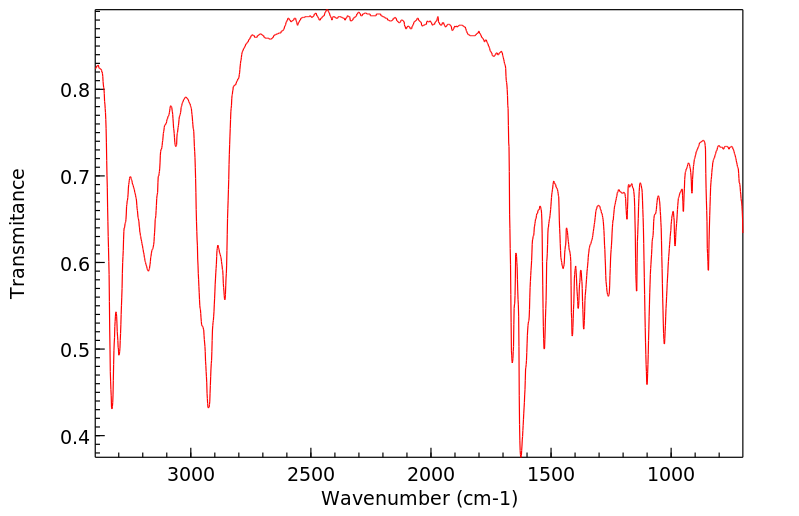
红外IR
-
拉曼Raman
-
峰位数据
-
峰位匹配
-
表征信息
同类化合物
(甲基3-(二甲基氨基)-2-苯基-2H-azirene-2-羧酸乙酯)
(±)-盐酸氯吡格雷
(±)-丙酰肉碱氯化物
(d(CH2)51,Tyr(Me)2,Arg8)-血管加压素
(S)-(+)-α-氨基-4-羧基-2-甲基苯乙酸
(S)-阿拉考特盐酸盐
(S)-赖诺普利-d5钠
(S)-2-氨基-5-氧代己酸,氢溴酸盐
(S)-2-[[[(1R,2R)-2-[[[3,5-双(叔丁基)-2-羟基苯基]亚甲基]氨基]环己基]硫脲基]-N-苄基-N,3,3-三甲基丁酰胺
(S)-2-[3-[(1R,2R)-2-(二丙基氨基)环己基]硫脲基]-N-异丙基-3,3-二甲基丁酰胺
(S)-1-(4-氨基氧基乙酰胺基苄基)乙二胺四乙酸
(S)-1-[N-[3-苯基-1-[(苯基甲氧基)羰基]丙基]-L-丙氨酰基]-L-脯氨酸
(R)-乙基N-甲酰基-N-(1-苯乙基)甘氨酸
(R)-丙酰肉碱-d3氯化物
(R)-4-N-Cbz-哌嗪-2-甲酸甲酯
(R)-3-氨基-2-苄基丙酸盐酸盐
(R)-1-(3-溴-2-甲基-1-氧丙基)-L-脯氨酸
(N-[(苄氧基)羰基]丙氨酰-N〜5〜-(diaminomethylidene)鸟氨酸)
(6-氯-2-吲哚基甲基)乙酰氨基丙二酸二乙酯
(4R)-N-亚硝基噻唑烷-4-羧酸
(3R)-1-噻-4-氮杂螺[4.4]壬烷-3-羧酸
(3-硝基-1H-1,2,4-三唑-1-基)乙酸乙酯
(2S,4R)-Boc-4-环己基-吡咯烷-2-羧酸
(2S,3S,5S)-2-氨基-3-羟基-1,6-二苯己烷-5-N-氨基甲酰基-L-缬氨酸
(2S,3S)-3-((S)-1-((1-(4-氟苯基)-1H-1,2,3-三唑-4-基)-甲基氨基)-1-氧-3-(噻唑-4-基)丙-2-基氨基甲酰基)-环氧乙烷-2-羧酸
(2S)-2,6-二氨基-N-[4-(5-氟-1,3-苯并噻唑-2-基)-2-甲基苯基]己酰胺二盐酸盐
(2S)-2-氨基-N,3,3-三甲基-N-(苯甲基)丁酰胺
(2S)-2-氨基-3-甲基-N-2-吡啶基丁酰胺
(2S)-2-氨基-3,3-二甲基-N-(苯基甲基)丁酰胺,
(2S)-2-氨基-3,3-二甲基-N-2-吡啶基丁酰胺
(2S,4R)-1-((S)-2-氨基-3,3-二甲基丁酰基)-4-羟基-N-(4-(4-甲基噻唑-5-基)苄基)吡咯烷-2-甲酰胺盐酸盐
(2R,3'S)苯那普利叔丁基酯d5
(2R)-2-氨基-3,3-二甲基-N-(苯甲基)丁酰胺
(2-氯丙烯基)草酰氯
(1S,3S,5S)-2-Boc-2-氮杂双环[3.1.0]己烷-3-羧酸
(1R,5R,6R)-5-(1-乙基丙氧基)-7-氧杂双环[4.1.0]庚-3-烯-3-羧酸乙基酯
(1R,4R,5S,6R)-4-氨基-2-氧杂双环[3.1.0]己烷-4,6-二羧酸
齐特巴坦
齐德巴坦钠盐
齐墩果-12-烯-28-酸,2,3-二羟基-,苯基甲基酯,(2a,3a)-
齐墩果-12-烯-28-酸,2,3-二羟基-,羧基甲基酯,(2a,3b)-(9CI)
黄酮-8-乙酸二甲氨基乙基酯
黄荧菌素
黄体生成激素释放激素(1-6)
黄体生成激素释放激素 (1-5) 酰肼
黄体瑞林
麦醇溶蛋白
麦角硫因
麦芽聚糖六乙酸酯
麦根酸
相关功能分类

联系我们


关注我们

公众号

