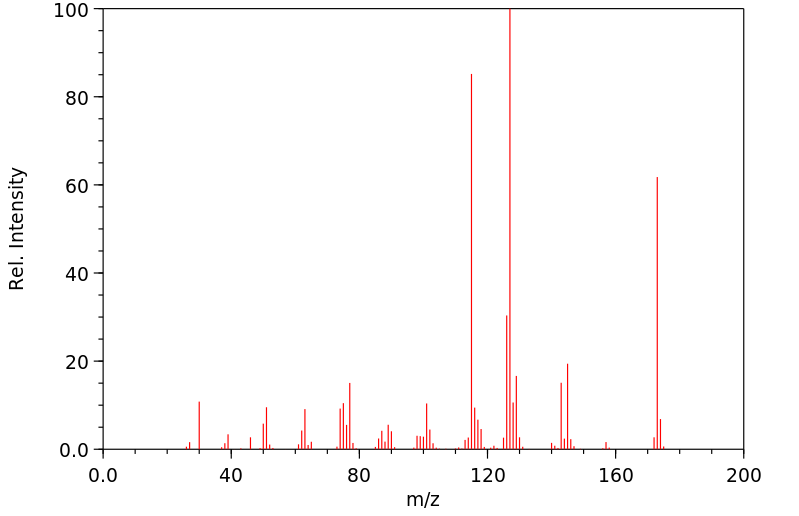
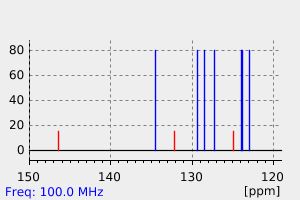
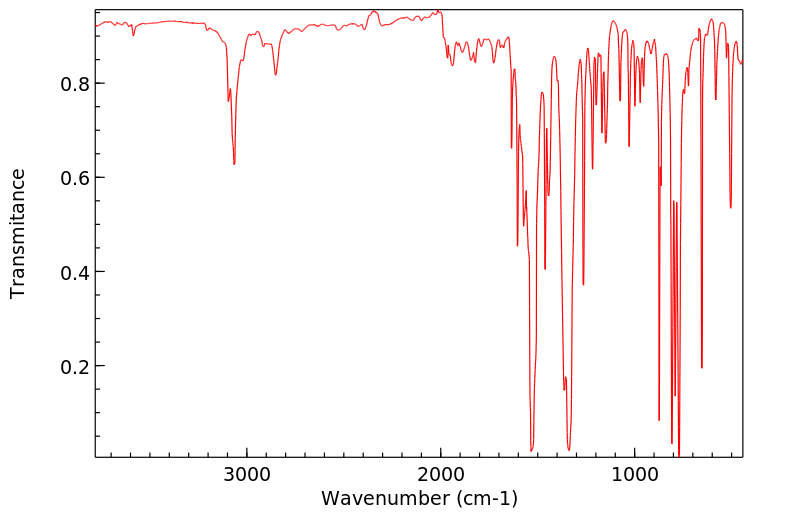
Nitronaphthalene appears as a yellow crystalline solid. Insoluble in water and denser than water. May irritate skin and eyes. Readily ignitable and may be difficult to extinguish once ignited. Used to make dyes and other chemicals.
颜色/状态:
Pale yellow needles
气味:
Odorless
闪点:
327 °F (NTP, 1992)
溶解度:
In water, 9.18 mg/l @ 25 °C
蒸汽密度:
5.96 (NTP, 1992) (Relative to Air)
蒸汽压力:
4.8X10⁻⁴ mm Hg @ 25 °C
亨利常数:
1.76e-06 atm-m3/mole
大气OH速率常数:
5.40e-12 cm3/molecule*sec
分解:
When heated to decomposition it emits toxic fumes of /nitrogen oxides/.
Incubation of 1-nitronaphthalene under anaerobic conditions with a postmitochondrial supernatant from the livers of male Fischer rats resulted in the stoichiometric formation of 1-naphthylamine. Under aerobic conditions, a rat liver metabolic system converted 1-nitronaphthalene into dihydrodiol and phenol metabolites.
N-Hydroxy-1-naphthylamine (which has been shown to induce tumors in experimental animals) has been detected as a metabolite of 1-nitronaphthalene in vitro.
1-Nitronaphthalene and its reactive products specifically targets the airway epithelium. Its toxicity is synergized by prior long-term ozone exposure. 1-NN appears to specifically target peroxiredoxin 6 and biliverdin reductase as well as the N-terminal region of calreticulin.
Evaluation: There is inadequate evidence for the carcinogenicity in experimental animals of 1-nitronaphthalene. No data were available from studies in humans on the carcinogenicity of 1-nitronaphthalene. Overall evaluation: 1-Nitronaphthalene is not classifiable as to its carcinogenicity to humans (Group 3).
After i.p. administration of (14)C1-NN (100 mg/kg; 60 microCi/kg) /to male Sprague Dawley rats/, 84% of the dose was eliminated in the urine and feces by 48 hr. At 96 hr, 60% of the dose was recovered in the urine, 32% in the feces, and 1% collectively in the tissues, blood, and gastrointestinal contents. The terminal phase rate constant (k(term)) of 1-NN was 0.21 hr(-1), the terminal phase half-life (T(1/2,term)) was 3.40 hr, and the systemic bioavailability was 0.67. When administered i.v. (10 mg/kg; 120 microCi/kg), 85% of the dose was eliminated in the urine and feces by 24 hr. At the end of the study (96 hr), 56% of the dose was recovered in the urine, 36% in the feces, and 1% collectively in the tissues, blood, and gastrointestinal contents. Interestingly, 88% of the dose was secreted into bile by 8 hr. The k(term) was 0.94 hr(-1) and the T(1/2,term) was 0.77 hr.
Lung and liver microsomes from male Swiss-Webster mice metabolized 1-nitronaphthalene to products that bound microsomal macromolecules. The binding was NADPH- and oxygen-dependent and was inhibited by carbon monoxide, nitrogen and SKF-525A. Little binding was detected with kidney microsomes. Pretreatment of the mice with beta-naphthoflavone enhanced the binding to lung microsomal macromolecules; phenobarbital pretreatment increased the binding to liver microsomes. Incubations were also conducted with lung slices and isolated lung cells. Autoradiographs of the lung slices showed that most of the binding occurred in the epithelial cells of the bronchioles and smaller airways. With the isolated lung cells, there was preferential binding of 1-nitronaphthalene to cell populations enriched in Clara cells. beta-Naphthoflavone pretreatment increased the binding of 1-nitronaphthalene in both the lung slices and isolated lung cells.
Microwave-Assisted Rapid and efficient Reduction of Aromatic Nitro Compounds to Amines with Propan-2-ol over Nanosized Perovskite-type SmFeO<sub>3</sub> powder as a New Recyclable Heterogeneous Catalyst
Nanosized perovskite-type SmFeO3 powder, prepared through the thermal decomposition of Sm[Fe(CN)6].4H2O with an average particle diameter of 28 nm and a specific surface area of 42 m2 g−1, was used as a recyclable heterogeneous catalyst for the efficient and selective reduction of aromatic nitro compounds into the corresponding amines by using propan-2-ol as a hydrogen donor (reducing agent) and KOH as a promoter under microwave irradiation. This highly regio- and chemoselective catalytic method is fast, clean, inexpensive, high yielding and also compatible with the substrates containing easily reducible functional groups. In addition, the nanosized SmFeO3 catalyst can be reused without loss of activity.
Reduction of aromatic nitro compounds to amines using zinc and aqueous chelating ethers: Mild and efficient method for zinc activation
作者:Pookot Kumar、Kuriya Lokanatha Rai
DOI:10.2478/s11696-012-0195-6
日期:2012.1.1
acts as a ligand and also serves as a co-solvent. Water is the proton source. This procedure is also a new method for the activation of zinc for electron transfer reduction of aromatic nitro compounds. The reduction is accomplished in a neutral medium and other reducing groups remained unaffected. The ethers used are dioxolane, 1,4-dioxane, ethoxymethoxyethane, dimethoxymethane, 1,2-dimethoxyethane,
Cyclic (Alkyl)(amino)carbene Ligand-Promoted Nitro Deoxygenative Hydroboration with Chromium Catalysis: Scope, Mechanism, and Applications
作者:Lixing Zhao、Chenyang Hu、Xuefeng Cong、Gongda Deng、Liu Leo Liu、Meiming Luo、Xiaoming Zeng
DOI:10.1021/jacs.0c12318
日期:2021.1.27
Transition metal catalysis that utilizes N-heterocycliccarbenes as noninnocent ligands in promoting transformations has not been well studied. We report here a cyclic (alkyl)(amino)carbene (CAAC) ligand-promoted nitro deoxygenative hydroboration with cost-effective chromium catalysis. Using 1 mol % of CAAC-Cr precatalyst, the addition of HBpin to nitro scaffolds leads to deoxygenation, allowing for
complexes supported with amide-phosphine based ligands. These complexes presented a pyridine-2,6-dicarboxamide based pincer cavity, decorated with hydrogen bonds, that participated in the binding of nitro-substrates closer to the Ru(II) centers, which is further supported with binding and docking studies. These ruthenium complexes functioned as the noteworthy catalysts for the borohydride mediated reduction
Base-free chemoselective transfer hydrogenation of nitroarenes to anilines with formic acid as hydrogen source by a reusable heterogeneous Pd/ZrP catalyst
作者:Jaya Tuteja、Shun Nishimura、Kohki Ebitani
DOI:10.1039/c4ra06174h
日期:——
transfer hydrogenation (CTH) of nitroarenes using FA as a hydrogensource. Various supported Pdcatalysts were examined for this transformation, and Pd supported ZrP (Pd/ZrP) proved to be the best catalyst for CTH of nitrobenzene. Applicability of the Pd/ZrPcatalyst is also explored for hydrogenation of various substituted nitroarenes. The Pd/ZrPcatalyst showed high specificity for hydrogenation of nitro