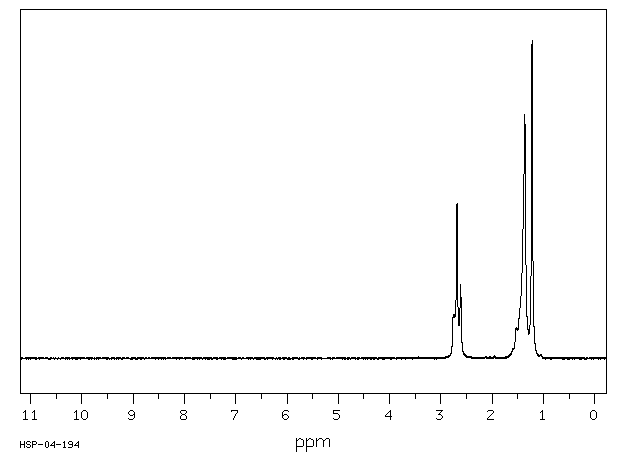
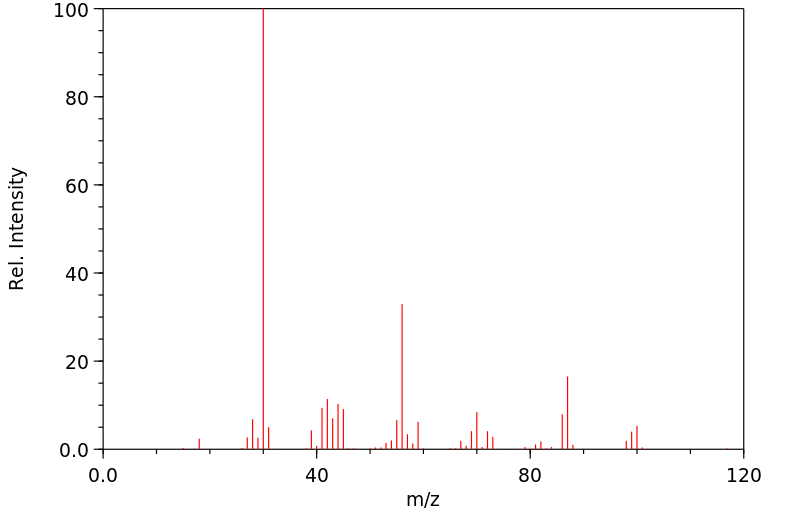
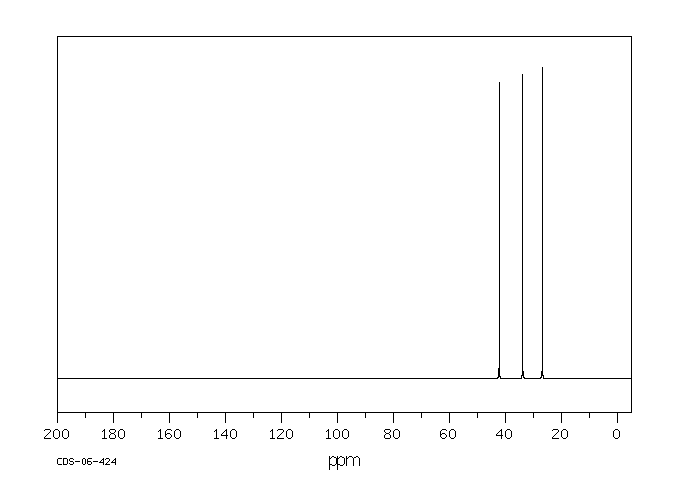
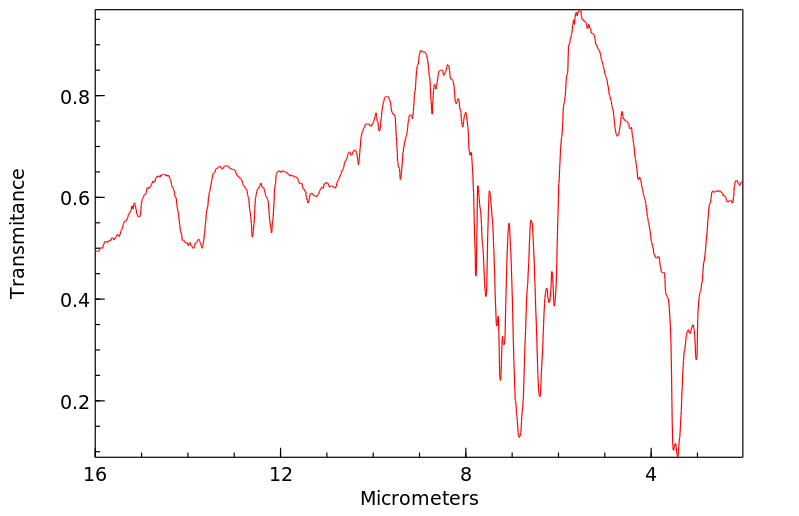
Hexamethylenediamine, solid is a colorless crystalline solid. It is soluble in water. It is corrosive to metals and tissue. Produces toxic oxides of nitrogen during combustion.
Following oral administration of (14)C-labeled 1,6-diaminohexane to male rats, approx 20% of the administered dose was recovered as (14)CO2 after 72 hr. Urinary and fecal excretion accounted for 47 and 27% of the administered radioactivity, respectively. Of several tissues examined, the highest concn of residual radioactivity were found in the prostate at 24 and 72 hr post-administration.
An isocyanate generation apparatus was developed and stable isocyanate atmospheres were obtained. At a concn of 5 ug 1,6-hexamethylene diisocyanate (HD) per cu m the precision was found to be 7% (n = 5). Three volunteers were each exposed to the different concn of HI (11.9, 20.5, and 22.1 micrograms/ cu m) and three concns of isophorone diisocyanate (IPDI) (12.1, 17.7, and 50.7 micrograms/cu m), in an exposure chamber. The duration of the exposure was 2 hr. Urine and blood samples were collected, and hydrolyzed under alkaline conditions to the HI and IPDI corresponding amines, 1,6-hexamethylene diamine (HDA) and isophorone diamine (IPDA), determined as their pentafluoropropionic anhydride amides (HDA-PFPA and IPDA-PFPA). The HDA- and IPDA-PFPA derivatives were analyzed using liquid chromatography mass spectrometry with thermospray monitoring negative ions. When working up samples from the exposed persons without hydrolysis, no HDA or IPDA was seen. The average urinary excretion of the corresponding amine was 39% for HI and 27% for IPDI . An association between the estimated inhaled dose and the total excreted amount was seen. The average urinary elimination half-time for HDA was 2.5 hr and for IPDA, 2.8 hr. The hydrolysis condition giving the highest yield of HDA and IPDA in urine was found to be hydrolysis wi the 3 M sodium hydroxide during 4 hr. No HDA or IPDA could be found in hydrolyzed plasma (< ca 0.1 micrograms/l) .
Provided are cyclic hydrocarbons of Formula I ##STR1## with an aminoalkyl sidechain that are useful for treating phospholipase A2 mediated conditions, diabetes, and obesity.
[EN] BICYCLYL-SUBSTITUTED ISOTHIAZOLINE COMPOUNDS<br/>[FR] COMPOSÉS ISOTHIAZOLINE SUBSTITUÉS PAR UN BICYCLYLE
申请人:BASF SE
公开号:WO2014206910A1
公开(公告)日:2014-12-31
The present invention relates to bicyclyl-substituted isothiazoline compounds of formula (I) wherein the variables are as defined in the claims and description. The compounds are useful for combating or controlling invertebrate pests, in particular arthropod pests and nematodes. The invention also relates to a method for controlling invertebrate pests by using these compounds and to plant propagation material and to an agricultural and a veterinary composition comprising said compounds.
The present invention relates to azoline compounds of formula (I) wherein A, B1, B2, B3, G1, G2, X1, R1, R3a, R3b, Rg1 and Rg2 are as defined in the claims and the description. The compounds are useful for combating or controlling invertebrate pests, in particular arthropod pests and nematodes. The invention also relates to a method for controlling invertebrate pests by using these compounds and to plant propagation material and to an agricultural and a veterinary composition comprising said compounds.
Synthesis and Biological Evaluation of the First Dual Tyrosyl-DNA Phosphodiesterase I (Tdp1)–Topoisomerase I (Top1) Inhibitors
作者:Trung Xuan Nguyen、Andrew Morrell、Martin Conda-Sheridan、Christophe Marchand、Keli Agama、Alun Bermingam、Andrew G. Stephen、Adel Chergui、Alena Naumova、Robert Fisher、Barry R. O’Keefe、Yves Pommier、Mark Cushman
DOI:10.1021/jm300335n
日期:2012.5.10
Substances with dualtyrosyl-DNAphosphodiesterase I–topoisomerase I inhibitory activity in one low molecular weight compound would constitute a unique class of anticancer agents that could potentially have significant advantages over drugs that work against the individual enzymes. The present study demonstrates the successful synthesis and evaluation of the firstdual Top1–Tdp1 inhibitors, which are based
Diamine Compound Having Phosphorylcholine Group, Polymer Thereof, and Process for Producing the Polymer
申请人:Nagase Yu
公开号:US20100036081A1
公开(公告)日:2010-02-11
Highly polymerizable diamine compounds having a phosphorylcholine group are disclosed. High-molecular weight polymers are obtained from the highly polymerizable diamine compound having a phosphorylcholine group as a monomer, and the polymers have improved mechanical strength, water resistance and heat resistance while maintaining excellent biocompatibility and processability of MPC polymers. Processes for producing the polymers are disclosed. The diamine compounds having a phosphorylcholine group are represented by Formula (I). The polymers contain at least 1 mol % of a specific structural unit with a phosphorylcholine group represented by Formula (II) and have a number average molecular weight of not less than 5,000. In the processes, the diamine compound is used as a monomer.