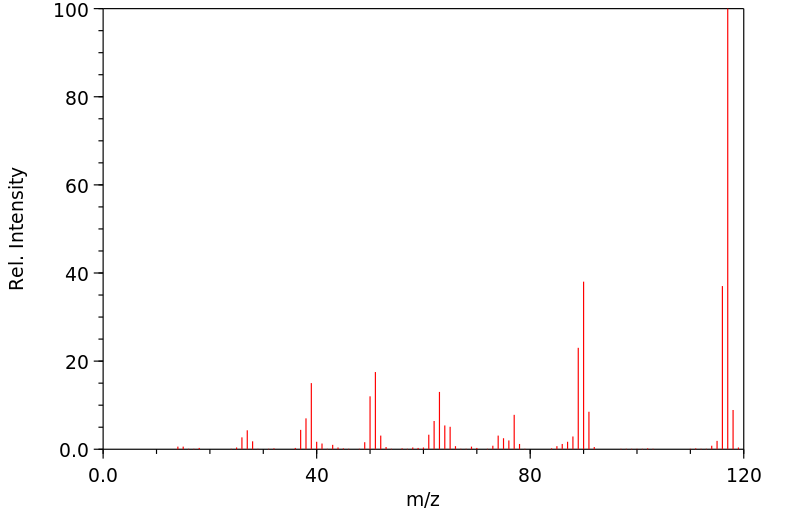
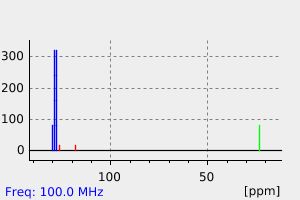
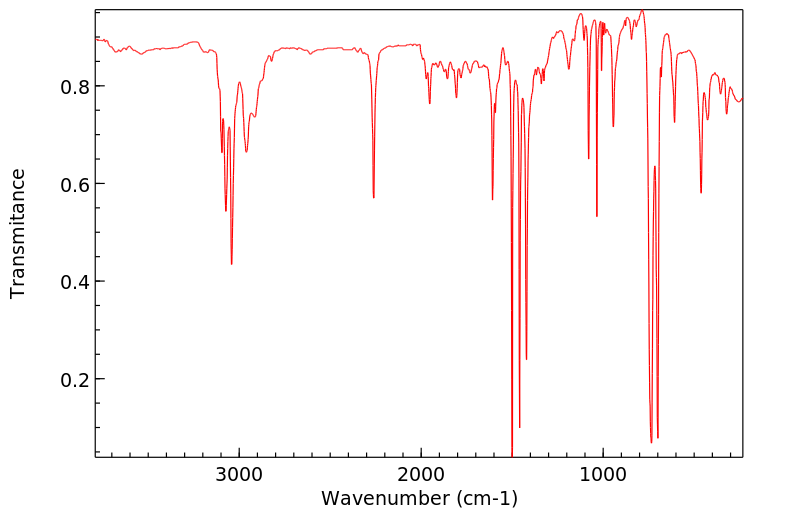
Groups of 3 male rats were administered once by gavage (58.6, 152.3, 210.9 mg/kg bw) and by ip injection (15.2, 22.3, 30..5 mg/kg bw). Cyanide was slowly liberated from the dosed nitrile and excreted as cyanide and thiocyanate... .
Benzyl cyanide is...metabolized into benzoic acid and thiocyanate, probably via hydroxylation to mandelonitrile. Hydrolysis of cyanide group to give phenylacetic acid...occurs as minor pathway.
Benzyl cyanide can be metabolized by rat nasal tissue enzymes to cyanide. However, the cyanide produced could be metabolized efficiently to the less toxic thiocyanate in the nasal cavity.
... Benzyl cyanide (150 mg/kg) administered orally to rats led to markedly increased urinary thiocyanate levels; for male rats this was equivalent to 54% of the dose and for females this was 65% over a period of 3 days. When adjusted for incomplete recoveries of the marker, thiocyanate, these values equated to 61 and 89%, respectively.
Organic nitriles decompose into cyanide ions both in vivo and in vitro. Consequently the primary mechanism of toxicity for organic nitriles is their production of toxic cyanide ions or hydrogen cyanide. Cyanide is an inhibitor of cytochrome c oxidase in the fourth complex of the electron transport chain (found in the membrane of the mitochondria of eukaryotic cells). It complexes with the ferric iron atom in this enzyme. The binding of cyanide to this cytochrome prevents transport of electrons from cytochrome c oxidase to oxygen. As a result, the electron transport chain is disrupted and the cell can no longer aerobically produce ATP for energy. Tissues that mainly depend on aerobic respiration, such as the central nervous system and the heart, are particularly affected. Cyanide is also known produce some of its toxic effects by binding to catalase, glutathione peroxidase, methemoglobin, hydroxocobalamin, phosphatase, tyrosinase, ascorbic acid oxidase, xanthine oxidase, succinic dehydrogenase, and Cu/Zn superoxide dismutase. Cyanide binds to the ferric ion of methemoglobin to form inactive cyanmethemoglobin. (L97)
来源:Toxin and Toxin Target Database (T3DB)
毒理性
致癌物分类
对人类无致癌性(未列入国际癌症研究机构IARC清单)。
No indication of carcinogenicity to humans (not listed by IARC).
Exposure to high levels of cyanide for a short time harms the brain and heart and can even cause coma, seizures, apnea, cardiac arrest and death. Chronic inhalation of cyanide causes breathing difficulties, chest pain, vomiting, blood changes, headaches, and enlargement of the thyroid gland. Skin contact with cyanide salts can irritate and produce sores. (L96, L97)
Cyanide poisoning is identified by rapid, deep breathing and shortness of breath, general weakness, giddiness, headaches, vertigo, confusion, convulsions/seizures and eventually loss of consciousness. (L96, L97)
1 H -2,1-苯并噻嗪-4(3 H)-1,2,2-二氧化物衍生 的2-氨基-3- R -4-芳基-4 H-吡喃多组分合成的特殊性†
摘要:
通过1的三组分相互作用合成了新的2-氨基-3- R -4-芳基-6-乙基-4,6-二氢吡喃并[3,2- c ] [2,1]苯并噻嗪5,5-二氧化物。H -2,1-苯并噻嗪-4(3 H)-1,2-二氧化物与芳基甲醛和活性亚甲基。根据活性亚甲基腈和芳基甲醛的性质,这种相互作用可以导致目标2-氨基-4 H-吡喃或双(1 H -2,1-苯并噻嗪-4(3 H)-一个2,2-二氧化物)(双加合物)。后者是这种交互的全新产品。通过单晶X射线衍射确认双加合物的结构。实际上,稳定的三乙铵盐的形成(与2-氨基-4 H-吡喃形成竞争的过程)似乎是可逆的,并且它们与活性亚甲基腈的相互作用导致2-氨基-4 H-吡喃形成。提出了包括双加合物形成阶段在内的三组分相互作用的扩展和调节机理。考虑到该机理的特殊性,我们能够控制反应的选择性。
Heterocyclic derivatives for the treatment of cancer and other proliferative diseases
申请人:——
公开号:US20020143182A1
公开(公告)日:2002-10-03
The invention relates to certain heterocyclic compounds useful for the treatment of cancer and other diseases, having the Formula (I):
1
wherein:
(a) m is an integer 0 or 1;
(b) R
12
is an alkyl, a substituted alkyl, a cycloalkyl, a substituted cycloalkyl, a heterocyclic, a substituted heterocyclic, a heteroaryl, a substituted heteroaryl, an aryl or a substituted aryl residue;
(c) Ar
3
is an aryl, a substituted aryl, a heteroaryl or a substituted heteroaryl residue;
(d) Ar
4
is an aryl, a substituted aryl, a heteroaryl or a substituted heteroaryl residue;
(e) R
5
is hydrogen, hydroxy, alkyl or substituted alkyl;
(f) - - - - - represents a bond present or absent; and
(g) W, X, Y and Z are independently or together C(O)—, C(S), S, O, or NH; or a pharmaceutically acceptable salt thereof.
Compositions for Treatment of Cystic Fibrosis and Other Chronic Diseases
申请人:Vertex Pharmaceuticals Incorporated
公开号:US20150231142A1
公开(公告)日:2015-08-20
The present invention relates to pharmaceutical compositions comprising an inhibitor of epithelial sodium channel activity in combination with at least one ABC Transporter modulator compound of Formula A, Formula B, Formula C, or Formula D. The invention also relates to pharmaceutical formulations thereof, and to methods of using such compositions in the treatment of CFTR mediated diseases, particularly cystic fibrosis using the pharmaceutical combination compositions.
Polystyrene-bound diaryl selenoxide and telluroxide have been prepared, which behaved as mild oxidizingagents for thiols to disulfides, phosphines to phosphine oxides, hydroquinone and catechol to p- and o-benzoquinones, and thioketones to oxo compounds. The telluroxide completed these reactions in shorter periods or under milder conditions than the selenoxide. In addition, they effected novel solvent-dependent
Tellurium tetraethoxide reacts with primary thioamides at room temperature, forming nitriles in high yields. On the other hand, the reactions with amides are largely temperature-dependent, giving predominantly esters at 80 °C and nitriles at a higher temperature. Similarly, tellurium tetraethoxide readily induces the C–N bond cleavage of ureas to give carbamates and amines.