接口广告
摩熵化学
数据开放平台 数据库官网
小程序
打开微信扫一扫
首页 分子通 化学资讯 化学百科 反应查询 关于我们
请输入关键词

正溴丁烷 | 109-65-9

中文名称
正溴丁烷
中文别名
1-溴丁烷;正丁基溴;溴正丁烷;溴代正丁烷;溴丁烷;n-溴丁烷;溴化正丁基;丁基溴;溴代丁烷
英文名称
1-bromo-butane
英文别名
n-Butylbromide;butyl bromide;n-bromobutane;bromobutane;n-butane bromide;bromo-n-butane;1-butyl bromide;1–bromobutane;1-bromo-n-butane;butane bromide;1-Bromobutane
正溴丁烷化学式
CAS
109-65-9
化学式
C4H9Br
mdl
MFCD00000260
分子量
137.019
InChiKey
MPPPKRYCTPRNTB-UHFFFAOYSA-N
BEILSTEIN
——
EINECS
——
  • 物化性质
  • 计算性质
  • ADMET
  • 安全信息
  • SDS
  • 制备方法与用途
  • 上下游信息
  • 反应信息
  • 文献信息
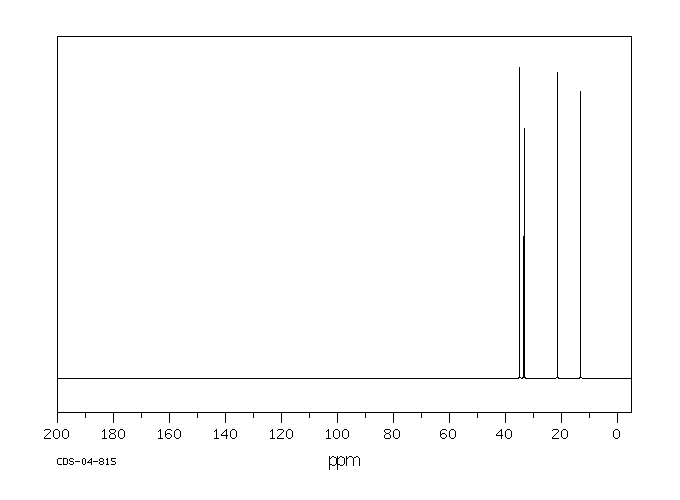
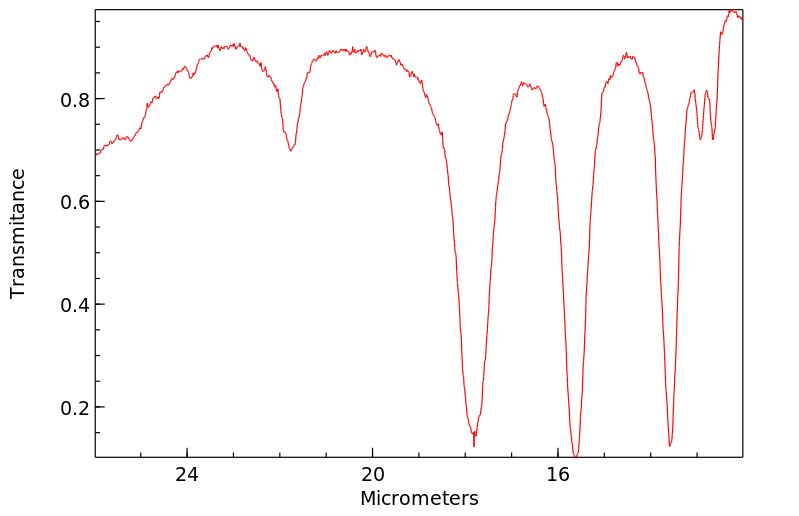
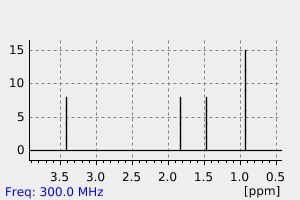
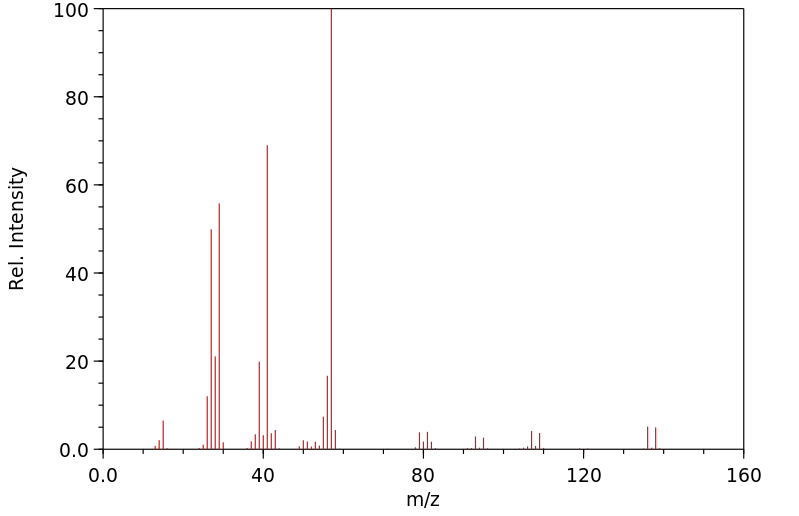
  • 表征谱图
  • 同类化合物
  • 相关功能分类
  • 相关结构分类

物化性质

  • 熔点:
    -112 °C
  • 沸点:
    100-104 °C(lit.)
  • 密度:
    1.276 g/mL at 25 °C(lit.)
  • 蒸气密度:
    4.7 (vs air)
  • 闪点:
    23 °C
  • 溶解度:
    0.6克/升
  • 介电常数:
    7.1600000000000001
  • LogP:
    2.75
  • 物理描述:
    1-bromobutane appears as a clear colorless liquid. Flash point 65°F. Denser than water and insoluble in water. Vapors heavier than air.
  • 颜色/状态:
    Colorless to pale straw-colored liquid
  • 蒸汽密度:
    4.72 (Air= 1)
  • 蒸汽压力:
    41.97 mm Hg at 25 °C
  • 大气OH速率常数:
    2.50e-12 cm3/molecule*sec
  • 自燃温度:
    509 °F (265 °C)
  • 粘度:
    0.606 mPa-sec at 25 °C
  • 汽化热:
    36.64 kJ/mol at 25 °C
  • 表面张力:
    25.90 mN/m at 25 °C
  • 折光率:
    Index of refraction = 1.4398 at 20 °C/D
  • 保留指数:
    719;701.9;703.5;703.6;705.4;706.9;710;712.2;711;717;719;717.4
  • 稳定性/保质期:
    1. 稳定性:稳定。

    2. 禁配物:强氧化剂、强碱、

    3. 应避免接触的条件:受热。

    4. 聚合危害:不聚合。

    5. 分解产物:溴化氢

计算性质

  • 辛醇/水分配系数(LogP):
    2.8
  • 重原子数:
    5
  • 可旋转键数:
    2
  • 环数:
    0.0
  • sp3杂化的碳原子比例:
    1.0
  • 拓扑面积:
    0
  • 氢给体数:
    0
  • 氢受体数:
    0

ADMET

代谢
在用化烃类化合物处理后,研究了肝脏中无机解作用。白鼠通过吸入浓度为0.75-25毫摩尔/毫升的化正丁烷,持续多达60分钟。吸入饱和化烃(包括正丁基化物)的动物肝脏中无机化物的浓度高于吸入不饱和化合物的动物。饱和化合物的解程度也比不饱和化合物高。因此,得出结论,肝脏组织损伤很可能是直接由化烃类化合物引起的,而不是由氢溴酸引起的,因为这种酸在解过程中释放得非常缓慢。
The hydrolysis of inorganic bromine in the liver following treatment with brominated hydrocarbons was studied. White-mice were administered ...n-butyl-bromide by inhalation in concentrations of 0.75-25 mmol/mL for up to 60 minutes. ...Concentrations of inorganic bromide in the liver were higher in animals that inhaled saturated, brominated hydrocarbons /(including n-butyl bromide)/ than in those that inhaled the unsaturated compounds. The degree of hydrolysis was also higher with the saturated compounds than with the unsaturated compounds. /It was concluded/ that liver tissue damage is probably caused directly by the brominated hydrocarbons rather than by hydrobromic-acid since this acid is released very slowly during hydrolysis.
来源:Hazardous Substances Data Bank (HSDB)
代谢
兔子和老鼠在服用1-丁烷后,除了排出丁基尿酸外,还会排出(2-羟基丁基)尿酸、(3-羟基丁基)尿酸和3-(丁基代)乳酸。尽管两种动物都会排出羟基丁基尿酸,但兔子只会排出少量的2-异构体。3-异构体已经从兔子尿液中分离出来,作为二环己基铵盐。3-(丁基代)乳酸在兔子体内形成更为容易;老鼠只会排出少量。在老鼠尿液中发现了丁基尿酸的亚砜,但在兔子尿液中没有发现。在兔子体内大约有14%,在老鼠体内大约有22%的1-丁烷剂量以羟基尿酸的形式排出。将大鼠肝脏切片与S-丁基半胱酸或丁基尿酸一起孵化,会形成(2-羟基丁基)尿酸和(3-羟基丁基)尿酸,但只有3-羟基酸是由兔肝切片形成的。给大鼠服用1-丁烷后,S-丁基谷胱甘肽、S-丁基半胱酰甘酸和S-丁基半胱酸会通过胆汁排出。兔子和老鼠在服用1,2-环氧丁烷后,分别排出约4%和11%剂量的(2-羟基丁基)尿酸。已经合成了以下物质:N-乙酰-S-(2-羟基丁基)-L-半胱氨酸[(2-羟基丁基)尿酸]和N-乙酰-S-(3-羟基丁基)-L-半胱氨酸[(3-羟基丁基)尿酸],作为二环己基铵盐,N-对甲苯磺酰-S-(2-羟基丁基)-L-半胱氨酸、S-丁基谷胱甘肽和N-乙酰-S-丁基半胱酰甘乙酯
Rabbits and rats dosed with 1-bromobutane excrete in urine, in addition to butylmercapturic acid, (2-hydroxybutyl)mercapturic acid, (3-hydroxybutyl)mercapturic acid and 3-(butylthio)lactic acid. Although both species excrete both the hydroxybutylmercapturic acids, only traces of the 2-isomer are excreted by the rabbit. The 3-isomer has been isolated from rabbit urine as the dicyclohexylammonium salt. 3-(Butylthio)lactic acid is formed more readily in the rabbit; only traces are excreted by the rat. Traces of the sulphoxide of butylmercapturic acid have been found in rat urine but not in rabbit urine. In the rabbit about 14% and in the rat about 22% of the dose of 1-bromobutane is excreted in the form of the hydroxymercapturic acids. Slices of rat liver incubated with S-butylcysteine or butylmercapturic acid form both (2-hydroxybutyl)mercapturic acid and (3-hydroxybutyl)mercapturic acid, but only the 3-hydroxy acid is formed by slices of rabbit liver. S-Butylglutathione, S-butylcysteinylglycine and S-butylcysteine are excreted in bile by rats dosed with 1-bromobutane. Rabbits and rats dosed with 1,2-epoxybutane excrete (2-hydroxybutyl)mercapturic acid to the extent of about 4% and 11% of the dose respectively. The following have been synthesized: N-acetyl-S-(2-hydroxybutyl)-l-cysteine [(2-hydroxybutyl)mercapturic acid] and N-acetyl-S-(3-hydroxybutyl)-l-cysteine [(3-hydroxybutyl)mercapturic acid] isolated as dicyclohexylammonium salts, N-toluene-p-sulphonyl-S-(2-hydroxybutyl)-l-cysteine, S-butylglutathione and N-acetyl-S-butylcysteinyl-glycine ethyl ester.
来源:Hazardous Substances Data Bank (HSDB)
代谢
兔子和老鼠在服用1-丁烷后,除了排出丁基尿酸外,还会排出(2-羟基丁基)尿酸、(3-羟基丁基)尿酸和3-(丁基代)乳酸。在大约14%的兔子和大约22%的老鼠中,1-丁烷的剂量以羟基尿酸的形式排出。1-丁烷还会形成谷胱甘肽结合物。在小鼠口服375-1500毫克/千克的化合物后,肝脏中已经鉴定出三种GSH结合物,包括S-丁基GSH、S-丁基半胱酸和(羟基丁基)尿酸
Rabbits and rats dosed with 1-bromobutane excrete in urine, in addition to butylmercapturic acid, (2-hydroxybutyl)mercapturic acid, (3-hydroxybutyl)mercapturic acid and 3-(butylthio)lactic acid. In the rabbit about 14% and in the rat about 22% of the dose of 1-bromobutane is excreted in the form of the hydroxymercapturic acids. 1-bromobutane also forms glutathione conjugates. Three kinds of GSH conjugates, including S-butyl GSH, S-butyl cysteine, and (hydroxybutyl)mercapturic acid, have been identified in mice livers after oral dosing with 375-1500 mg/kg of the compound.
来源:Toxin and Toxin Target Database (T3DB)
毒理性
  • 毒性总结
1-丁烷与肝脏谷胱甘肽(GSH)迅速反应,导致其快速耗竭。这可能导致肝脏损伤,并已显示会增加血清丙酸转酶和天冬氨酸酶的平。肝脏中巴比妥酸反应物质的含量也可能显著增加。脾脏GSH平也可能会因为单次1-丁烷治疗而显著降低。在处理后6小时,脾脏中检测到S-丁基GSH结合物。口服1-丁烷显著抑制了对T依赖性抗原的抗体反应和脾细胞内白介素-2的产生。
1-bromobutane reacts quickly with hepatic glutathione (GSH) leading to its rapid depletion. This can cause liver damage and has been shown to increase serum levels of alanine aminotransferase and aspartate aminotransferase. Hepatic contents of thiobarbituric acid reactive substances can also be significantly increased. Splenic GSH levels can also be significantly reduced by single treatment with 1-bromobutane. S-Butyl GSH conjugates were detected in spleen from 6 hr after treatment. Oral 1-bromobutane significantly suppressed the antibody response to a T-dependent antigen and the production of splenic intracellular interlukin-2.
来源:Toxin and Toxin Target Database (T3DB)
毒理性
  • 致癌物分类
对人类不具有致癌性(未被国际癌症研究机构IARC列名)。
No indication of carcinogenicity to humans (not listed by IARC).
来源:Toxin and Toxin Target Database (T3DB)
毒理性
  • 健康影响
肝脏毒性,口服摄入时具有免疫毒性。长期暴露/慢性接触可能导致肺损伤和粘膜损伤。可能引起皮肤和眼睛刺激。不是致癌物,也不是致突变物,也不是致畸物。
Hepatoxic, immunotoxic when ingested orally. Can cause lung damage and mucous membranes over extended periods/chronic exposures. Can cause skin and eye irritation. Not a carcinogen nor a mutagen nor a teratogen.
来源:Toxin and Toxin Target Database (T3DB)
毒理性
  • 暴露途径
口服(L626);吸入(L626);皮肤给药(L626)
Oral (L626) ; inhalation (L626) ; dermal (L626)
来源:Toxin and Toxin Target Database (T3DB)
毒理性
  • 症状
皮肤接触会导致皮肤刺激,皮肤和眼睛发红和瘙痒。急性暴露可能导致咳嗽、呼吸急促、头痛、恶心和呕吐。
Skin irritation if contacts skin, redness and itching of skin and eyes. Acute exposure may lead to coughing, shortness of breath, headache, nausea, vomiting
来源:Toxin and Toxin Target Database (T3DB)
吸收、分配和排泄
n-丁基经口服(在LD50剂量下)主要沉积在大脑、肝脏和肾周细胞系统中,主要通过肺部排出。
/n-Butyl bromide administered orally (at the LD50) was deposited mainly in the brain, liver, and perirenal cellular system, and excreted primarily by the lungs./
来源:Hazardous Substances Data Bank (HSDB)
安全信息

  • TSCA:
    Yes
  • 危险等级:
    3
  • 危险品标志:
    Xi
  • 安全说明:
    S16,S26,S37/39,S60
  • 危险类别码:
    R10,R36/37/38
  • WGK Germany:
    2
  • 海关编码:
    2903399090
  • 危险品运输编号:
    UN 1126 3/PG 2
  • 危险类别:
    3
  • RTECS号:
    EJ6225000
  • 包装等级:
    II
  • 储存条件:
    储存注意事项: - 储存在阴凉、通风良好的库房中。 - 远离火源和热源,库温不宜超过37℃。 - 保持容器密封。 - 应与氧化剂、碱类及活性金属粉末等分开存放,切忌混储。 - 使用防爆型照明和通风设施。 - 禁止使用能产生火花的机械设备和工具。 - 储存区域应配备泄漏应急处理设备和合适的收容材料。

SDS

SDS:f24f98df299d1ca79420eb3fb87f5eaf
查看
第一部分:化学品名称

制备方法与用途

丁烷简介

丁烷是一种重要的精细化工产品,主要用于有机合成中作为烷基化剂。它还是杀菌剂二甲嘧酚乙嘧酚的中间体,并用于生产有机膦化合物三丁基膦、相转移催化剂四正丁基溴化铵及表面活性剂。此外,丁烷也可用作溶剂、稀有元素萃取剂,并作为合成农药、医药、染料香料的原料,还可以作为制冷剂和溶剂。

化学性质

丁烷为无色透明具有芳香味的液体,熔点为-112℃,沸点在100~104℃之间,折射率(20℃)为1.4390,相对密度为1.276。其沸点约为75℉(23℃),不溶于,但能溶解于醇、醚和氯仿等有机溶剂。

用途 生产方法

丁烷可以由正丁醇在红存在下与作用制得;或者在硫酸存在的条件下,通过正丁醇氢溴酸反应获得。具体步骤为将正丁醇氢溴酸混合后滴加入硫酸中,加热回流1.5小时,进行蒸馏以获取粗品,再用洗至pH值为6-7,并用无水氯化钙即得成品。

另一种生产方法是将正丁醇溴化钠硫酸搅拌均匀,加热回流3小时,蒸出粗品丁烷后进行洗涤及处理,最终通过蒸馏获得成品。反应方程式为:[ \text{CH}_3\text{CH}_2\text{CH}_2\text{CH}_2\text{OH} + \text{NaBr} + \text{H}_2\text{SO}_4 \rightarrow \text{CH}_3\text{CH}_2\text{CH}_2\text{CH}_2\text{Br} + \text{Na}_2\text{SO}_4 + \text{H}_2\text{O} ]

分类
  • 易燃液体
  • 毒性分级:中毒
    • 急性毒性腹腔-大鼠 LD50: 4450毫克/公斤;腹腔-小鼠 LD50: 1424毫克/公斤
  • 爆炸物危险特性:与空气混合可爆
  • 可燃性危险特性:遇明火、高温、氧化剂易燃,高热分解有毒化物气体
储运及灭火
  • 库房应通风、低温干燥,并与氧化剂分开存放。
  • 灭火剂:干粉、干砂、二氧化碳、泡沫、1211灭火剂

上下游信息

  • 上游原料
    中文名称 英文名称 CAS号 化学式 分子量
  • 下游产品
    中文名称 英文名称 CAS号 化学式 分子量

反应信息

  • 作为反应物:
    描述:
    正溴丁烷硫脲 作用下, 以 乙醇 为溶剂, 生成 丁硫醇
    参考文献:
    名称:
    一锅合成8烷基巯基咖啡因衍生物的两步三组分法†
    摘要:
    已经描述了一种高效,无味,两步三组分法,用于一锅合成一些8-烷基巯基咖啡因衍生物。烷基溴,硫脲和8-溴咖啡因的无催化剂三组分反应以优异的定量收率得到了8-烷基巯基咖啡因产物。此外,还讨论了参数对样品反应的影响。
    DOI:
    10.1039/c6ra17814f
  • 作为产物:
    描述:
    乙酸丁酯 在 bismuth(III) bromide 三甲基溴硅烷 作用下, 以 neat (no solvent) 为溶剂, 反应 2.25h, 以90%的产率得到正溴丁烷
    参考文献:
    名称:
    Labrouillere, Mireille; Roux, Christophe Le; Oussaid, Abdelouahad, Bulletin de la Societe Chimique de France, 1995, vol. 132, p. 522 - 530