


2-联苯基甲醇 | 2928-43-0
中文名称
2-联苯基甲醇
中文别名
2-苯基苄醇;2-羟甲基联苯;2-联苯甲醇
英文名称
2-biphenylmethanol
英文别名
o-phenylbenzyl alcohol;2-phenylbenzyl alcohol;(2-phenylphenyl)methanol

CAS
2928-43-0
化学式
C13H12O
mdl
MFCD00004620
分子量
184.238
InChiKey
VKTQADPEPIVMHK-UHFFFAOYSA-N
BEILSTEIN
——
EINECS
——
-
物化性质
-
计算性质
-
ADMET
-
安全信息
-
SDS
-
制备方法与用途
-
上下游信息
-
文献信息
-
表征谱图
-
同类化合物
-
相关功能分类
-
相关结构分类
物化性质
-
熔点:46-48 °C (lit.)
-
沸点:96 °C/0.04 mmHg (lit.)
-
密度:1.0120 (rough estimate)
-
闪点:>230 °F
-
溶解度:可溶于氯仿(少许)、甲醇(少许)
-
稳定性/保质期:
遵照规定使用和储存,则不会分解。
计算性质
-
辛醇/水分配系数(LogP):2.7
-
重原子数:14
-
可旋转键数:2
-
环数:2.0
-
sp3杂化的碳原子比例:0.076
-
拓扑面积:20.2
-
氢给体数:1
-
氢受体数:1
安全信息
-
危险品标志:Xn
-
安全说明:S22,S24/25
-
危险类别码:R20/21/22
-
WGK Germany:3
-
海关编码:2906299090
-
危险性防范说明:P280,P305+P351+P338
-
危险性描述:H302
-
储存条件:存放于阴凉干燥处
SDS

| Name: | 2-Biphenylmethanol 98% Material Safety Data Sheet |
| Synonym: | None |
| CAS: | 2928-43-0 |
Synonym:None
Section 2 - COMPOSITION, INFORMATION ON INGREDIENTS
| CAS# | Chemical Name | content | EINECS# |
| 2928-43-0 | 2-biphenylmethanol | 98.0 | 220-892-7 |
Risk Phrases: None Listed.
Section 3 - HAZARDS IDENTIFICATION
EMERGENCY OVERVIEW
The toxicological properties of this material have not been fully investigated.
Potential Health Effects
Eye:
May cause eye irritation.
Skin:
May cause skin irritation.
Ingestion:
May cause irritation of the digestive tract. The toxicological properties of this substance have not been fully investigated.
Inhalation:
May cause respiratory tract irritation. The toxicological properties of this substance have not been fully investigated.
Chronic:
No information found.
Section 4 - FIRST AID MEASURES
Eyes: Flush eyes with plenty of water for at least 15 minutes, occasionally lifting the upper and lower eyelids. Get medical aid immediately.
Skin:
Get medical aid. Flush skin with plenty of water for at least 15 minutes while removing contaminated clothing and shoes. Wash clothing before reuse.
Ingestion:
If victim is conscious and alert, give 2-4 cupfuls of milk or water.
Never give anything by mouth to an unconscious person. Get medical aid immediately.
Inhalation:
Remove from exposure and move to fresh air immediately. If not breathing, give artificial respiration. If breathing is difficult, give oxygen. Get medical aid.
Notes to Physician:
Antidote: None reported.
Section 5 - FIRE FIGHTING MEASURES
General Information:
As in any fire, wear a self-contained breathing apparatus in pressure-demand, MSHA/NIOSH (approved or equivalent), and full protective gear. During a fire, irritating and highly toxic gases may be generated by thermal decomposition or combustion.
Extinguishing Media:
Use water spray, dry chemical, carbon dioxide, or appropriate foam.
Section 6 - ACCIDENTAL RELEASE MEASURES
General Information: Use proper personal protective equipment as indicated in Section 8.
Spills/Leaks:
Clean up spills immediately, observing precautions in the Protective Equipment section. Sweep up or absorb material, then place into a suitable clean, dry, closed container for disposal. Avoid generating dusty conditions. Provide ventilation.
Section 7 - HANDLING and STORAGE
Handling:
Wash thoroughly after handling. Remove contaminated clothing and wash before reuse. Use with adequate ventilation. Minimize dust generation and accumulation. Avoid contact with eyes, skin, and clothing. Keep container tightly closed. Avoid ingestion and inhalation.
Storage:
Keep container closed when not in use. Store in a tightly closed container. Store in a cool, dry, well-ventilated area away from incompatible substances.
Section 8 - EXPOSURE CONTROLS, PERSONAL PROTECTION
Engineering Controls:
Use adequate ventilation to keep airborne concentrations low.
Exposure Limits CAS# 2928-43-0: Personal Protective Equipment Eyes: Wear appropriate protective eyeglasses or chemical safety goggles as described by OSHA's eye and face protection regulations in 29 CFR 1910.133 or European Standard EN166.
Skin:
Wear appropriate protective gloves to prevent skin exposure.
Clothing:
Wear appropriate protective clothing to prevent skin exposure.
Respirators:
Follow the OSHA respirator regulations found in 29 CFR 1910.134 or European Standard EN 149. Use a NIOSH/MSHA or European Standard EN 149 approved respirator if exposure limits are exceeded or if irritation or other symptoms are experienced.
Section 9 - PHYSICAL AND CHEMICAL PROPERTIES
Physical State: Crystalline powder
Color: white
Odor: Not available.
pH: Not available.
Vapor Pressure: Not available.
Viscosity: Not available.
Boiling Point: 96 deg C @ .04mm Hg
Freezing/Melting Point: 46.00 - 48.00 deg C
Autoignition Temperature: Not available.
Flash Point: > 112 deg C (> 233.60 deg F)
Explosion Limits, lower: N/A
Explosion Limits, upper: N/A
Decomposition Temperature:
Solubility in water:
Specific Gravity/Density:
Molecular Formula: C13H12O
Molecular Weight: 184.24
Section 10 - STABILITY AND REACTIVITY
Chemical Stability:
Stable under normal temperatures and pressures.
Conditions to Avoid:
Incompatible materials, dust generation, strong oxidants.
Incompatibilities with Other Materials:
Oxidizing agents, acids, acid chlorides, acid anhydrides.
Hazardous Decomposition Products:
Irritating and toxic fumes and gases.
Hazardous Polymerization: Has not been reported
Section 11 - TOXICOLOGICAL INFORMATION
RTECS#:
CAS# 2928-43-0 unlisted.
LD50/LC50:
Not available.
Carcinogenicity:
2-biphenylmethanol - Not listed by ACGIH, IARC, or NTP.
Section 12 - ECOLOGICAL INFORMATION
Other No information available.
Section 13 - DISPOSAL CONSIDERATIONS
Dispose of in a manner consistent with federal, state, and local regulations.
Section 14 - TRANSPORT INFORMATION
IATA
Not regulated as a hazardous material.
IMO
Not regulated as a hazardous material.
RID/ADR
Not regulated as a hazardous material.
Section 15 - REGULATORY INFORMATION
European/International Regulations
European Labeling in Accordance with EC Directives
Hazard Symbols: Not available.
Risk Phrases:
Safety Phrases:
S 24/25 Avoid contact with skin and eyes.
S 28A After contact with skin, wash immediately with
plenty of water.
S 37 Wear suitable gloves.
S 45 In case of accident or if you feel unwell, seek
medical advice immediately (show the label where
possible).
WGK (Water Danger/Protection)
CAS# 2928-43-0: No information available.
Canada
None of the chemicals in this product are listed on the DSL/NDSL list.
CAS# 2928-43-0 is not listed on Canada's Ingredient Disclosure List.
US FEDERAL
TSCA
CAS# 2928-43-0 is not listed on the TSCA inventory.
It is for research and development use only.
SECTION 16 - ADDITIONAL INFORMATION
N/A
上下游信息
-
上游原料
中文名称 英文名称 CAS号 化学式 分子量 2-(p-氯苯氧基)-2-甲基丙酸盐二异丙基铵 2-methylbiphenyl 643-58-3 C13H12 168.238 二氢-3-(异十二碳烯基)呋喃-2,5-二酮 2-Biphenylcarboxylic acid 947-84-2 C13H10O2 198.221 甲基2-联苯羧酸酯 biphenyl-2-carboxylic acid methyl ester 16605-99-5 C14H12O2 212.248 —— 2-phenylbenzyl trifluoroacetate 1598409-40-5 C15H11F3O2 280.246 联苯-2-甲醛 2-Phenylbenzaldehyde 1203-68-5 C13H10O 182.222 2-氰基联苯 biphenyl-2-carbonitrile 24973-49-7 C13H9N 179.221 2-苯基溴化甲基苯 2-phenylbenzyl bromide 19853-09-9 C13H11Br 247.134 2-苯基苯甲酸乙酯 2-phenylbenzoic acid ethyl ester 19926-49-9 C15H14O2 226.275 2-(氯甲基)联苯 2-phenylbenzyl chloride 38580-83-5 C13H11Cl 202.683 2-苯基苄胺 2-phenylbenzylamine 1924-77-2 C13H13N 183.253 -
下游产品
中文名称 英文名称 CAS号 化学式 分子量 —— 2-(methoxymethyl)biphenyl 92495-58-4 C14H14O 198.265 2-(p-氯苯氧基)-2-甲基丙酸盐二异丙基铵 2-methylbiphenyl 643-58-3 C13H12 168.238 —— 2-phenylbenzyl acetate 19853-16-8 C15H14O2 226.275 —— biphenyl-2-ylmethyl methanesulfonate 862420-19-7 C14H14O3S 262.329 3-联苯甲醇 3-phenyl-benzyl alcohol 69605-90-9 C13H12O 184.238 —— 2-phenylbenzyl trifluoroacetate 1598409-40-5 C15H11F3O2 280.246 —— (biphenyl-2-yl)methanethiol 860589-80-6 C13H12S 200.304 —— 2-Iminomethyl-biphenyl —— C13H11N 181.237 联苯-2-甲醛 2-Phenylbenzaldehyde 1203-68-5 C13H10O 182.222 2-苯基溴化甲基苯 2-phenylbenzyl bromide 19853-09-9 C13H11Br 247.134 邻乙炔基联苯 2-ethynyl-1,1'-biphenyl 52889-62-0 C14H10 178.233 2-(氯甲基)联苯 2-phenylbenzyl chloride 38580-83-5 C13H11Cl 202.683 —— 4-(2-phenylbenzyloxy)benzoic acid 179487-62-8 C20H16O3 304.345 苄基[1,1'-联苯基]-2-羧酸酯 benzyl [1,1'-biphenyl]-2-carboxylate 67460-13-3 C20H16O2 288.346 —— methyl 4-([{1,1’-biphenyl}-2-yl]methoxy)benzoate 179487-59-3 C21H18O3 318.372 —— α-(4'-chlorophenyl)biphenyl-2-methanol 113769-85-0 C19H15ClO 294.78 —— (2-biphenyl)diazomethane 84648-87-3 C13H10N2 194.236 2-联苯乙腈 2-(biphenyl-2-yl)acetonitrile 19853-10-2 C14H11N 193.248 —— 2-(prop-2-yn-1-yl)-1,1'-biphenyl 73234-90-9 C15H12 192.26 2-联苯基-2-萘基甲醇 2-biphenyl-2-naphthylmethanol 1008533-18-3 C23H18O 310.395 - 1
- 2
反应信息
-
作为反应物:参考文献:名称:Visible light mediated oxidative lactonization of 2-methyl-1,1′-biaryls for the synthesis of benzocoumarins摘要:开发了一种可见光介导的2-甲基-1,1'-联苯基C-H内酯化反应,以氧氧化剂为氧化剂,产率较高地生成苯并香豆素。DOI:10.1039/c9ob00529c
-
作为产物:描述:参考文献:名称:通过Ru(II)催化的[3 + 2]环空和分子内Friedel-Crafts环化一锅法合成多取代的螺芴-茚摘要:Ru(II)通过[3 + 2]环化催化一锅法合成多取代的螺芴-茚,然后实现了分子内Friedel-Crafts烷基化。这种简单的方法提供了广泛的芳基酮和内部炔烃,以中等到良好的产率获得了PAHs骨架。DOI:10.1021/acs.joc.5b01517
文献信息
-
A Bifunctional Copper Catalyst Enables Ester Reduction with H<sub>2</sub>: Expanding the Reactivity Space of Nucleophilic Copper Hydrides作者:Birte M. Zimmermann、Trung Tran Ngoc、Dimitrios-Ioannis Tzaras、Trinadh Kaicharla、Johannes F. TeichertDOI:10.1021/jacs.1c09626日期:2021.10.13activation of esters through hydrogen bonding and formation of nucleophilic copper(I) hydrides from H2, resulting in a catalytic hydride transfer to esters. The reduction step is further facilitated by a proton shuttle mediated by the guanidinium subunit. This bifunctional approach to ester reductions for the first time shifts the reactivity of generally considered “soft” copper(I) hydrides to previously
-
Biaryl-methanethio-, -sulphinyl- and sulphonyl derivatives申请人:CEPHALON, INC.公开号:EP1586559A1公开(公告)日:2005-10-19FIELD OF THE INVENTION The present invention is related to chemical compositions, processes for the preparation thereof and uses of the composition. Particularly, the present invention relates to compositions that include substituted biaryl-methanesulfinyl acetamides of Formula (I): wherein Ar, Y, R1, R2, R4, R5, q and x are as defined herein; and their use in the treatment of diseases, including treatment of sleepiness associated with narcolepsy, obstructive sleep apnea, or shift work disorder; Parkinson's disease; Alzheimer's disease; attention deficit disorder; attention deficit hyperactivity disorder; depression; or fatigue associated with a neurological disease; as well as the promotion of wakefulness.
-
Water-soluble palladacycles containing hydroxymethyl groups: synthesis, crystal structures and use as catalysts for amination and Suzuki coupling of reactions作者:Xin Han、Hong-Mei Li、Chen Xu、Zhi-Qiang Xiao、Zhi-Qiang Wang、Wei-Jun Fu、Xin-Qi Hao、Mao-Ping SongDOI:10.1007/s11243-016-0036-5日期:2016.52-dicyclohexylphosphino-2′,6′-dimethoxybiphenyl(Sphos)]-palladacycles containing hydroxymethyl groups 2–3 were prepared by cyclopalladation and chloride bridge-splitting reactions. The complexes were characterized by elemental analysis, ESI–MS and NMR. In addition, single-crystal X-ray analysis reveals that they have one-dimensional lamellar structures involving intermolecular hydrogen bonds and π–π interactions
-
Synthesis, in Vitro Pharmacology, Structure−Activity Relationships, and Pharmacokinetics of 3-Alkoxy-2-amino-6-fluorobicyclo[3.1.0]hexane-2,6-dicarboxylic Acid Derivatives as Potent and Selective Group II Metabotropic Glutamate Receptor Antagonists作者:Atsuro Nakazato、Kazunari Sakagami、Akito Yasuhara、Hiroshi Ohta、Ryoko Yoshikawa、Manabu Itoh、Masato Nakamura、Shigeyuki ChakiDOI:10.1021/jm0400294日期:2004.8.1Novel group II metabotropic glutamate receptor (mGluR) antagonists, 3-alkoxy-2-amino-6-fluorobicyclo[3.1.0]hexane-2,6-dicarboxylic acid derivatives 11 and 12, were discovered by the incorporation of a hydroxy or alkoxyl group onto the C-3 portion of selective and potent group II mGluR agonist 5, (1R,2S,5R,6R)-2-amino-6-fluorobicyclo[3.1.0]hexane-2,6-dicarboxylic acid. Among these compounds, (1R,2R通过掺入羟基或烷氧基,发现了新型的II类代谢型谷氨酸受体(mGluR)拮抗剂3-烷氧基-2-氨基-6-氟双环[3.1.0]己烷-2,6-二羧酸衍生物11和12。在选择性和有效的第II组mGluR激动剂5(1R,2S,5R,6R)-2-氨基-6-氟双环[3.1.0]己烷-2,6-二羧酸的C-3部分上连接基团 在这些化合物中,(1R,2R,3R,5R,6R)-2-氨基-3-(3,4-二氯苄氧基)-6-氟双环[3.1.0]己烷-2,6-二羧酸(-)- 11be(MGS0039)是一种具有最佳药代动力学特征的高选择性强效II组mGluR拮抗剂。化合物(-)-11对mGlu 2(Ki = 2.38 +/- 0.40 nM)和mGlu 3(4.46 +/- 0.31 nM)表现出高亲和力,但对mGluR 7(Ki = 664 +/- 106 nM)的亲和力低,和有效的mGlu 2拮抗剂活性(IC50 =
-
Lewis Base-Promoted Ring-Opening 1,3-Dioxygenation of Unactivated Cyclopropanes Using a Hypervalent Iodine Reagent作者:Matthew H. Gieuw、Zhihai Ke、Ying-Yeung YeungDOI:10.1002/anie.201713422日期:2018.3.26A facile and effective system has been developed for the regio‐ and chemoselective ring‐opening/electrophilic functionalization of cyclopropanes through C−C bond activation by [bis(trifluoroacetoxy)iodo]benzene with the aid of the Lewis basic promoter p‐toluenesulfonamide. The p‐toluenesulfonamide‐promoted system works well for a wide range of cyclopropanes, resulting in the formation of 1,3‐diol products
表征谱图
-
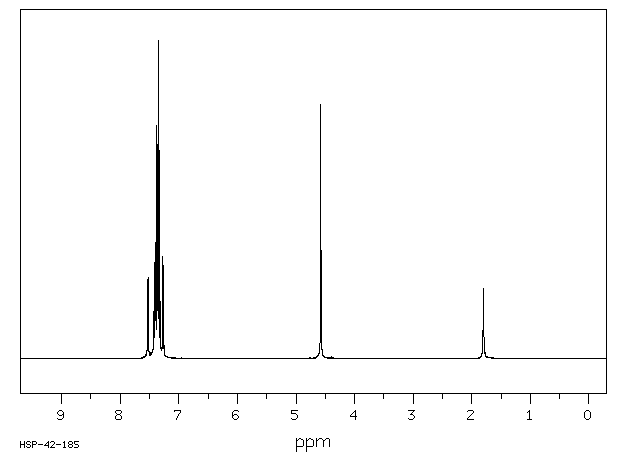
氢谱1HNMR
-
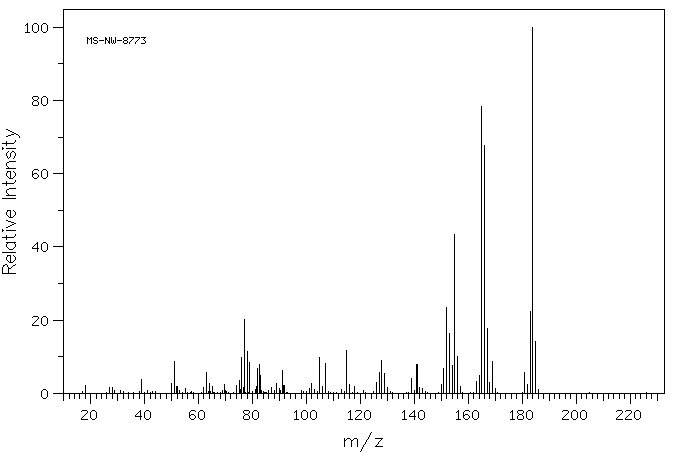
质谱MS
-
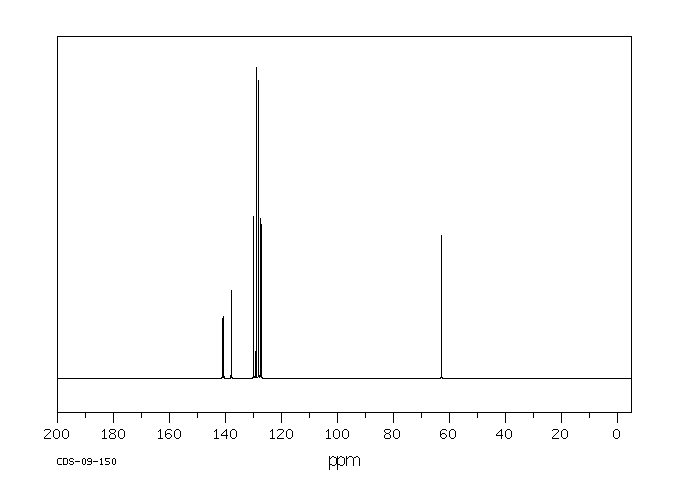
碳谱13CNMR
-
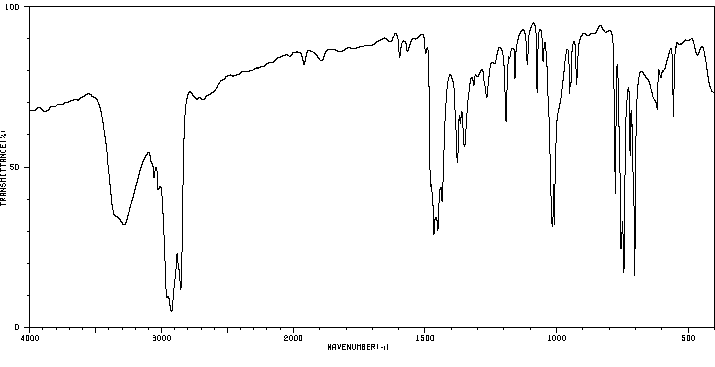
红外IR
-
拉曼Raman
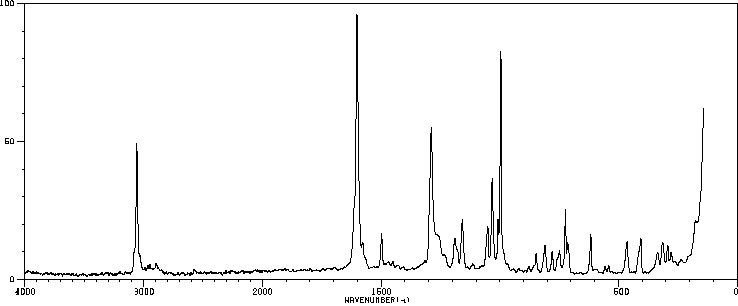
-
峰位数据
-
峰位匹配
-
表征信息
同类化合物
(βS)-β-氨基-4-(4-羟基苯氧基)-3,5-二碘苯甲丙醇
(S,S)-邻甲苯基-DIPAMP
(S)-(-)-7'-〔4(S)-(苄基)恶唑-2-基]-7-二(3,5-二-叔丁基苯基)膦基-2,2',3,3'-四氢-1,1-螺二氢茚
(S)-盐酸沙丁胺醇
(S)-3-(叔丁基)-4-(2,6-二甲氧基苯基)-2,3-二氢苯并[d][1,3]氧磷杂环戊二烯
(S)-2,2'-双[双(3,5-三氟甲基苯基)膦基]-4,4',6,6'-四甲氧基联苯
(S)-1-[3,5-双(三氟甲基)苯基]-3-[1-(二甲基氨基)-3-甲基丁烷-2-基]硫脲
(R)富马酸托特罗定
(R)-(-)-盐酸尼古地平
(R)-(-)-4,12-双(二苯基膦基)[2.2]对环芳烷(1,5环辛二烯)铑(I)四氟硼酸盐
(R)-(+)-7-双(3,5-二叔丁基苯基)膦基7''-[((6-甲基吡啶-2-基甲基)氨基]-2,2'',3,3''-四氢-1,1''-螺双茚满
(R)-(+)-7-双(3,5-二叔丁基苯基)膦基7''-[(4-叔丁基吡啶-2-基甲基)氨基]-2,2'',3,3''-四氢-1,1''-螺双茚满
(R)-(+)-7-双(3,5-二叔丁基苯基)膦基7''-[(3-甲基吡啶-2-基甲基)氨基]-2,2'',3,3''-四氢-1,1''-螺双茚满
(R)-(+)-4,7-双(3,5-二-叔丁基苯基)膦基-7“-[(吡啶-2-基甲基)氨基]-2,2”,3,3'-四氢1,1'-螺二茚满
(R)-3-(叔丁基)-4-(2,6-二苯氧基苯基)-2,3-二氢苯并[d][1,3]氧杂磷杂环戊烯
(R)-2-[((二苯基膦基)甲基]吡咯烷
(R)-1-[3,5-双(三氟甲基)苯基]-3-[1-(二甲基氨基)-3-甲基丁烷-2-基]硫脲
(N-(4-甲氧基苯基)-N-甲基-3-(1-哌啶基)丙-2-烯酰胺)
(5-溴-2-羟基苯基)-4-氯苯甲酮
(5-溴-2-氯苯基)(4-羟基苯基)甲酮
(5-氧代-3-苯基-2,5-二氢-1,2,3,4-oxatriazol-3-鎓)
(4S,5R)-4-甲基-5-苯基-1,2,3-氧代噻唑烷-2,2-二氧化物-3-羧酸叔丁酯
(4S,4''S)-2,2''-亚环戊基双[4,5-二氢-4-(苯甲基)恶唑]
(4-溴苯基)-[2-氟-4-[6-[甲基(丙-2-烯基)氨基]己氧基]苯基]甲酮
(4-丁氧基苯甲基)三苯基溴化磷
(3aR,8aR)-(-)-4,4,8,8-四(3,5-二甲基苯基)四氢-2,2-二甲基-6-苯基-1,3-二氧戊环[4,5-e]二恶唑磷
(3aR,6aS)-5-氧代六氢环戊基[c]吡咯-2(1H)-羧酸酯
(2Z)-3-[[(4-氯苯基)氨基]-2-氰基丙烯酸乙酯
(2S,3S,5S)-5-(叔丁氧基甲酰氨基)-2-(N-5-噻唑基-甲氧羰基)氨基-1,6-二苯基-3-羟基己烷
(2S,2''S,3S,3''S)-3,3''-二叔丁基-4,4''-双(2,6-二甲氧基苯基)-2,2'',3,3''-四氢-2,2''-联苯并[d][1,3]氧杂磷杂戊环
(2S)-(-)-2-{[[[[3,5-双(氟代甲基)苯基]氨基]硫代甲基]氨基}-N-(二苯基甲基)-N,3,3-三甲基丁酰胺
(2S)-2-[[[[[((1S,2S)-2-氨基环己基]氨基]硫代甲基]氨基]-N-(二苯甲基)-N,3,3-三甲基丁酰胺
(2S)-2-[[[[[[((1R,2R)-2-氨基环己基]氨基]硫代甲基]氨基]-N-(二苯甲基)-N,3,3-三甲基丁酰胺
(2-硝基苯基)磷酸三酰胺
(2,6-二氯苯基)乙酰氯
(2,3-二甲氧基-5-甲基苯基)硼酸
(1S,2S,3S,5S)-5-叠氮基-3-(苯基甲氧基)-2-[(苯基甲氧基)甲基]环戊醇
(1S,2S,3R,5R)-2-(苄氧基)甲基-6-氧杂双环[3.1.0]己-3-醇
(1-(4-氟苯基)环丙基)甲胺盐酸盐
(1-(3-溴苯基)环丁基)甲胺盐酸盐
(1-(2-氯苯基)环丁基)甲胺盐酸盐
(1-(2-氟苯基)环丙基)甲胺盐酸盐
(1-(2,6-二氟苯基)环丙基)甲胺盐酸盐
(-)-去甲基西布曲明
龙蒿油
龙胆酸钠
龙胆酸叔丁酯
龙胆酸
龙胆紫-d6
龙胆紫

联系我们


关注我们

公众号

