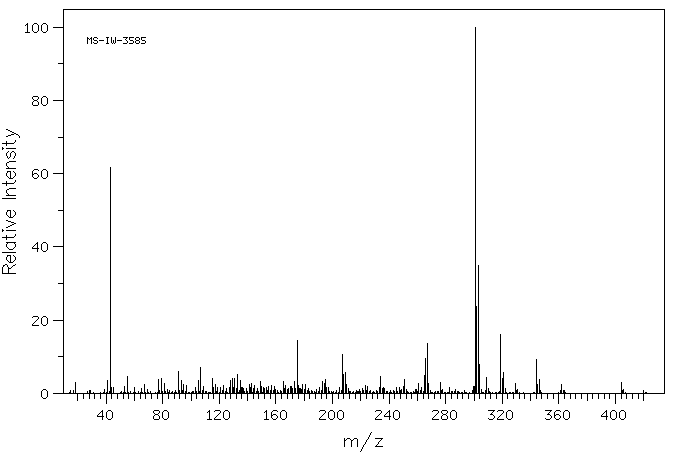
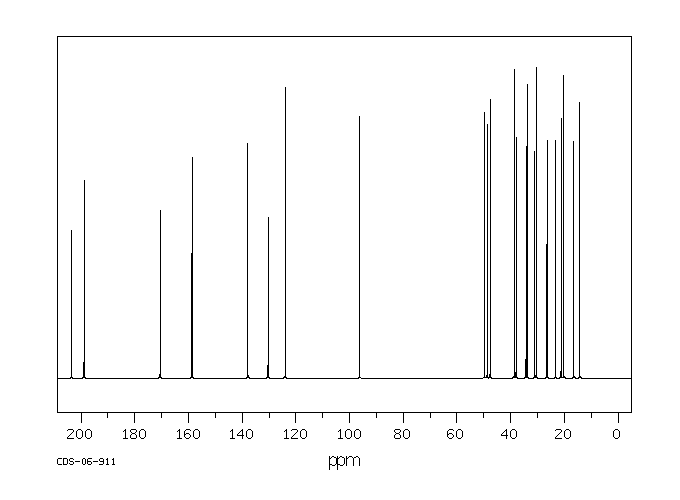
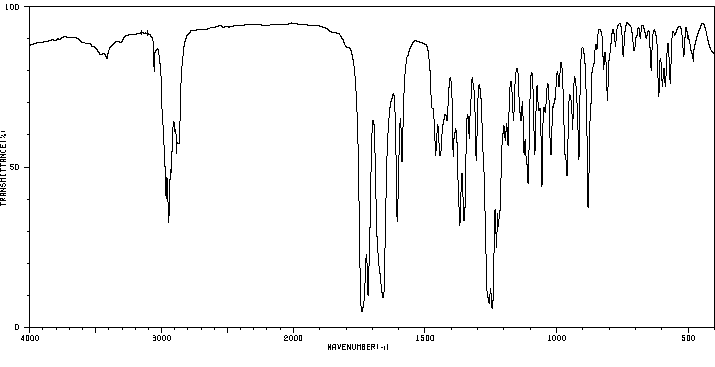
The major metabolites of chlormadinone acetate are 2alpha- hydroxychlormadinone acetate and 3beta-hydroxychlormadinone acetate. Incubation of chlormadinone acetate with human or rat liver microsomes produces mainly the 3beta-hydroxy metabolite. In contrast, incubation with microsomes from phenobarbital-treated rats produces the 2alpha-hydroxy metabolite, indicating that the metabolite pattern is dependent on the hepatic monoxygenase state.
/SRP:/ Immediate first aid: Ensure that adequate decontamination has been carried out. If patient is not breathing, start artificial respiration, preferably with a demand valve resuscitator, bag-valve-mask device, or pocket mask, as trained. Perform CPR if necessary. Immediately flush contaminated eyes with gently flowing water. Do not induce vomiting. If vomiting occurs, lean patient forward or place on the left side (head-down position, if possible) to maintain an open airway and prevent aspiration. Keep patient quiet and maintain normal body temperature. Obtain medical attention. /Poisons A and B/
/SRP:/ Basic treatment: Establish a patent airway (oropharyngeal or nasopharyngeal airway, if needed). Suction if necessary. Watch for signs of respiratory insufficiency and assist ventilations if needed. Administer oxygen by nonrebreather mask at 10 to 15 L/min. Monitor for pulmonary edema and treat if necessary ... . Monitor for shock and treat if necessary ... . Anticipate seizures and treat if necessary ... . For eye contamination, flush eyes immediately with water. Irrigate each eye continuously with 0.9% saline (NS) during transport ... . Do not use emetics. For ingestion, rinse mouth and administer 5 mL/kg up to 200 mL of water for dilution if the patient can swallow, has a strong gag reflex, and does not drool ... . Cover skin burns with dry sterile dressings after decontamination ... . /Poisons A and B/
来源:Hazardous Substances Data Bank (HSDB)
毒理性
解毒与急救
/SRP:/ 高级治疗:对于无意识、严重肺水肿或严重呼吸困难的病人,考虑进行口咽或鼻咽气管插管以控制气道。使用气囊面罩装置的正压通气技术可能有益。考虑使用药物治疗肺水肿……。对于严重的支气管痉挛,考虑给予β激动剂,如沙丁胺醇……。监测心率和必要时治疗心律失常……。开始静脉输注D5W /SRP: "保持开放",最低流量/。如果出现低血容量的迹象,使用0.9%生理盐水(NS)或乳酸林格氏液。对于伴有低血容量迹象的低血压,谨慎给予液体。注意液体过载的迹象……。使用地西泮或劳拉西泮治疗癫痫……。使用丙美卡因氢氯化物协助眼部冲洗……。 /Poisons A and B/
/SRP:/ Advanced treatment: Consider orotracheal or nasotracheal intubation for airway control in the patient who is unconscious, has severe pulmonary edema, or is in severe respiratory distress. Positive-pressure ventilation techniques with a bag valve mask device may be beneficial. Consider drug therapy for pulmonary edema ... . Consider administering a beta agonist such as albuterol for severe bronchospasm ... . Monitor cardiac rhythm and treat arrhythmias as necessary ... . Start IV administration of D5W /SRP: "To keep open", minimal flow rate/. Use 0.9% saline (NS) or lactated Ringer's if signs of hypovolemia are present. For hypotension with signs of hypovolemia, administer fluid cautiously. Watch for signs of fluid overload ... . Treat seizures with diazepam or lorazepam ... . Use proparacaine hydrochloride to assist eye irrigation ... . /Poisons A and B/
/PRECAUTIONS FOR ANTINEOPLASTIC AGENTS:/ There is no method available for routine monitoring of personnel for evidence of hazardous drug exposure. Tests for the presence of mutagens or chromosomal damage are not drug specific and are of value only in controlled studies. Chemical analysis of urine for the presence of hazardous drugs at the sensitivity level needed to detect occupational exposure is limited to a few drugs and is not yet commercially available. /Antineoplastic agents/
/CASE REPORTS/ ... Drug-induced pure red cell aplasia (PRCA) is a rare secondary form of PRCA, and is usually acute and fully reversible by the withdrawal of the causative drugs. We report a rare case of PRCA in a prostate cancer patient treated with combined androgen blockade (CAB) consisted of leuprolide acetate as a luteinizing hormone-releasing hormone agonist and chlormadinone acetate as an antiandrogen. This case demonstrated that these drugs could be a cause of PRCA, and suggests that regular close monitoring for anemia is needed in prostate cancer patients treated with these drugs.
... Pharmacokinetic studies have shown rapid and almost complete absorption after oral administration, and chlormadinone acetate is being bound to albumin rather than SHBG (Sex-Hormone-Binding-Globulin). Multiple dosing studies have demonstrated that steady state is reached by day 7 after oral administration with peak plasma concentrations in the region of 2 ng/mL. ...
The half-life and metabolic clearance rate of chlormadinone acetate were computed after a single iv injection of 60 to 90 mcCi 1-alpha-tritiated-chlormadinone acetate (specific activity 222 mcCi/mg) into 7 women aged 34-52 years. Plasma was extracted with acetone:MeOH for total radioactivity; then extracted with water and ether for free steroid radioactivity; then with n-butanol for conjugated steroid radioactivity; and finally extracted with chloroform:MeOH and chromatographed on thin layer with ether:benzene for specific radioactivity due to chlormadinone acetate. Blood samples were taken at 0 .25, 0.5, 1, 8, 24 hours and every 24 hours for 5 days. ... All 4 curves, total radioactivity, conjugated steroids, free steroids, and specific activity had the same biphasic form: a rapid loss for about 24 hours, and an approaching equilibrium after 24 hours. The metabolic clearance rate was 42.61 liters per day... These data generate an estimate of the concentration of chlormadinone acetate in plasma of women taking 0.5 mg daily: about .45 ng/mL, i.e. about one-thirteenth the concentration of progesterone.
Published data on pharmacokinetic parameters for chlormadinone acetate (CMA) are in part contradictory, especially with regard to terminal half-life (t(1/2,z)). Single and multiple doses of CMA (2 mg) and ethinylestradiol (EE; 0.03 mg) were administered to healthy female volunteers for six menstrual cycles. Plasma concentrations of CMA and EE were determined by gas chromatography-mass spectrometry. Single-dose and steady-state pharmacokinetic parameters were calculated. In a separate study, healthy female volunteers were given a single 2-mg dose of radiolabeled CMA. Concentrations of radioactivity in fecal and urine samples were determined via liquid scintillation. Excretion of total radioactivity was calculated as percentage of administered dose. Eighteen women completed the repeated-dose study. Peak plasma concentrations for CMA and EE were reached within 1 and 2 hr after taking the study drug. Peak plasma concentrations of CMA were approximately 1600 pg/mL after single-dose administration and 2000 pg/mL after multiple dosing. CMA and EE showed linear pharmacokinetics throughout six cycles, with constant trough values of approximately 400-500 pg/mL for CMA and 20-40 pg/mL for EE. Mass balance factors were 1.2-1.4 for CMA and 1.6-1.7 for EE, and accumulation factors were 1.7-2 for CMA and 1.7-1.8 for EE. Mean t(1/2,z) of CMA was approximately 25 hr after single dosing and 36-39 hr at steady state. In the excretion balance study, mean dose of CMA recovered was 87.3+/-6.4%, with urinary and fecal excretion accounting for 45% and 42%, respectively. The pharmacokinetics of CMA and EE is linear after multiple dosing and remains stable during long-term administration, once steady state is reached. The t(1/2,z) of CMA was 36-39 hr after multiple dosing, which is considerably shorter than the 80 hr often quoted in the literature.
来源:Hazardous Substances Data Bank (HSDB)
吸收、分配和排泄
两片不同包衣片剂(含有炔雌醇和醋酸氯米芬)的生物利用度和生物等效性(Bellissima作为测试药物,原始制剂作为参照药物)在20名健康女性志愿者口服单次给药后被研究。该研究根据单中心、随机、单次给药、双向交叉设计进行,清洗期为28天。采集血样进行药代动力学分析,直至给药后168小时,使用验证的LC-MS/MS方法测定炔雌醇和醋酸氯米芬的血浆浓度。观察到的炔雌醇平均最大血浆浓度(Cmax)为124.96 pg/mL(测试药物)和129.12 pg/mL(参照药物)。在醋酸氯米芬的情况下,Cmax平均为6.9566 ng/mL(测试药物)和6.6663 ng/mL(参照药物)。炔雌醇的血浆浓度-时间曲线下面积(AUC(0-infinity))的几何平均值为1292.35 pg/mL x hr(测试药物)和1380.49 pg/mL x hr(参照药物)。对于醋酸氯米芬,AUC(0-infinity)的几何平均值为53.322 ng/mL x hr(测试药物)和58.111 ng/mL x hr(参照药物)。炔雌醇的tmax中位数为1.5小时,无论是测试药物还是参照药物,而醋酸氯米芬的tmax中位数为1.0小时(测试药物)和1.5小时(参照药物)。炔雌醇的血浆消除半衰期(t1/2)为14.96小时(测试药物)和15.41小时(参照药物),醋酸氯米芬的血浆消除半衰期为56.63小时(测试药物)和56.17小时(参照药物)。两个主要目标参数AUC(0-infinity)和Cmax通过方差分析(ANOVA)进行了参数检验。AUC(0-infinity)比率(测试药物/参照药物:93.72% [86.62%-101.39%])的点估计值和90%置信区间表明两种制剂在炔雌醇暴露程度方面高度相似。炔雌醇的Cmax也观察到高度相似性,因为Cmax比率的点估计值和90%置信区间为96.18%(90.82%-101.86%)。关于醋酸氯米芬的AUC(0-infinity)比率,点估计值为91.60%,90%置信区间为84.08%-99.79%。此外,两种制剂的可交换性也由该活性成分Cmax的点估计值和90%置信区间(104.72% [95.76%-114.53%])所暗示。由于炔雌醇和醋酸氯米芬的AUC(0-infinity)和Cmax的所有90%置信区间都落在了通常接受的80%-125%范围内,因此证明了测试药物和参照药物的生物等效性。
The bioavailability and bioequivalence of two different film coated tablets containing ethinylestradiol and chlormadinone acetate (Bellissima as test and the respective preparation from the originator as reference) were investigated in 20 healthy female volunteers after oral single-dose administration. The study was performed according to a single-center, randomised, single-dose, 2-way cross-over design with a wash-out phase of 28 days. Blood samples for pharmacokinetic profiling were taken up to 168 hr post-dose, and ethinylestradiol and chlormadinone acetate plasma concentrations were determined with a validated LC-MS/MS method. The observed mean maximum plasma concentrations (Cmax) of ethinylestradiol were 124.96 pg/mL (test) and 129.12 pg/mL (reference). In the case of chlormadinone acetate, Cmax averaged 6.9566 ng/mL (test) and 6.6663 ng/mL (reference). The geometric means of area under the plasma concentration-time curve (AUC(0-infinity)) of ethinylestradiol were 1292.35 pg/mL x hr (test) and 1380.49 pg/mL x hr (reference). For chlormadinone acetate, geometric means of AUC(0-infinity) were 53.322 ng/mL x hr (test) and 58.111 ng/mL x hr (reference). The median of tmax of ethinylestradiol was 1.5 hr for both test and reference and the median of tmax of chlormadinone acetate 1.0 hr (test) and 1.5 hr (reference). Plasma elimination half-lives (t1/2) of ethinylestradiol were 14.96 hr (test) and 15.41 hr (reference) and of chlormadinone acetate 56.63 hr (test) and 56.17 hr (reference), respectively. Both primary target parameters AUC(0-infinity) and Cmax were tested parametrically by analysis of variance (ANOVA). The point estimator and the 90% confidence intervals for the AUC(0-infinity) ratio (test/reference: 93.72% [86.62%-101.39%]) indicate high similarity of both formulations with respect to the extent of ethinylestradiol exposure. A high degree of similarity was also observed for Cmax of ethinylestradiol, as the point estimator and the 90% confidence interval for the Cmax ratio are 96.18% (90.82%-101.86%). Regarding the AUC(0-infinity) ratio of chlormadinone acetate, the point estimator is 91.60% and the 90% confidence interval 84.08%-99.79%. Furthermore, exchangeability of both formulations is also suggested by the point estimator and 90% confidence of Cmax of this active agent (104.72% [95.76%-114.53%]). Bioequivalence between test and reference formulation was demonstrated since for both ethinylestradiol and chlormadinone acetate all 90% confidence intervals of AUC(0-infinity) and Cmax fall into the generally accepted range of 80%-125%.
After intravenous injection of radiolabelled chlormadinone acetate, the steroid and its metabolites have an initial rapid half-life of 2.4 hours, followed by a slow half-life of 80.1 hours. The mean metabolic clearance rate is 126 L/day for chlormadinone acetate and 42.6 L/day for chlormadinone acetate and its metabolites. The long half-life and slow elimination rate are probably due to accumulation of the drug in fat tissue.
Dibenzyl amine compounds and derivatives, pharmaceutical compositions containing such compounds and the use of such compounds to elevate certain plasma lipid levels, including high density lipoprotein-cholesterol and to lower certain other plasma lipid levels, such as LDL-cholesterol and triglycerides and accordingly to treat diseases which are exacerbated by low levels of HDL cholesterol and/or high levels of LDL-cholesterol and triglycerides, such as atherosclerosis and cardiovascular diseases in some mammals, including humans.
[EN] AMINE-LINKED C3-GLUTARIMIDE DEGRONIMERS FOR TARGET PROTEIN DEGRADATION<br/>[FR] DÉGRONIMÈRES DE C3-GLUTARIMIDE LIÉS À UNE AMINE POUR LA DÉGRADATION DE PROTÉINES CIBLES
申请人:C4 THERAPEUTICS INC
公开号:WO2017197051A1
公开(公告)日:2017-11-16
This invention provides amine-linked C3-glutarimide Degronimers and Degrons for therapeutic applications as described further herein, and methods of use and compositions thereof as well as methods for their preparation.
[EN] ASH1L INHIBITORS AND METHODS OF TREATMENT THEREWITH<br/>[FR] INHIBITEURS DE ASH1L ET MÉTHODES DE TRAITEMENT AU MOYEN DE CEUX-CI
申请人:UNIV MICHIGAN REGENTS
公开号:WO2017197240A1
公开(公告)日:2017-11-16
Provided herein are small molecule inhibitors of ASH1L activity and small molecules that facilitate ASH1L degradation and methods of use thereof for the treatment of disease, including acute leukemia, solid cancers and other diseases dependent on activity of ASH1L.
[EN] GLUCOCORTICOID RECEPTOR MODULATORS<br/>[FR] MODULATEURS DE RÉCEPTEURS DES GLUCOCORTICOÏDES
申请人:ORIC PHARMACEUTICALS INC
公开号:WO2018191283A1
公开(公告)日:2018-10-18
Described herein are glucocorticoid receptor modulators and pharmaceutical compositions comprising said compounds. The subject compounds and compositions are useful for the treatment of cancer and hypercortisolism.
Urinary and biliary metabolites of 17.ALPHA.-acetoxy-6-chloro-4,6-pregnadiene-3,20-dione in the rabbit.
作者:TATSUYA ABE、AKIRA KAMBEGAWA
DOI:10.1248/cpb.22.2824
日期:——
Ten metabolites of 17α-acetoxy-6-chloro-4, 6-pregnadiene-3, 20-dione were isolated from urine and bile of the rabbit and their chemical structures were determined. The urinary main metabolite was 17α-acetoxy-2ξ, 3ξ-dihydroxy-5ξ-pregnan-20-one. The biliary main metabolite was 17α-acetoxy-6-chloro-2ξ, 3ξ-dihydroxy-4, 6-pregnadien-20-one. The administered compound was metabolized through two courses, one was oxidation at C-2 and another was dechlorination at C-6, in the rabbit. A small amount of the metabolite oxidized at C-21 was identified from urine.