


N-(对甲苯磺酰)-3-吡咯啉 | 16851-72-2
中文名称
N-(对甲苯磺酰)-3-吡咯啉
中文别名
1-(对甲苯磺酰基)-2,5-二氢吡咯;N-(对甲苯磺酰基)-3-吡咯烷;1-(甲苯-4-磺酰基)-2,5-二氢-1H-吡咯;N-对甲苯磺酰-3-吡咯啉
英文名称
1-[(4-methylphenyl)sulfonyl]-2,5-dihydro-1H-pyrrole
英文别名
1-tosyl-2,5-dihydro-1H-pyrrole;N-tosyl-2,5-dihydropyrrole;1-(toluene-4-sulfonyl)-2,5-dihydro-1H-pyrrole;2,5-dihydro-1-tosyl-1H-pyrrole;N-tosyl-3-pyrroline;1-(p-toluenesulfonyl)-2,5-dihydropyrrole;1-(p-tosyl)-2,5-dihydro-1H-pyrrole;N-p-tosyl-2,5-dihydro-1H-pyrrole;1-tosyl-2,5-dihydropyrrole;1-tosyl-3-pyrroline;N-(p-Toluenesulfonyl)-3-pyrroline;1-(4-methylphenyl)sulfonyl-2,5-dihydropyrrole

CAS
16851-72-2
化学式
C11H13NO2S
mdl
MFCD01321189
分子量
223.296
InChiKey
UNYMIBRUQCUASP-UHFFFAOYSA-N
BEILSTEIN
——
EINECS
——
-
物化性质
-
计算性质
-
ADMET
-
安全信息
-
SDS
-
制备方法与用途
-
上下游信息
-
文献信息
-
表征谱图
-
同类化合物
-
相关功能分类
-
相关结构分类
物化性质
-
熔点:127°C
-
沸点:354℃
-
密度:1.264
-
闪点:168℃
计算性质
-
辛醇/水分配系数(LogP):1.7
-
重原子数:15
-
可旋转键数:2
-
环数:2.0
-
sp3杂化的碳原子比例:0.272
-
拓扑面积:45.8
-
氢给体数:0
-
氢受体数:3
安全信息
-
危险类别码:R36/37/38
-
海关编码:2933990090
-
安全说明:S26,S36
-
危险性防范说明:P264,P280,P302+P352+P332+P313+P362+P364,P305+P351+P338+P337+P313
-
危险性描述:H315,H319
-
储存条件:| 室温 |
SDS

N-(p-Toluenesulfonyl)-3-pyrroline Revision number: 5
SAFETY DATA SHEET
Section 1. IDENTIFICATION
Product name: N-(p-Toluenesulfonyl)-3-pyrroline
Revision number: 5
Section 2. HAZARDS IDENTIFICATION
GHS classification
PHYSICAL HAZARDS Not classified
HEALTH HAZARDS
Skin corrosion/irritation Category 2
Category 2A
Serious eye damage/eye irritation
ENVIRONMENTAL HAZARDS Not classified
GHS label elements, including precautionary statements
Pictograms or hazard symbols
Signal word Warning
Hazard statements Causes skin irritation
Causes serious eye irritation
Precautionary statements:
Wash hands thoroughly after handling.
[Prevention]
Wear protective gloves/eye protection/face protection.
IF IN EYES: Rinse cautiously with water for several minutes. Remove contact lenses,
[Response]
if present and easy to do. Continue rinsing.
If eye irritation persists: Get medical advice/attention.
IF ON SKIN: Gently wash with plenty of soap and water.
If skin irritation occurs: Get medical advice/attention.
Take off contaminated clothing and wash before reuse.
Section 3. COMPOSITION/INFORMATION ON INGREDIENTS
Substance/mixture: Substance
Components: N-(p-Toluenesulfonyl)-3-pyrroline
Percent: >98.0%(GC)
CAS Number: 16851-72-2
Synonyms: N-Tosyl-3-pyrroline
C11H13NO2S
Chemical Formula:
Section 4. FIRST AID MEASURES
Inhalation: Remove victim to fresh air and keep at rest in a position comfortable for breathing.
Get medical advice/attention if you feel unwell.
N-(p-Toluenesulfonyl)-3-pyrroline
Section 4. FIRST AID MEASURES
Skin contact: Remove/Take off immediately all contaminated clothing. Gently wash with plenty of
soap and water. If skin irritation or rash occurs: Get medical advice/attention.
Eye contact: Rinse cautiously with water for several minutes. Remove contact lenses, if present
and easy to do. Continue rinsing. If eye irritation persists: Get medical
advice/attention.
Ingestion: Get medical advice/attention if you feel unwell. Rinse mouth.
A rescuer should wear personal protective equipment, such as rubber gloves and air-
Protection of first-aiders:
tight goggles.
Section 5. FIRE-FIGHTING MEASURES
Suitable extinguishing Dry chemical, foam, water spray, carbon dioxide.
media:
Specific hazards arising Take care as it may decompose upon combustion or in high temperatures to
from the chemical: generate poisonous fume.
Precautions for firefighters: Fire-extinguishing work is done from the windward and the suitable fire-extinguishing
method according to the surrounding situation is used. Uninvolved persons should
evacuate to a safe place. In case of fire in the surroundings: Remove movable
containers if safe to do so.
Special protective When extinguishing fire, be sure to wear personal protective equipment.
equipment for firefighters:
Section 6. ACCIDENTAL RELEASE MEASURES
Personal precautions, Use personal protective equipment. Keep people away from and upwind of spill/leak.
protective equipment and Entry to non-involved personnel should be controlled around the leakage area by
emergency procedures: roping off, etc.
Environmental precautions: Prevent product from entering drains.
Methods and materials for Sweep dust to collect it into an airtight container, taking care not to disperse it.
containment and cleaning Adhered or collected material should be promptly disposed of, in accordance with
up: appropriate laws and regulations.
Section 7. HANDLING AND STORAGE
Precautions for safe handling
Technical measures: Handling is performed in a well ventilated place. Wear suitable protective equipment.
Prevent dispersion of dust. Wash hands and face thoroughly after handling.
Use a local exhaust if dust or aerosol will be generated.
Advice on safe handling: Avoid contact with skin, eyes and clothing.
Conditions for safe storage, including any
incompatibilities
Storage conditions: Keep container tightly closed. Store in a cool and dark place.
Store away from incompatible materials such as oxidizing agents.
Packaging material: Comply with laws.
Section 8. EXPOSURE CONTROLS / PERSONAL PROTECTION
Engineering controls: Install a closed system or local exhaust as possible so that workers should not be
exposed directly. Also install safety shower and eye bath.
Personal protective equipment
Respiratory protection: Dust respirator. Follow local and national regulations.
Hand protection: Protective gloves.
Safety glasses. A face-shield, if the situation requires.
Eye protection:
Skin and body protection: Protective clothing. Protective boots, if the situation requires.
Section 9. PHYSICAL AND CHEMICAL PROPERTIES
Physical state (20°C): Solid
Crystal- Powder
Form:
Colour: White - Almost white
No data available
Odour:
N-(p-Toluenesulfonyl)-3-pyrroline
Section 9. PHYSICAL AND CHEMICAL PROPERTIES
pH: No data available
Melting point/freezing point:127°C
Boiling point/range: No data available
Flash point: No data available
Flammability or explosive
limits:
Lower: No data available
Upper: No data available
Relative density: No data available
Solubility(ies):
[Water] No data available
[Other solvents]
Soluble: Hot methanol
Section 10. STABILITY AND REACTIVITY
Chemical stability: Stable under proper conditions.
Possibility of hazardous No special reactivity has been reported.
reactions:
Incompatible materials: Oxidizing agents
Hazardous decomposition Carbon monoxide, Carbon dioxide, Nitrogen oxides (NOx), Sulfur oxides
products:
Section 11. TOXICOLOGICAL INFORMATION
Acute Toxicity: No data available
Skin corrosion/irritation: No data available
Serious eye No data available
damage/irritation:
Germ cell mutagenicity: No data available
Carcinogenicity:
IARC = No data available
NTP = No data available
Reproductive toxicity: No data available
Section 12. ECOLOGICAL INFORMATION
Ecotoxicity:
Fish: No data available
Crustacea: No data available
No data available
Algae:
Persistence / degradability: No data available
No data available
Bioaccumulative
potential(BCF):
Mobility in soil
Log Pow: No data available
Soil adsorption (Koc): No data available
Henry's Law No data available
constant(PaM3/mol):
Section 13. DISPOSAL CONSIDERATIONS
Recycle to process, if possible. Consult your local regional authorities. You may be able to dissolve or mix material
with a combustible solvent and burn in a chemical incinerator equipped with an afterburner and scrubber system.
Observe all federal, state and local regulations when disposing of the substance.
Section 14. TRANSPORT INFORMATION
Hazards Class: Does not correspond to the classification standard of the United Nations
UN-No: Not listed
N-(p-Toluenesulfonyl)-3-pyrroline
Section 15. REGULATORY INFORMATION
Safe management ordinance of dangerous chemical product (State Council announces on January 26, 2002
and revised on February 16,2011): Safe use and production, the storage of a dangerous chemical, transport,
loading and unloading were prescribed.
SECTION 16 - ADDITIONAL INFORMATION
N/A
SAFETY DATA SHEET
Section 1. IDENTIFICATION
Product name: N-(p-Toluenesulfonyl)-3-pyrroline
Revision number: 5
Section 2. HAZARDS IDENTIFICATION
GHS classification
PHYSICAL HAZARDS Not classified
HEALTH HAZARDS
Skin corrosion/irritation Category 2
Category 2A
Serious eye damage/eye irritation
ENVIRONMENTAL HAZARDS Not classified
GHS label elements, including precautionary statements
Pictograms or hazard symbols
Signal word Warning
Hazard statements Causes skin irritation
Causes serious eye irritation
Precautionary statements:
Wash hands thoroughly after handling.
[Prevention]
Wear protective gloves/eye protection/face protection.
IF IN EYES: Rinse cautiously with water for several minutes. Remove contact lenses,
[Response]
if present and easy to do. Continue rinsing.
If eye irritation persists: Get medical advice/attention.
IF ON SKIN: Gently wash with plenty of soap and water.
If skin irritation occurs: Get medical advice/attention.
Take off contaminated clothing and wash before reuse.
Section 3. COMPOSITION/INFORMATION ON INGREDIENTS
Substance/mixture: Substance
Components: N-(p-Toluenesulfonyl)-3-pyrroline
Percent: >98.0%(GC)
CAS Number: 16851-72-2
Synonyms: N-Tosyl-3-pyrroline
C11H13NO2S
Chemical Formula:
Section 4. FIRST AID MEASURES
Inhalation: Remove victim to fresh air and keep at rest in a position comfortable for breathing.
Get medical advice/attention if you feel unwell.
N-(p-Toluenesulfonyl)-3-pyrroline
Section 4. FIRST AID MEASURES
Skin contact: Remove/Take off immediately all contaminated clothing. Gently wash with plenty of
soap and water. If skin irritation or rash occurs: Get medical advice/attention.
Eye contact: Rinse cautiously with water for several minutes. Remove contact lenses, if present
and easy to do. Continue rinsing. If eye irritation persists: Get medical
advice/attention.
Ingestion: Get medical advice/attention if you feel unwell. Rinse mouth.
A rescuer should wear personal protective equipment, such as rubber gloves and air-
Protection of first-aiders:
tight goggles.
Section 5. FIRE-FIGHTING MEASURES
Suitable extinguishing Dry chemical, foam, water spray, carbon dioxide.
media:
Specific hazards arising Take care as it may decompose upon combustion or in high temperatures to
from the chemical: generate poisonous fume.
Precautions for firefighters: Fire-extinguishing work is done from the windward and the suitable fire-extinguishing
method according to the surrounding situation is used. Uninvolved persons should
evacuate to a safe place. In case of fire in the surroundings: Remove movable
containers if safe to do so.
Special protective When extinguishing fire, be sure to wear personal protective equipment.
equipment for firefighters:
Section 6. ACCIDENTAL RELEASE MEASURES
Personal precautions, Use personal protective equipment. Keep people away from and upwind of spill/leak.
protective equipment and Entry to non-involved personnel should be controlled around the leakage area by
emergency procedures: roping off, etc.
Environmental precautions: Prevent product from entering drains.
Methods and materials for Sweep dust to collect it into an airtight container, taking care not to disperse it.
containment and cleaning Adhered or collected material should be promptly disposed of, in accordance with
up: appropriate laws and regulations.
Section 7. HANDLING AND STORAGE
Precautions for safe handling
Technical measures: Handling is performed in a well ventilated place. Wear suitable protective equipment.
Prevent dispersion of dust. Wash hands and face thoroughly after handling.
Use a local exhaust if dust or aerosol will be generated.
Advice on safe handling: Avoid contact with skin, eyes and clothing.
Conditions for safe storage, including any
incompatibilities
Storage conditions: Keep container tightly closed. Store in a cool and dark place.
Store away from incompatible materials such as oxidizing agents.
Packaging material: Comply with laws.
Section 8. EXPOSURE CONTROLS / PERSONAL PROTECTION
Engineering controls: Install a closed system or local exhaust as possible so that workers should not be
exposed directly. Also install safety shower and eye bath.
Personal protective equipment
Respiratory protection: Dust respirator. Follow local and national regulations.
Hand protection: Protective gloves.
Safety glasses. A face-shield, if the situation requires.
Eye protection:
Skin and body protection: Protective clothing. Protective boots, if the situation requires.
Section 9. PHYSICAL AND CHEMICAL PROPERTIES
Physical state (20°C): Solid
Crystal- Powder
Form:
Colour: White - Almost white
No data available
Odour:
N-(p-Toluenesulfonyl)-3-pyrroline
Section 9. PHYSICAL AND CHEMICAL PROPERTIES
pH: No data available
Melting point/freezing point:127°C
Boiling point/range: No data available
Flash point: No data available
Flammability or explosive
limits:
Lower: No data available
Upper: No data available
Relative density: No data available
Solubility(ies):
[Water] No data available
[Other solvents]
Soluble: Hot methanol
Section 10. STABILITY AND REACTIVITY
Chemical stability: Stable under proper conditions.
Possibility of hazardous No special reactivity has been reported.
reactions:
Incompatible materials: Oxidizing agents
Hazardous decomposition Carbon monoxide, Carbon dioxide, Nitrogen oxides (NOx), Sulfur oxides
products:
Section 11. TOXICOLOGICAL INFORMATION
Acute Toxicity: No data available
Skin corrosion/irritation: No data available
Serious eye No data available
damage/irritation:
Germ cell mutagenicity: No data available
Carcinogenicity:
IARC = No data available
NTP = No data available
Reproductive toxicity: No data available
Section 12. ECOLOGICAL INFORMATION
Ecotoxicity:
Fish: No data available
Crustacea: No data available
No data available
Algae:
Persistence / degradability: No data available
No data available
Bioaccumulative
potential(BCF):
Mobility in soil
Log Pow: No data available
Soil adsorption (Koc): No data available
Henry's Law No data available
constant(PaM3/mol):
Section 13. DISPOSAL CONSIDERATIONS
Recycle to process, if possible. Consult your local regional authorities. You may be able to dissolve or mix material
with a combustible solvent and burn in a chemical incinerator equipped with an afterburner and scrubber system.
Observe all federal, state and local regulations when disposing of the substance.
Section 14. TRANSPORT INFORMATION
Hazards Class: Does not correspond to the classification standard of the United Nations
UN-No: Not listed
N-(p-Toluenesulfonyl)-3-pyrroline
Section 15. REGULATORY INFORMATION
Safe management ordinance of dangerous chemical product (State Council announces on January 26, 2002
and revised on February 16,2011): Safe use and production, the storage of a dangerous chemical, transport,
loading and unloading were prescribed.
SECTION 16 - ADDITIONAL INFORMATION
N/A
上下游信息
-
上游原料
中文名称 英文名称 CAS号 化学式 分子量 —— N-allyl-N-((2E)-2-butenyl)-p-toluenesulfonamide 952688-49-2 C14H19NO2S 265.376 N,N-二烯丙基-4-甲基苯磺酰胺 N,N-Diallyltosylamide 50487-72-4 C13H17NO2S 251.349 —— N-allyl-4-methyl-N-(3-methylbut-2-en-1-yl)benzenesulfonamide 135979-17-8 C15H21NO2S 279.403 —— N,N-di(buta-2,3-dien-1-yl)-4-methylbenzenesulfonamide —— C15H17NO2S 275.371 —— N-allyl-4-methyl-N-(2-oxoethyl)benzenesulfonamide 361459-74-7 C12H15NO3S 253.322 —— (Z)-N-(but-2-en-1-yl)-4-methylbenzenesulfonamide 155940-97-9 C11H15NO2S 225.312 N,N-二烯丙基苯磺酰胺 N,N-diallylbenzenesulfonamide 25630-24-4 C12H15NO2S 237.323 —— 1-tosyl-2-vinylaziridine 126690-80-0 C11H13NO2S 223.296 —— N-(buta-2,3-dien-1-yl)-4-methylbenzenesulfonamide 346587-69-7 C11H13NO2S 223.296 —— N,N-bis(2-butynyl)-(4-methylphenyl)sulfonamide 170751-34-5 C15H17NO2S 275.371 4-甲基-N-(丙-2-炔-1-基)苯-1-磺酰胺 4-methyl-N-prop-2-ynylbenzenesulfonamide 55022-46-3 C10H11NO2S 209.269 N-烯丙基-N-(乙氧羰基甲基)甲苯-4-磺酰胺 N-allyl-N-(ethoxycarbonylmethyl)toluene-4-sulfonamide 869275-28-5 C14H19NO4S 297.375 —— N-(2-hydroxybut-3-en-1-yl)-4-methylbenzenesulfonamide —— C11H15NO3S 241.311 N-Ts-甘氨酸乙酯 ethyl N-tosylglycinate 5465-67-8 C11H15NO4S 257.31 - 1
- 2
-
下游产品
中文名称 英文名称 CAS号 化学式 分子量 1-对甲苯磺酰吡咯烷 N-tosylpyrrolidine 6435-78-5 C11H15NO2S 225.312 1-对甲苯磺酰基-3-吡咯烷醇 1-tosylpyrrolidin-3-ol 170456-83-4 C11H15NO3S 241.311 1-对甲苯磺酰基-3-吡咯烷酮 1-tosylpyrrolidin-3-one 73696-28-3 C11H13NO3S 239.295 —— 1-(4-toluenesulfonyl)-pyrrolidine-3-carbonitrile 1127903-81-4 C12H14N2O2S 250.321 3-甲苯磺酰-6-噁-双环[3.1.0]己烷 3-(toluene-4-sulfonyl)-6-oxa-3-azabicyclo[3.1.0]hexane 159555-66-5 C11H13NO3S 239.295 —— 2,3-Diethenyl-1,4-bis(4-methylphenylsulfonylamino)butane —— C22H28N2O4S2 448.607 4-溴-1-(甲苯-4-磺酰基)吡咯烷-3-醇 4-bromo-1-tosylpyrrolidin-3-ol 170456-84-5 C11H14BrNO3S 320.207 4-溴-1-[(4-甲基苯基)磺酰基]吡咯烷-3-酮 4-bromo-1-tosylpyrrolidin-3-one 170456-82-3 C11H12BrNO3S 318.191
反应信息
-
作为反应物:描述:参考文献:名称:使用钌卡宾催化剂和硅烷还原烯烃摘要:在三烷基硅烷的存在下,钌卡宾配合物能够介导烯烃的还原。在这些还原条件下,当动力学有利的闭环复分解是可能的时,可以进行一锅环化还原序列。DOI:10.1055/s-2005-872695
-
作为产物:描述:N-(buta-2,3-dien-1-yl)-4-methylbenzenesulfonamide 在 二环己胺 、 copper(I) bromide 作用下, 以 1,4-二氧六环 为溶剂, 反应 3.0h, 以42%的产率得到N-(对甲苯磺酰)-3-吡咯啉参考文献:名称:用于 3-吡咯啉合成的铜催化多米诺同系化和环异构化反应摘要:发现溴化铜是产生 3-吡咯啉的多米诺反应序列的有效催化剂。Cu(I) 催化炔丙基磺酰胺的 Crabbe 反应和丙二烯中间体的选择性环异构化是使用微波辐射条件进行的,提供了广泛的 2-取代-和 2,5-二取代-3-吡咯啉。反应中间体的机理研究揭示了两种可能的反应途径;两者都提到了乙烯基铜中间体的重要性。DOI:10.1002/ejoc.201301621
-
作为试剂:描述:N,N-二烯丙基-4-甲基苯磺酰胺 、 在 silica gel 、 氢气 、 N,N-二烯丙基-4-甲基苯磺酰胺 、 N-(对甲苯磺酰)-2-吡咯啉 、 N-(对甲苯磺酰)-3-吡咯啉 、 title compound 作用下, 以 甲苯 为溶剂, 70.0~260.0 ℃ 、8.0 MPa 条件下, 反应 11.09h, 以8% of 1-(toluene-4-sulfonyl)-2,3-dihydro-1H-pyrrole were formed的产率得到N-(对甲苯磺酰)-2-吡咯啉参考文献:名称:Metathesis catalysts摘要:本发明公开了一种新型的交换催化剂,其化学式为其中R1、R2、R3、R4、R5、R6、X1、X2、L和Y如本文所述,以及制备该催化剂的过程和它们在环闭合或交叉交换反应等交换反应中的应用。公开号:US07781586B2
文献信息
-
Grubbs–Hoveyda type catalysts bearing a dicationic <i>N</i>-heterocyclic carbene for biphasic olefin metathesis reactions in ionic liquids作者:Maximilian Koy、Hagen J Altmann、Benjamin Autenrieth、Wolfgang Frey、Michael R BuchmeiserDOI:10.3762/bjoc.11.178日期:——(-)) based on a dicationic N-heterocyclic carbene (NHC) ligand was prepared. The reactivity was tested in ring opening metathesis polymerization (ROMP) under biphasic conditions using a nonpolar organic solvent (toluene) and the ionic liquid (IL) 1-butyl-2,3-dimethylimidazolium tetrafluoroborate [BDMIM(+)][BF4 (-)]. The structure of Ru-2 was confirmed by single crystal X-ray analysis.
-
Monothiolate ruthenium alkylidene complexes with tricyclic fluorinated N-heterocyclic carbene ligands作者:Timur R. Akmalov、Salekh M. Masoud、Daria V. Vorobyeva、Fedor M. Dolgushin、Sergey E. Nefedov、Sergey N. OsipovDOI:10.1016/j.mencom.2019.01.011日期:2019.1New monothiolate ruthenium alkylidene complexes bearing bulky tricyclic N-heterocyclic carbene ligands decorated with two geminal trifluoromethyl groups were synthesized. Their catalytic activity in representative olefin metathesis reactions, such as ring closing metathesis of diallyltosylamine and selfmetathesis of allylbenzene, has been evaluated.
-
RECYCLABLE METATHESIS CATALYSTS申请人:Trustees of Boston College, The公开号:US20160168181A1公开(公告)日:2016-06-16Highly active, recoverable and recyclable transition metal-based metathesis catalysts and their organometallic complexes including dendrimeric complexes are disclosed, including a Ru complex bearing a 1,3-dimesityl-4,5-dihydroimidazol-2-ylidene and styrenyl ether ligand. The heterocyclic ligand significantly enhances the catalytic activity, and the styrenyl ether allows for the easy recovery of the Ru complex. Derivatized catalysts capable of being immobilized on substrate surfaces are also disclosed. The present catalysts can be used to catalyze ring-closing metathesis (RCM), ring-opening (ROM) and cross metatheses (CM) reactions, and promote the efficient formation of various trisubstituted olefins at ambient temperature in high yield.
-
Ring‐Closing Olefin Metathesis Catalyzed by Well‐Defined Vanadium Alkylidene Complexes作者:Dmitry S. Belov、Gabriela Tejeda、Charlene Tsay、Konstantin V. BukhryakovDOI:10.1002/chem.202005438日期:2021.3.8selectivity in ring‐opening metathesis polymerization of strained cyclic olefins comparable to those of Ru, Mo, and W catalysts. However, the application of V alkylidenes in routine organic synthesis is limited. Here, we present the first example of ring‐closing olefin metathesis catalyzed by well‐defined V chloride alkylidene phosphine complexes. The developed catalysts exhibit tolerance to various functional
-
A simple and practical phase-separation approach to the recycling of a homogeneous metathesis catalyst作者:Anna Michrowska、Łukasz Gułajski、Karol GrelaDOI:10.1039/b517088e日期:——The air stable asarone-derived Ru carbene 16, a robust olefin metathesis catalyst, can be easily separated after reaction by deposition on silica gel and reused up to nine times. This procedure provides products of excellent purity with low Ru content.空气稳定的阿萨酮衍生的Ru卡宾16是一种强健的烯烃复分解催化剂,可通过反应后沉积在硅胶上轻松分离并重复使用多达九次。该方法提供了具有低Ru含量的高纯度产品。
表征谱图
-
氢谱1HNMR
-
质谱MS
-
碳谱13CNMR
-
红外IR
-
拉曼Raman
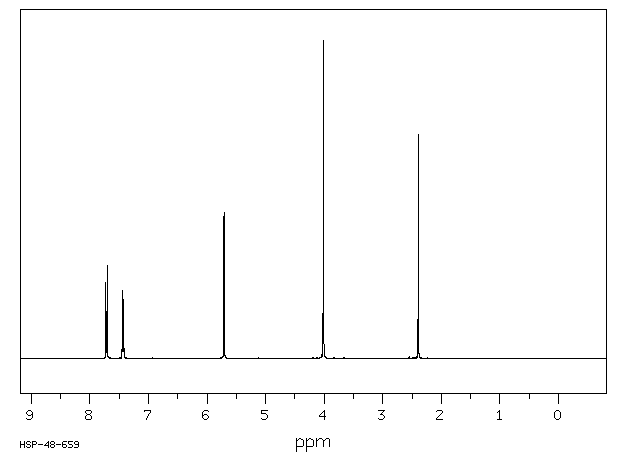
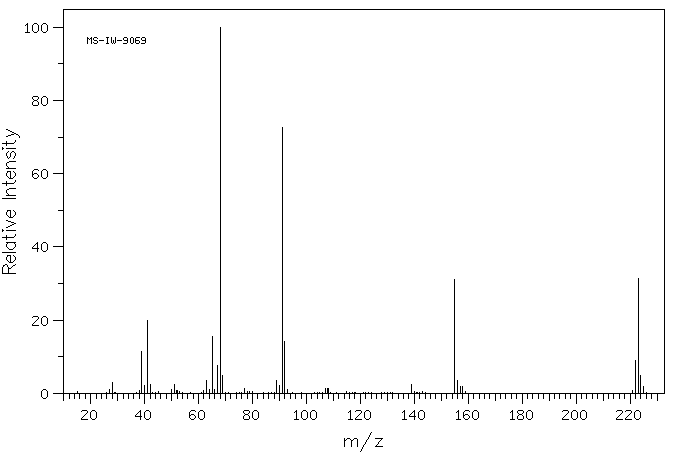
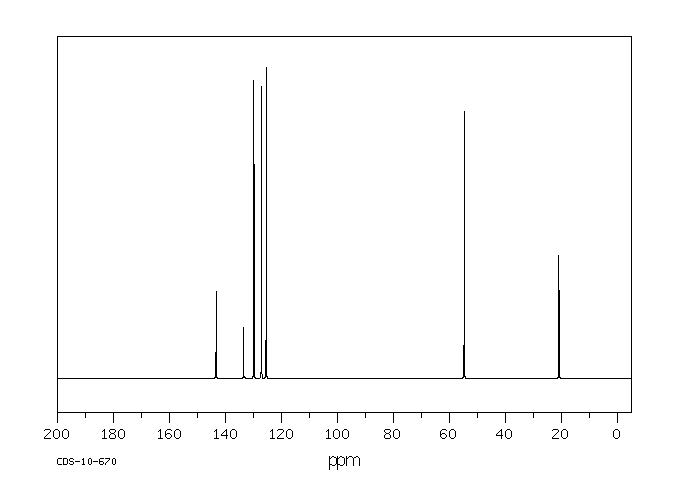
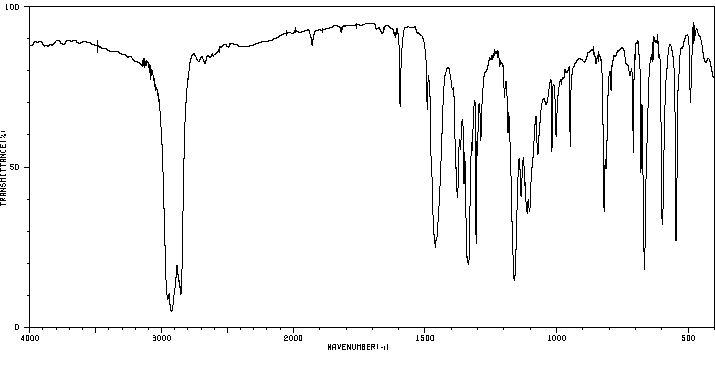
-
峰位数据
-
峰位匹配
-
表征信息
同类化合物
(βS)-β-氨基-4-(4-羟基苯氧基)-3,5-二碘苯甲丙醇
(S,S)-邻甲苯基-DIPAMP
(S)-(-)-7'-〔4(S)-(苄基)恶唑-2-基]-7-二(3,5-二-叔丁基苯基)膦基-2,2',3,3'-四氢-1,1-螺二氢茚
(S)-盐酸沙丁胺醇
(S)-3-(叔丁基)-4-(2,6-二甲氧基苯基)-2,3-二氢苯并[d][1,3]氧磷杂环戊二烯
(S)-2,2'-双[双(3,5-三氟甲基苯基)膦基]-4,4',6,6'-四甲氧基联苯
(S)-1-[3,5-双(三氟甲基)苯基]-3-[1-(二甲基氨基)-3-甲基丁烷-2-基]硫脲
(R)富马酸托特罗定
(R)-(-)-盐酸尼古地平
(R)-(-)-4,12-双(二苯基膦基)[2.2]对环芳烷(1,5环辛二烯)铑(I)四氟硼酸盐
(R)-(+)-7-双(3,5-二叔丁基苯基)膦基7''-[((6-甲基吡啶-2-基甲基)氨基]-2,2'',3,3''-四氢-1,1''-螺双茚满
(R)-(+)-7-双(3,5-二叔丁基苯基)膦基7''-[(4-叔丁基吡啶-2-基甲基)氨基]-2,2'',3,3''-四氢-1,1''-螺双茚满
(R)-(+)-7-双(3,5-二叔丁基苯基)膦基7''-[(3-甲基吡啶-2-基甲基)氨基]-2,2'',3,3''-四氢-1,1''-螺双茚满
(R)-(+)-4,7-双(3,5-二-叔丁基苯基)膦基-7“-[(吡啶-2-基甲基)氨基]-2,2”,3,3'-四氢1,1'-螺二茚满
(R)-3-(叔丁基)-4-(2,6-二苯氧基苯基)-2,3-二氢苯并[d][1,3]氧杂磷杂环戊烯
(R)-2-[((二苯基膦基)甲基]吡咯烷
(R)-1-[3,5-双(三氟甲基)苯基]-3-[1-(二甲基氨基)-3-甲基丁烷-2-基]硫脲
(N-(4-甲氧基苯基)-N-甲基-3-(1-哌啶基)丙-2-烯酰胺)
(5-溴-2-羟基苯基)-4-氯苯甲酮
(5-溴-2-氯苯基)(4-羟基苯基)甲酮
(5-氧代-3-苯基-2,5-二氢-1,2,3,4-oxatriazol-3-鎓)
(4S,5R)-4-甲基-5-苯基-1,2,3-氧代噻唑烷-2,2-二氧化物-3-羧酸叔丁酯
(4S,4''S)-2,2''-亚环戊基双[4,5-二氢-4-(苯甲基)恶唑]
(4-溴苯基)-[2-氟-4-[6-[甲基(丙-2-烯基)氨基]己氧基]苯基]甲酮
(4-丁氧基苯甲基)三苯基溴化磷
(3aR,8aR)-(-)-4,4,8,8-四(3,5-二甲基苯基)四氢-2,2-二甲基-6-苯基-1,3-二氧戊环[4,5-e]二恶唑磷
(3aR,6aS)-5-氧代六氢环戊基[c]吡咯-2(1H)-羧酸酯
(2Z)-3-[[(4-氯苯基)氨基]-2-氰基丙烯酸乙酯
(2S,3S,5S)-5-(叔丁氧基甲酰氨基)-2-(N-5-噻唑基-甲氧羰基)氨基-1,6-二苯基-3-羟基己烷
(2S,2''S,3S,3''S)-3,3''-二叔丁基-4,4''-双(2,6-二甲氧基苯基)-2,2'',3,3''-四氢-2,2''-联苯并[d][1,3]氧杂磷杂戊环
(2S)-(-)-2-{[[[[3,5-双(氟代甲基)苯基]氨基]硫代甲基]氨基}-N-(二苯基甲基)-N,3,3-三甲基丁酰胺
(2S)-2-[[[[[((1S,2S)-2-氨基环己基]氨基]硫代甲基]氨基]-N-(二苯甲基)-N,3,3-三甲基丁酰胺
(2S)-2-[[[[[[((1R,2R)-2-氨基环己基]氨基]硫代甲基]氨基]-N-(二苯甲基)-N,3,3-三甲基丁酰胺
(2-硝基苯基)磷酸三酰胺
(2,6-二氯苯基)乙酰氯
(2,3-二甲氧基-5-甲基苯基)硼酸
(1S,2S,3S,5S)-5-叠氮基-3-(苯基甲氧基)-2-[(苯基甲氧基)甲基]环戊醇
(1S,2S,3R,5R)-2-(苄氧基)甲基-6-氧杂双环[3.1.0]己-3-醇
(1-(4-氟苯基)环丙基)甲胺盐酸盐
(1-(3-溴苯基)环丁基)甲胺盐酸盐
(1-(2-氯苯基)环丁基)甲胺盐酸盐
(1-(2-氟苯基)环丙基)甲胺盐酸盐
(1-(2,6-二氟苯基)环丙基)甲胺盐酸盐
(-)-去甲基西布曲明
龙蒿油
龙胆酸钠
龙胆酸叔丁酯
龙胆酸
龙胆紫-d6
龙胆紫

联系我们


关注我们

公众号

