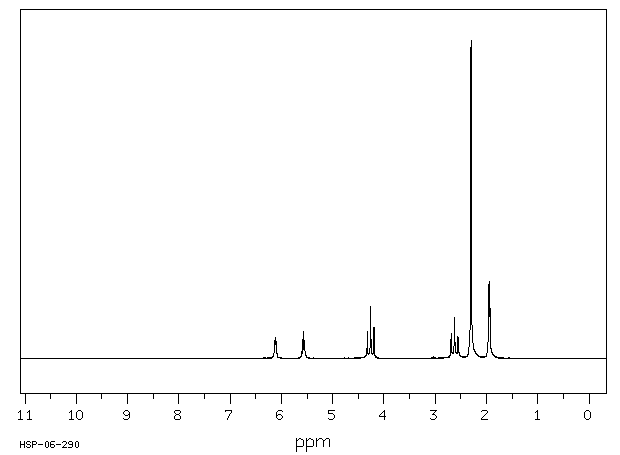
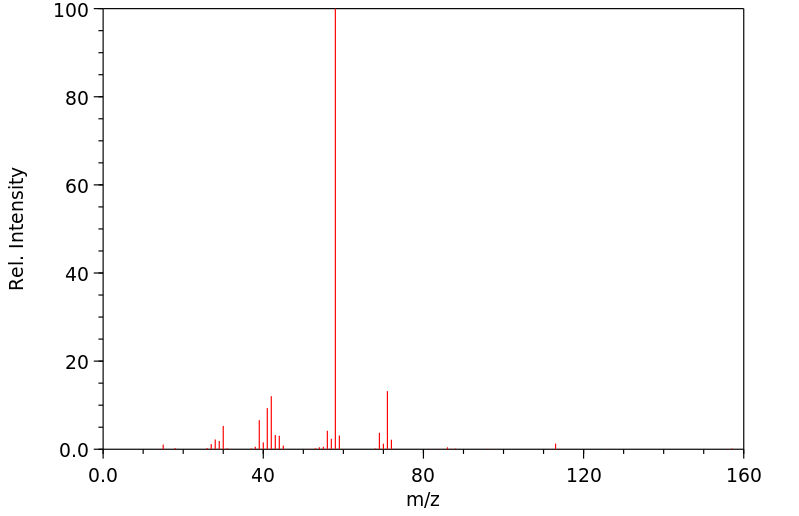
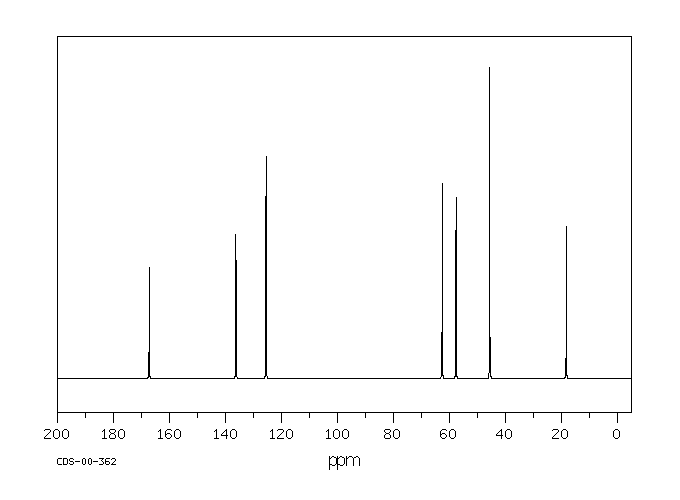
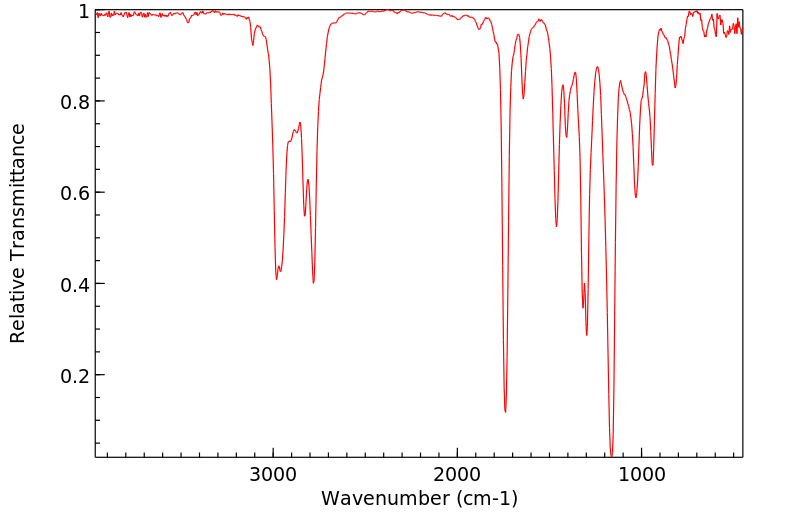
2-dimethylaminoethyl methacrylate appears as a clear colorless liquid. Less dense than water and insoluble in water. Vapors heavier than air and corrosive to eyes and mucous membranes. May polymerize exothermically if heated or contaminated. If polymerization takes place inside a closed container, the container may rupture violently. Produces toxic oxides of nitrogen during combustion. Toxic by skin absorption, ingestion and inhalation. Used to make plastics and in textiles.
颜色/状态:
Liquid
气味:
Amine-like
蒸汽密度:
5.4 (AIR= 1)
蒸汽压力:
0.72 mm Hg at 25 °C (est)
自燃温度:
255 °C
分解:
When heated to decomposition it emits toxic fumes of nitroxides.
粘度:
1.34 mPa s at 25 °C
汽化热:
48.8 kJ/mol
聚合:
METHYL METHACRYLATE, AND IN GENERAL THE METHACRYLIC ESTERS, POLYMERIZE MUCH LESS READILY THAN THE CORRESPONDING ORDINARY ACRYLATES. NONE THE LESS, THEY ARE STABILIZED BY ADDING HYDROQUINONE OR PYROGALLOL, PARTICULARLY IN THE PRESENCE OF METALLIC COPPER. /METHACRYLATES/
2-(Dimethylamino)ethyl methacrylate was rapidly hydrolyzed to methacrylic acid (CAS 79-41-4) and N,N,-dimethylaminoethanol (CAS 108-01-0) when incubated with simulated saliva or simulated intestinal fluid in vitro, but not with simulated gastric fluid.. 90% degradation was observed in simulated saliva after 4 hours at 37 °C, 86% degradation after incubation with simulated intestinal fluid for 4 hours at 37 °C. Degradation was below 8% after incubation with simulated gastric fluid for 4 hours at 37 °C.
IDENTIFICATION AND USE: N,N-dimethylaminoethyl methacrylate is a colorless liquid with amine-like odor.It is used in binders for coatings, textile chemicals, dispersing agents for nonaqueous systems, antistatic agents, stabilizers for chlorinated polymers, ion exchange resins, emulsifying agents, cationic precipitating agents. It is also used in dental materials, antithrombogenic prosthetics, experimental use in slow-release capsules, in cosmetics. More recently, It is also used in nanoparticles for gene delivery and drug delivery. HUMAN EXPOSURE AND TOXICITY: pH-Sensitive poly(N,N-dimethylaminoethyl methacrylate (DMAEMA)/2-hydroxyethyl methacrylate (HEMA)) nanoparticles were not cytotoxic. ANIMAL STUDIES: Dimethylaminoethyl methacrylate decreased the heart rate and force of contraction of isolated, perfused rabbit heart when added to perfusing liquid. Dimethylaminoethyl methacrylate was strongly irritating to skin of guinea pigs and conjunctiva of rabbits. When administered by gastric gavage to rabbits, dimethylaminoethyl methacrylate initially suppressed brain electrical activity and then induced clonic-tonic spasms. In dogs it produced hypertensive effect following iv administration. The toxicity of 6 acrylates and 6 methacrylates, including N,N-dimethylaminoethyl methacrylate, was determined in rats and fish. All the esters were less toxic than acrylamide and acrylonitrile.
来源:Hazardous Substances Data Bank (HSDB)
毒理性
吸入症状
咳嗽。喉咙痛。
Cough. Sore throat.
来源:ILO-WHO International Chemical Safety Cards (ICSCs)
毒理性
皮肤症状
皮肤烧伤。疼痛。
Skin burns. Pain.
来源:ILO-WHO International Chemical Safety Cards (ICSCs)
毒理性
眼睛症状
红斑。疼痛。严重深度烧伤。
Redness. Pain. Severe deep burns.
来源:ILO-WHO International Chemical Safety Cards (ICSCs)
毒理性
摄入症状
腹痛。腹泻。恶心。呕吐。灼热感。休克或昏厥。
Abdominal pain. Diarrhoea. Nausea. Vomiting. Burning sensation. Shock or collapse.
来源:ILO-WHO International Chemical Safety Cards (ICSCs)
1.周国泰,化学危险品安全技术全书,化学工业出版社,1997 2.国家环保局有毒化学品管理办公室、北京化工研究院合编,化学品毒性法规环境数据手册,中国环境科学出版社.1992 3.Canadian Centre for Occupational Health and Safety,CHEMINFO Database.1998 4.Canadian Centre for Occupational Health and Safety, RTECS Database, 1989
我们报告了使用RAFT水性分散聚合配方通过聚合诱导的自组装(PISA)合成阳离子空间稳定的二嵌段共聚物纳米粒子。阳离子空间稳定剂是基于季铵化的聚甲基丙烯酸2-(二甲基氨基)乙酯(PQDMA)的大分子链转移剂(macro-CTA),疏水性成核嵌段基于聚甲基丙烯酸2-(羟丙基)酯(PHPMA)。研究了各种合成参数(如盐浓度,固体含量,相对嵌段组成和阳离子电荷密度)的影响。在没有盐的情况下,由于高度阳离子的PQDMA稳定剂链之间的排斥力强,因此自组装会遇到问题。然而,在存在盐的情况下,可以通过以下方式解决此问题:(i)将QDMA单体与非离子型共聚单体(例如,单甲基丙烯酸甘油酯,GMA)进行统计共聚,或(ii)使用PQDMA宏CTA和聚(甲基丙烯酸单甘油酯)(PGMA)宏CTA。这些阳离子二嵌段共聚物纳米粒子通过1 H NMR光谱,动态光散射(DLS),透射电子显微镜(TEM)和水性电泳。NMR研
[EN] PHENOTHIAZINE DERIVATIVES AND USES THEREOF<br/>[FR] DÉRIVÉS DE PHÉNOTHIAZINE ET LEURS UTILISATIONS
申请人:CAMP4 THERAPEUTICS CORP
公开号:WO2019195789A1
公开(公告)日:2019-10-10
The present invention provides phenothiazine compounds, processes for their preparation, pharmaceutical compositions comprising the compounds, and the use of the compounds or the compositions in the treatment of various diseases or conditions, for example ribosomal disorders and ribosomopathies, e.g. Diamond Blackfan anemia (DBA).
SILANE COUPLING COMPOUNDS AND MEDICAL AND/OR DENTAL CURABLE COMPOSITIONS COMPRISING THE SAME
申请人:KABUSHIKI KAISHA SHOFU
公开号:US20190300552A1
公开(公告)日:2019-10-03
The present invention relate to a novel silane coupling agent and a medical and/or dental curable composition comprising the same. It is an object of the present invention to provide a novel silane coupling agent that imparts high affinity to a radical polymerizable monomer, thereby imparting high mechanical strength, flexibility and durability when used for a medical and/or dental curable composition, and an inorganic filler surface-treated with the novel silane coupling agent and a novel medical and/or dental curable composition. A silane coupling agent including repeating units such as a urethane bond and polyethylene glycol (ether bond) at a specific position is used.
[EN] A DENTAL COMPOSITION<br/>[FR] COMPOSITION DENTAIRE
申请人:STICK TECH OY
公开号:WO2020035321A1
公开(公告)日:2020-02-20
A dental composition comprising10-50 wt-% of a methacrylate-based first matrix component, a polymerisation system and as a second matrix component 1-50 wt-% of a compound having a general formula (I).
Disclosed are enol ethers compounds. The enol ethers exhibit low volatile organic content and are useful in a variety of chemical applications. The enol ethers can be used in applications as diluents, wetting agents, coalescing aids, paint additives and as intermediates in chemical processes. The enol ethers also have particular utility as film-hardening additives in coating formulations.
[EN] RANDOM COPOLYMER THERAPEUTIC AGENT CARRIERS AND ASSEMBLIES THEREOF<br/>[FR] SUPPORTS POUR AGENTS THÉRAPEUTIQUES À BASE D'UN COPOLYMÈRE ALÉATOIRE ET ENSEMBLES À BASE DE CEUX-CI
申请人:UNIV WASHINGTON CT COMMERCIALI
公开号:WO2015073579A1
公开(公告)日:2015-05-21
Provided herein are particles assemblies including a shell surrounding a core. The shell includes a particle-stabilizing random copolymer. The core includes a core random copolymer. The particle assemblies have a biomimetic design in which the polymeric components containing discrete chemical and biological functionalities are designed to spontaneously self-assemble into particles. Also provided herein are random copolymers having conjugated therapeutic agents that can be cleaved from the copolymers by an enzyme or water.