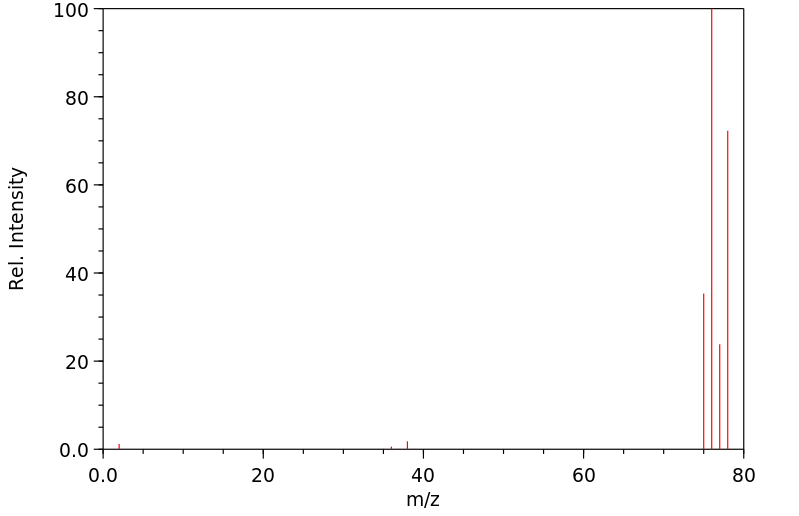
Arsine appears as a colorless gas with a disagreeable garlic odor. Flammable. Heavier than air. Flame easily flashes back to the source of leak. Extremely toxic by inhalation; has been used as a military poison gas. Confirmed human carcinogen. Under prolonged exposure to fire or heat containers may rupture violently and rocket. Rate of onset: Immediate to 24 hours Persistence: Minutes to hours Odor threshold: 0.5 ppm Source/use/other hazard: Used in electronics industry; reacts with H20 (don't use H2O in fire).
颜色/状态:
Colorless gas
气味:
Disagreeable garlic odor
沸点:
-62.5 °C
熔点:
-116 °C
闪点:
Flammable gas
溶解度:
In water, 28 mg/100 mL at 20 °C
密度:
1.689 at 185 °F (EPA, 1998)
蒸汽密度:
2.66 to 2.695 (EPA, 1998) (Relative to Air)
蒸汽压力:
11,000 mm Hg at 20 °C
稳定性/保质期:
On exposure to light, moist arsine decomposes quickly depositing shiny black arsenic
分解:
Decomposition point: 300 °C
粘度:
Viscosity of the gas at 101.325 kPa at 0 °C: 0.01458 mPaXs, 0.01458 mNXs/sq m
汽化热:
16.69 kJ/mol
电离电位:
9.89 eV
气味阈值:
The odor cannot always be relied upon for detection of the gas even though it often has an offensive smell resembling that of onions or carbide, which should arouse suspicion.
... Following inhalation of arsine and conversion to As(III), arsenic metabolism included methylation, and urinary excretion followed a triphasic model with periods of 28 hours, 59 hours, and 9 days.
IDENTIFICATION: Arsine is a colorless, extremely flammable gas with a garlic odor. The gas is heavier than air and accumulates close to the surface, which makes distant ignition possible in the presence of flame or spark. Arsine is extensively used in the semiconductor industry for epitaxial growth of gallium arsenide, as a doping agent for silicon based solid state electronic devices and the manufacture of light emitting diodes. HUMAN EXPOSURE: In humans arsine is absorbed via the lungs and mucosal surface of the respiratory tract. After exposure, the concentration of arsine increases rapidly in blood, whereas the distribution to the liver, kidneys and other organs is much slower. In humans, arsine is metabolized to trivalent and pentavalent arsenic. Trivalent arsenic is methylated to monomethylarsonate and dimethylarsinate. Arsine metabolites are mainly excreted via urine. Arsine in humans induces hemolysis with an increase in plasma hemoglobin, iron and potassium and subsequent anemia and kidney damage. No reliable information is available on exposure levels at which these effects occur. Myocardial and pulmonary failures are other causes of death. Severe liver lesions are rare. Anemia is observed accompanied by Heinz-Ehrlich corpuscles and increased leukocytosis. Hemoglobin, hemosiderin, erythrocytes, proteins and casts, found in urine. There are no data on the carcinogenicity or mutagenicity of arsine in humans. ANIMAL STUDIES: In animals, arsine is absorbed via the lungs and respiratory tract. In animals exposed to arsine, the concentration of arsine increases rapidly in blood, whereas distribution to liver, kidneys and lungs and other organs is much slower. In animals, arsine is metabolized to trivalent and pentavalent arsenic. Trivalent arsenic is methylated to monomethylarsonate and dimethylarsinate. These metabolites are mainly excreted via urine. The acute toxicity of arsine in different species is high. Inhalation of arsine by mice caused an increase in the relative spleen weight and a decrease in hematocrit. Histopathological changes observed included hemosiderosis and extramedullary hematopoietic activity in the spleen. Repeated exposure to arsine caused persistent splenomegaly and slight suppression of bone marrow erythroid precursors in rats, mice and Syrian Golden hamsters. Methemoglobinemia was noted in mice. In one study arsine did not induce developmental toxicity in mice or rats. There are no data on the carcinogenicity or mutagenicity in animals.
Classification of carcinogenicity: 1) evidence in humans: sufficient; 2) evidence in animals: limited. Overall summary evaluation of carcinogenic risk to humans is Group 1: Carcinogenic to humans. NOTE: This evaluation applies to the group of chemicals as a whole and not necessarily to all individual chemicals within the group. /Arsenic and arsenic compounds/
CLASSIFICATION: A; human carcinogen. BASIS FOR CLASSIFICATION: Based on sufficient evidence from human data. An increased lung cancer mortality was observed in multiple human populations exposed primarily through inhalation. Also, increased mortality from multiple internal organ cancers (liver, kidney, lung, and bladder) and an increased incidence of skin cancer were observed in populations consuming drinking water high in inorganic arsenic. HUMAN CARCINOGENICITY DATA: Sufficient. ANIMAL CARCINOGENICITY DATA: Inadequate. /Inorganic Arsenic/ /based on former classification system/
来源:Hazardous Substances Data Bank (HSDB)
毒理性
暴露途径
该物质可以通过吸入被身体吸收。
The substance can be absorbed into the body by inhalation.
来源:ILO-WHO International Chemical Safety Cards (ICSCs)
毒理性
暴露途径
吸入,皮肤和/或眼睛接触(液体)
inhalation, skin and/or eye contact (liquid)
来源:The National Institute for Occupational Safety and Health (NIOSH)
... Few studies of arsine absorption, distribution, or metabolism /were available/. One human study, however, provides some information. /Investigators/ studied a worker with acute arsine intoxication. The worker excreted dark red urine the morning following exposure and was hospitalized and hemodialyzed on the 3 successive days with gradual improvement. Daily blood samples and 24-hour urine samples were begun 20 hours after exposure and were collected during the subsequent 24 days. During this period, the amount of arsenic excreted was 41 mg. The species of arsenic excreted were monomethylarsonate (MMA) (about 16 mg), dimethylarsinate (DMA) (about 13 mg), and As(III) (8 mg). A much smaller amount of arsenobetaine was also detected, but in subsequent studies, this was thought to have been derived from diet.
Practically all arsenic compounds which are toxic may be absorbed from ... Alimentary tract. The vapors, particularly arsine & ethyl arsine diffuse through the pulmonary sac.
/Among 9 men exposed several months to undetermined amounts of arsine in extraction of gold/ arsine content of urine ranged from 0.3-3.3 mg/L (0.37-4.3 mg of arsenic trioxide (As2O3)). Max arsenic excretions in urine of 7/9 men ranged from 1.0-3.3 mg of As/L, with an average of 2 mg/L. Three months later 1 man ... excreting slightly above 1 mg/L; one 0.4 mg/L ...
Since arsenic appears to be excreted rather freely in urine, ...levels found in urine of intoxicated workers could have resulted from inhalation of concentrations below 1 mg/cu m or 0.31 ppm.
About 60% of arsine gas is absorbed by mice exposed to 0.025-2.5 mg/L by inhalation. In rabbits, highest concentrations were found in liver, lung and kidneys.
relatively lowtemperature. The samples have been sintered at 1100 and 1120 °C for SmFeAsO 1− x F x and GdFeAsO 1− x F x , respectively. These temperatures are at least 50–60° lower than other previous reports. All of the so-prepared samples possess a tetragonal ZrCuSiAs-type structure. Dramatically supression of the lattice parameters and increase in T c proved that this lowtemperature process was
摘要 以纳米级 ReF 3 作为氟资源,在相对较低的温度下制备了一系列 SmFeAsO 1− x F x 和 GdFeAsO 1− x F x ( x =0.05, 0.1, 0.15, 0.2, 0.25) 样品. SmFeAsO 1− x F x 和 GdFeAsO 1− x F x 分别在 1100 和 1120 °C 下烧结样品。这些温度至少比之前的其他报告低 50–60°。所有如此制备的样品都具有四方 ZrCuSiAs 型结构。晶格参数的显着抑制和 T c 的增加证明这种低温过程更有效地将氟引入稀土 FeAsO 中。SmFeAsO 1− x F x 的超导转变出现在 39.5 K 处,x =0.05,而 GdFeAsO 1− x F x 出现在 22 K 处,x =0.1。检测到的最高 T c 在 SmFeAsO 0.8 F 0.2 中为 54 K,在 GdFeAsO 0.75 F
Symmetry-Breaking Transitions in SmCu1+δAs2—χPχ(δ = 0 — 0.2, χ = 0 — 2). Effect of P and Additional Cu Atoms on Crystal Structures and Magnetic Properties
作者:Yurij Mozharivskyj、Alexandra O. Pecharsky、Sergej Bud'ko、Hugo F. Franzen
Symmetrieerniedrigende Phasenumwandlungen in SmCu1+δAs2—χPχ(δ = 0 — 0.2, χ = 0 — 2). Der Einflus von P- und zusatzlichen Cu-Atomen auf dieKristallstrukturenund magnetische Eigenschaften DieKristallstrukturen der Verbindungen SmCu1+δAs2—χPχ (δ = 0 — 0, 2, χ = 0 — 2), die symmetrieerniedrigende Phasenumwandlungen eingehen, und von SmCuP2, 3 wurden durch Rontgen-Einkristall- und -Pulver-Methoden untersucht
magnetoresistance measurements are reported in detail for the compounds, RCuAs2 for R=Pr, Nd, Sm, Gd, Tb, Dy, Ho, and Er, crystallizing in HfCuSi2-type tetragonal structure, with the aim of bringing out anomalies among ‘normal’ (that is, other than Ce and Yb) rare-earths. The results establish that all these compounds order antiferromagnetically at lowtemperatures with deviations from de Gennes scaling. Isothermal
摘要 详细报道了在 HfCuSi2 中结晶的化合物 R=Pr、Nd、Sm、Gd、Tb、Dy、Ho 和 Er 的直流磁化强度、热容量、电阻率 (ρ) 和磁阻测量结果-型四方结构,目的是在“正常”(即除 Ce 和 Yb 之外)稀土中发现异常。结果表明,所有这些化合物在低温下都是反铁磁有序的,与德热内斯标度存在偏差。低于各自 Neel 温度 (TN) 的等温磁化 (M) 数据揭示了大多数化合物(除了 R = Sm 和 Gd)存在场诱导的类超磁性跃迁,而在 Sm 和 Gd 化合物中,M 基本上随磁性线性变化场地。关于 ρ 行为,一方面,在 Sm 和其他方面,超过 50 K 的温度依赖性似乎存在细微差别。此外,对于 R=Ho 和 Er,对于 R=Sm、Gd、Tb 和 Dy 在顺磁状态(大约 20-30 K )最近报道的意外 ρ(T) 最小值基本上不存在。总体结果表明,该系列中的普通稀土在磁性方面呈现
Lattice distortions in layered type arsenides LnTAs2 (Ln=La–Nd, Sm, Gd, Tb; T=Ag, Au): Crystal structures, electronic and magnetic properties
The lanthanide coinage-metal diarsenides LnTAs2 (Ln=La, Ce–Nd, Sm; T=Ag, Au) have been reinvestigated and their structures have been refined from single crystal X-ray data. Two different distortion variants of the HfCuSi2 type are found: PrAgAs2, NdAgAs2, SmAgAs2, GdAgAs2, TbAgAs2, NdAuAs2 and SmAuAs2 crystallize as twofold superstructures in space group Pmcn with the As atoms of their planar layers
New arsenides LnAgAs2 (Ln=La, Ce, Pr, Nd, Sm, Gd, Tb, Dy) and their crystal structure
作者:R.O. Demchyna、Yu.B. Kuz’ma、V.S. Babizhetsky
DOI:10.1016/s0925-8388(00)01273-1
日期:2001.2
LnAgAs2 (Ln=La, Ce, Pr, Nd, Sm, Gd, Tb, Dy) have been obtained by sintering of pure components. LaAgAs2 and CeAgAs2 exhibit the tetragonal HfCuSi2 type structure with space group P4/nmm. The crystal structure of CeAgAs2 has been refined using X-ray powder diffraction data (a=4.0777(2) A, c=10.5262 A, R=0.078). The LnAgAs2 (Ln=Pr, Nd, Sm, Gd, Tb, Dy) compounds possess a crystal structure of a new type