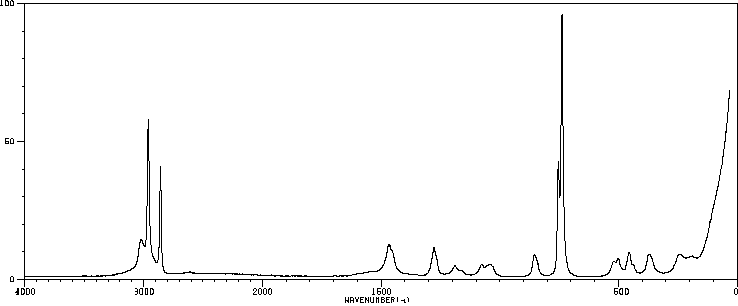
Trimethyl phosphate appears as a pale straw colored liquid. Inhalation may irritate respiratory tract. Vapor or liquid may irritate skin or eyes. Ingestion may irritate the mucous membranes of the gastrointestinal tract.
Rats treated orally at 100 mg/kg and mice treated ip at 1000 mg/kg with (32)P-labeled trimethyl phosphate excreted primarily dimethyl phosphate in the urine. Only traces of the parent compound were detected, and only in the rats at less than 6 hr after treatment. S-Methyl cysteine and S-methyl cysteine N-acetate were also isolated. Small amounts of S-methyl glutathione were detected, presumably the initial methylation product in this series of metabolites ... . Metabolism of trimethyl phosphate was faster in the mouse than in the rat, but there was no evidence of further conversion to monomethyl phosphate in either species ... .
IDENTIFICATION AND USE: Trimethyl phosphate is a colorless liquid. It is used as a gasoline additive for controlling surface ignition and spark plug fouling; methylating agent, chemical intermediate in the production of polymethyl polyphosphates; flame retardant solvent for paints and polymers; catalyst in the preparation of polymers and resins. HUMAN EXPOSURE AND TOXICITY: Weakness and paralysis are neurotoxic effects of trimethyl phosphate. ANIMAL STUDIES: Trimethyl phosphate was a rabbit eye irritant. In rabbits oral or dermal administration produced flaccid and spastic paralysis. Trimethyl phosphate was neurotoxic in beagle dogs. After 4 wk, neurotoxicity was noted in impairment of hopping, tactile placing, and atactic gait. Electrophysiologic tests indicated a prolonged latency of neuromuscular impulse transmission after wk 9, followed by a decrease in maximum conduction velocity of sensory fibers. Peripheral nerve fibers also had abnormalities at this time, including paranodal and internodal swelling, paranodal demyelination, and distal fragmentation. Trimethyl phosphate induced sterility in mice, rats and rabbits. Trimethyl phosphate primarily affected epididymal spermatozoa, probably by action of sperm motility. Trimethyl phosphate causes aspermia in D. melanogaster males. Evidence from cytological studies of larval testes suggests that the chemosterilizing effect of the chemical is upon early primary spermatocytes. In developmental studies in mice, F1 male progeny were sterile or semi-sterile, resulting from heritable translocations. Thus, trimethyl phosphate is capable of causing chromosomal damage in mouse spermatids. in NTP carcinogenicity studies trimethyl phosphate was associated with the induction of benign fibromas of the subcutaneous tissue in male Fischer rats. No evidence of carcinogenicity of the compound was obtained in female rats. Trimethylphosphate was carcinogenic in female mice, inducing adenocarcinomas of the uterus/endometrium. No evidence of carcinogenicity of the compound was obtained in male mice. ECOTOXICITY STUDIES: In Japanese quail treated orally with trimethyl phosphate, there was rapid decline in the percentage of fertile eggs during the 10 day period following the first dose. In another study it was reported that only 81% of eggs laid between 1 and 35 days after treatment of male quail with trimethyl phosphate were fertile, significantly less than in the control group .
来源:Hazardous Substances Data Bank (HSDB)
毒理性
暴露途径
该物质可以通过吸入其蒸汽、通过皮肤接触以及摄入进入人体。
The substance can be absorbed into the body by inhalation of its vapour, through the skin and by ingestion.
来源:ILO-WHO International Chemical Safety Cards (ICSCs)
毒理性
吸入症状
咳嗽。喉咙痛。
Cough. Sore throat.
来源:ILO-WHO International Chemical Safety Cards (ICSCs)
毒理性
皮肤症状
Redness.
Redness.
来源:ILO-WHO International Chemical Safety Cards (ICSCs)
毒理性
眼睛症状
Redness.
Redness.
来源:ILO-WHO International Chemical Safety Cards (ICSCs)
烟酰胺腺嘌呤二核苷酸 (NAD) 辅因子代谢在癌症发展中发挥着重要作用。肿瘤细胞对 NAD 和 ATP 的需求增加,以支持快速生长和增殖。通过靶向关键的 NAD 生物合成酶来限制可用 NAD 的量已成为一种有前景的抗癌治疗方法。在哺乳动物中,烟酰胺/烟酸腺苷酸转移酶 (NMNAT) 催化所有已知 NAD 合成途径的关键下游反应。合成了新型烟酰胺/烟酸腺嘌呤二核苷酸 (NAD/NaAD) 类似物 1-4,在腺苷部分的核糖 2'-C 和 3'-C-位置含有甲基,作为人类三种亚型的抑制剂NMN-腺苷酰转移酶,命名为 hNMNAT-1、hNMNAT-2 和 hNMNAT-3。基于 NMR 的构象分析表明,各个 NAD 类似物 (1-4) 具有不同的构象偏好。对二核苷酸 1-4 作为 hNMNAT 同工型抑制剂的生物学评估揭示了不同构象(北抗和南顺)与酶抑制活性之间的结构关系。在合成和测试的新系列 NAD
Deoxygenation of Polyhydroxybenzenes: An Alternative Strategy for the Benzene-Free Synthesis of Aromatic Chemicals
作者:Chad A. Hansen、J. W. Frost
DOI:10.1021/ja0176346
日期:2002.5.1
e requires 2 enzyme-catalyzed and 2 chemical steps. By contrast, synthesis of hydroquinone using the shikimate pathway and intermediacy of quinic acid requires 18 enzyme-catalyzed steps and 1 chemical step. Methylation of triacetic acid lactone, cyclization, and regioselective deoxygenation of phloroglucinol methyl ether affords resorcinol. Given the ability to synthesize triacetic acid lactone from
A Facile and Efficient Synthesis of (15R)-Latanoprost from Chiral Precursor Corey Lactone Diol
作者:K VIJENDHAR、B SRINIVAS、SATHYANARAYANA BOODIDA
DOI:10.1007/s12039-015-0963-2
日期:2015.11
synthetic protocol is a good alternative for the synthesis of latanoprost with high stereo selectivity and improved yield. A simple, convenient and convergent approach for the synthesis of (15R) latanoprost is reported with high stereo selectivity and improved yield fromchiral precursor Corey lactone diol using Swern oxidation, allylic reduction and Wittig reaction conditions.
Bimolecular nucleophilic substitution (SN2) is one of the most well-known fundamental reactions in organic chemistry to generate new molecules from two molecules. In principle, a nucleophile attacks from the back side of an alkylatingagent having a suitable leaving group, most commonly a halide. However, alkyl halides are expensive, very harmful, toxic and not so stable, which makes them problematic
COMPOUNDS FOR USING IN IMAGING AND PARTICULARLY FOR THE DIAGNOSIS OF NEURODEGENERATIVE DISEASES
申请人:CENTRE NATIONAL DE LA RECHERCHE SCIENTIFIQUE
公开号:US20190211011A1
公开(公告)日:2019-07-11
The invention relates to compounds of formula (II) for using in imaging and particularly for the diagnosis of neurodegenerative diseases
该发明涉及公式(II)的化合物,用于影像学,特别是用于诊断神经退行性疾病。
[EN] NUCLEOTIDE AND NUCLEOSIDE COMPOSITIONS AND USES RELATED THERETO<br/>[FR] COMPOSITIONS À BASE DE NUCLÉOTIDE ET DE NUCLÉOSIDE ET UTILISATIONS CORRESPONDANTES
申请人:UNIV EMORY
公开号:WO2015038596A1
公开(公告)日:2015-03-19
This disclosure relates to nucleotide and nucleoside therapeutic compositions and uses in treating infectious diseases, viral infections, and cancer, where the base of the nucleotide or nucleoside contains at least one thiol, thione or thioether.