接口广告
摩熵化学
数据开放平台 数据库官网
小程序
打开微信扫一扫
首页 分子通 化学资讯 化学百科 反应查询 关于我们
请输入关键词

灭线磷 | 13194-48-4

中文名称
灭线磷
中文别名
灭克磷;虫线磷;益收宝;益舒宝;丙线磷;O-乙基-S,S'-二丙基二硫代磷酸酯;O-乙基-S,S-二丙基二硫代磷酸酯
英文名称
Ethoprophos
英文别名
Ethoprop;O-ethyl S,S-dipropyl phosphorodithioate;mocap;S,s-dipropyl O-ethyl phosphorodithioate;1-[ethoxy(propylsulfanyl)phosphoryl]sulfanylpropane
灭线磷化学式
CAS
13194-48-4
化学式
C8H19O2PS2
mdl
MFCD00055333
分子量
242.343
InChiKey
VJYFKVYYMZPMAB-UHFFFAOYSA-N
BEILSTEIN
——
EINECS
——
  • 物化性质
  • 计算性质
  • ADMET
  • 安全信息
  • SDS
  • 制备方法与用途
  • 上下游信息
  • 反应信息
  • 文献信息
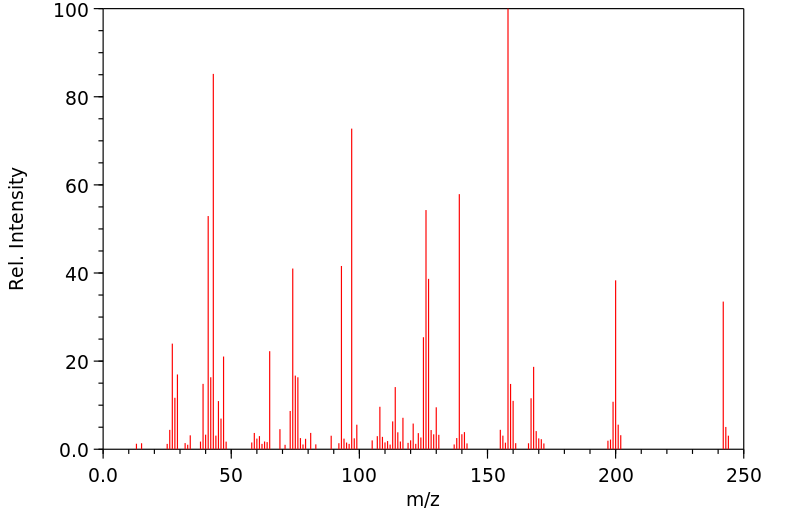
  • 表征谱图
  • 同类化合物
  • 相关功能分类
  • 相关结构分类

物化性质

  • 熔点:
    -13 °C
  • 沸点:
    86-91°C
  • 密度:
    d420 1.094
  • 闪点:
    100 °C
  • 溶解度:
    DMF:5mg/mL;二甲基亚砜:5mg/mL;乙醇:1.6mg/mL
  • 物理描述:
    Ethorop is one of a family of organophosphorus pesticides. It is combustible though it may require some effort to ignite. It is very toxic by skin absorption and inhalation. It may or may not be water soluble.
  • 颜色/状态:
    Pale yellow liquid
  • 蒸汽密度:
    Relative vapor density (air = 1): 8.4
  • 蒸汽压力:
    3.8X10⁻⁴ mm Hg @ 20-25 °C
  • 稳定性/保质期:

    纯品是一种淡黄色的透明液体,略微带有醇的气味。

  • 分解:
    When heated to decomposition it emits very toxic fumes of /phosphorus oxides and sulfur oxides/.
  • 腐蚀性:
    Non-corrosive to metals
  • 碰撞截面:
    149.27 Ų [M+H]+ [CCS Type: TW]
  • 保留指数:
    1606;1616;1647;1629;1591.4;1611.3;1631.5;1620.6;1621.2

计算性质

  • 辛醇/水分配系数(LogP):
    3.6
  • 重原子数:
    13
  • 可旋转键数:
    8
  • 环数:
    0.0
  • sp3杂化的碳原子比例:
    1.0
  • 拓扑面积:
    76.9
  • 氢给体数:
    0
  • 氢受体数:
    4

ADMET

代谢
在给大鼠通过胃管给药标记的Mocap后,尿液中含有了甲基丙基醚、甲基丙基亚砜和甲基丙基砜的微量...主要的溶性代谢物是O-乙基-S-丙基酰酸。这也同样在肝脏微粒体和上清液中得到了。大鼠尿液中还含有O-乙基磷酸、S-丙基酰酸和S,S-二丙基代二酰酸。大鼠和兔肝上清液酶在谷胱甘肽存在的情况下去乙基化Mocap,并形成了S-乙基谷胱甘肽
After admin of labeled Mocap by stomach tube to rats, urine contained traces of methyl propyl sulfide, methyl propyl sulfoxide and methyl propyl sulfone... Major water-sol metabolite was o-ethyl-s-propyl phosphorothioic acid. This was also obtained with liver microsomes and supernatant. Rat urine also contained o-ethyl phosphoric acid, s-propyl phosphorothiolic acid and s,s-dipropyl phosphorodithioic acid. Rat and rabbit liver supernatant enzymes de-ethylated Mocap in the presence of glutathione and formed s-ethylglutathione.
来源:Hazardous Substances Data Bank (HSDB)
代谢
在代谢研究中,对Crl:CD(SD)BR大鼠通过单次静脉注射(雄性和雌性)、单次口服给药(雌性,代谢和药代动力学研究;雄性,仅代谢)或多次口服给药给予乙氧苯。口服给药后,乙氧苯被完全吸收并完全代谢。代谢是通过去烷基化一个或两个S-丙基基团,然后是羟基化,可能是接着的共轭反应。通过高效液相色谱法鉴定出两种尿液代谢物,而另外三种被认为是这些代谢物共轭物的可能形式。粪便代谢物的薄层色谱图与尿液代谢物的色谱图相似。
In a metabolism study, ethoprop was administered to Crl:CD(SD)BR rats as a single IV bolus (males and females); single oral bolus (females, metabolism and pharmacokinetic studies; males, metabolism only); or by multiple oral doses. Following oral administration, ethoprop was completely absorbed and completely metabolized. ...Metabolism was by dealkylation of one or both S-propyl groups, followed by hydroxylation and probably conjugation. Two urinary metabolites were identified by HPLC while 3 others were believed to be possible conjugates of those metabolites. The TLC profiles of fecal metabolites were similar to the profiles for urinary metabolites.
来源:Hazardous Substances Data Bank (HSDB)
代谢
有机化合物的代谢主要通过氧化、通过酯酶解以及与谷胱甘肽反应进行。去甲基化和葡萄糖醛酸化也可能发生。有机农药的氧化可能导致产生中等毒性的产物。一般来说,酯本身并不直接有毒,但需要通过氧化代谢转化为近端毒素。谷胱甘肽转移酶反应产生的产物在大多数情况下毒性较低。对氧酶(PON1)是有机化合物代谢的关键酶。PON1可以通过解使一些有机化合物失活。PON1解多种有机磷杀虫剂以及神经毒剂(如梭曼、沙林和VX)的活性代谢物。PON1的多态性导致这种酯酶的酶平和催化效率不同,这反过来表明不同个体可能更容易受到有机暴露的毒性影响。
Metabolism of organophosphates occurs principally by oxidation, by hydrolysis via esterases and by reaction with glutathione. Demethylation and glucuronidation may also occur. Oxidation of organophosphorus pesticides may result in moderately toxic products. In general, phosphorothioates are not directly toxic but require oxidative metabolism to the proximal toxin. The glutathione transferase reactions produce products that are, in most cases, of low toxicity. Paraoxonase (PON1) is a key enzyme in the metabolism of organophosphates. PON1 can inactivate some organophosphates through hydrolysis. PON1 hydrolyzes the active metabolites in several organophosphates insecticides as well as, nerve agents such as soman, sarin, and VX. The presence of PON1 polymorphisms causes there to be different enzyme levels and catalytic efficiency of this esterase, which in turn suggests that different individuals may be more susceptible to the toxic effect of organophosphate exposure.
来源:Toxin and Toxin Target Database (T3DB)
毒理性
  • 毒性总结
乙氧丙是一种胆碱酯酶乙酰胆碱酯酶(AChE)抑制剂胆碱酯酶抑制剂(或“抗胆碱酯酶”)抑制乙酰胆碱酯酶的作用。由于其基本功能,干扰乙酰胆碱酯酶作用的化学物质是强大的神经毒素,在低剂量时会导致过度流涎和眼泪,随后是肌肉痉挛,最终导致死亡。神经气体和许多用于杀虫剂的物质已被证明通过结合乙酰胆碱酯酶活性位点的丝氨酸,完全抑制该酶。乙酰胆碱酯酶分解神经递质乙酰胆碱,后者在神经和肌肉接头处释放,以使肌肉或器官放松。乙酰胆碱酯酶抑制的结果是乙酰胆碱积累并继续发挥作用,使得任何神经冲动持续传递,肌肉收缩不会停止。最常见的乙酰胆碱酯酶抑制剂之一是基于的化合物,它们被设计用来结合到酶的活性位点上。结构要求是一个带有两个亲脂性基团的原子,一个离去基团(如卤素或硫氰酸盐),以及一个末端的氧。
Ethoprop is a cholinesterase or acetylcholinesterase (AChE) inhibitor. A cholinesterase inhibitor (or 'anticholinesterase') suppresses the action of acetylcholinesterase. Because of its essential function, chemicals that interfere with the action of acetylcholinesterase are potent neurotoxins, causing excessive salivation and eye-watering in low doses, followed by muscle spasms and ultimately death. Nerve gases and many substances used in insecticides have been shown to act by binding a serine in the active site of acetylcholine esterase, inhibiting the enzyme completely. Acetylcholine esterase breaks down the neurotransmitter acetylcholine, which is released at nerve and muscle junctions, in order to allow the muscle or organ to relax. The result of acetylcholine esterase inhibition is that acetylcholine builds up and continues to act so that any nerve impulses are continually transmitted and muscle contractions do not stop. Among the most common acetylcholinesterase inhibitors are phosphorus-based compounds, which are designed to bind to the active site of the enzyme. The structural requirements are a phosphorus atom bearing two lipophilic groups, a leaving group (such as a halide or thiocyanate), and a terminal oxygen.
来源:Toxin and Toxin Target Database (T3DB)
毒理性
  • 致癌性证据
癌症分类:可能对人类致癌
Cancer Classification: Likely to be Carcinogenic to Humans
来源:Hazardous Substances Data Bank (HSDB)
毒理性
  • 致癌物分类
对人类不具有致癌性(未被国际癌症研究机构IARC列名)。
No indication of carcinogenicity to humans (not listed by IARC).
来源:Toxin and Toxin Target Database (T3DB)
毒理性
  • 健康影响
急性接触胆碱酯酶抑制剂可能会导致胆碱能危象,表现为严重的恶心/呕吐、流涎、出汗、心动过缓、低血压、崩溃和抽搐。肌肉无力可能性增加,如果呼吸肌受到影响,可能会导致死亡。在运动神经积累的乙酰胆碱会导致神经肌肉接头处尼古丁受体的过度刺激。当这种情况发生时,可以看到肌肉无力、疲劳、肌肉痉挛、肌束震颤和麻痹的症状。当自主神经节积累乙酰胆碱时,这会导致交感系统中尼古丁受体的过度刺激。与此相关的症状包括高血压和低血糖。由于乙酰胆碱积累,中枢神经系统中尼古丁乙酰胆碱受体的过度刺激会导致焦虑、头痛、抽搐、共济失调、呼吸和循环抑制、震颤、全身无力,甚至可能昏迷。当由于副交感神经节积累乙酰胆碱导致毒蕈碱受体过度刺激时,可能会出现视力障碍、胸部紧绷、由于支气管收缩引起的喘息、支气管分泌物增加、唾液分泌增加、流泪、出汗、肠蠕动和排尿的症状。生育、生长和发育方面的某些生殖效应已特定与有机农药暴露有关。关于生殖效应的大多数研究都是在农村地区使用农药和杀虫剂的农民中进行的。在女性中,月经周期紊乱、怀孕时间延长、自然流产、死产以及后代的一些发育效应已与有机农药暴露有关。产前暴露与胎儿生长和发育受损有关。神经毒性效应也与有机农药中毒有关,导致人类出现四种神经毒性效应:胆碱能综合征、中间综合征、有机诱导的迟发性多发性神经病(OPIDP)和慢性有机诱导的神经精神障碍(COPIND)。这些综合征在急性 and 慢性暴露于有机农药后出现。
Acute exposure to cholinesterase inhibitors can cause a cholinergic crisis characterized by severe nausea/vomiting, salivation, sweating, bradycardia, hypotension, collapse, and convulsions. Increasing muscle weakness is a possibility and may result in death if respiratory muscles are involved. Accumulation of ACh at motor nerves causes overstimulation of nicotinic expression at the neuromuscular junction. When this occurs symptoms such as muscle weakness, fatigue, muscle cramps, fasciculation, and paralysis can be seen. When there is an accumulation of ACh at autonomic ganglia this causes overstimulation of nicotinic expression in the sympathetic system. Symptoms associated with this are hypertension, and hypoglycemia. Overstimulation of nicotinic acetylcholine receptors in the central nervous system, due to accumulation of ACh, results in anxiety, headache, convulsions, ataxia, depression of respiration and circulation, tremor, general weakness, and potentially coma. When there is expression of muscarinic overstimulation due to excess acetylcholine at muscarinic acetylcholine receptors symptoms of visual disturbances, tightness in chest, wheezing due to bronchoconstriction, increased bronchial secretions, increased salivation, lacrimation, sweating, peristalsis, and urination can occur. Certain reproductive effects in fertility, growth, and development for males and females have been linked specifically to organophosphate pesticide exposure. Most of the research on reproductive effects has been conducted on farmers working with pesticides and insecticdes in rural areas. In females menstrual cycle disturbances, longer pregnancies, spontaneous abortions, stillbirths, and some developmental effects in offspring have been linked to organophosphate pesticide exposure. Prenatal exposure has been linked to impaired fetal growth and development. Neurotoxic effects have also been linked to poisoning with OP pesticides causing four neurotoxic effects in humans: cholinergic syndrome, intermediate syndrome, organophosphate-induced delayed polyneuropathy (OPIDP), and chronic organophosphate-induced neuropsychiatric disorder (COPIND). These syndromes result after acute and chronic exposure to OP pesticides.
来源:Toxin and Toxin Target Database (T3DB)
毒理性
  • 暴露途径
该物质可以通过吸入、皮肤接触、眼睛接触和摄入而被人体吸入危险量的有害物质。
The substance can be absorbed into the body in hazardous amounts by inhalation, through the skin, through the eyes and by ingestion.
来源:ILO-WHO International Chemical Safety Cards (ICSCs)
吸收、分配和排泄
在代谢研究中,将乙氧苯通过单次静脉注射(雄性和雌性)或单次口服(雌性,用于代谢和药代动力学研究;雄性,仅用于代谢研究)或多次口服给药的方式给予Crl:CD(SD)BR大鼠。口服给药后,乙氧苯被完全吸收并完全代谢。排泄途径包括尿液(超过50%的给药剂量)、粪便(7-16%)和呼吸(11-19%),在48小时内基本完成。
In a metabolism study, ethoprop was administered to Crl:CD(SD)BR rats as a single IV bolus (males and females); single oral bolus (females, metabolism and pharmacokinetic studies; males, metabolism only); or by multiple oral doses. Following oral administration, ethoprop was completely absorbed and completely metabolized. Excretion was by urinary (>50% administered dose), fecal (7-16%), and respiratory (11-19%) routes and was essentially complete by 48 hours.
来源:Hazardous Substances Data Bank (HSDB)

安全信息

  • 危险等级:
    6.1(a)
  • 危险品标志:
    T+,N
  • 安全说明:
    S27,S27/28,S28,S36/37/39,S45,S60,S61
  • 危险类别码:
    R50/53,R25,R26/27,R43
  • WGK Germany:
    3
  • 海关编码:
    2930909067
  • RTECS号:
    TE4025000
  • 包装等级:
    II
  • 危险类别:
    6.1(a)
  • 危险品运输编号:
    UN 2810
  • 储存条件:
    库房应保持通风、低温和干燥,并与其他非食品原料分开储存和运输。

SDS

SDS:56927a7c327a24f73aab62829da35057
查看

模块 1. 化学
1.1 产品标识符
: 灭线磷
产品名称
1.2 鉴别的其他方法
O-Ethyl S,S-dipropyl phOSphorodithioate
Ethoprop
EthoprofOS
1.3 有关的确定了的物质或混合物的用途和建议不适合的用途
仅用于研发。不作为药品、家庭或其它用途。

模块 2. 危险性概述
2.1 GHS-分类
急性毒性, 经口 (类别 2)
急性毒性, 吸入 (类别 1)
急性毒性, 经皮 (类别 1)
皮肤过敏 (类别 1)
急性生毒性 (类别 1)
慢性生毒性 (类别 1)
2.2 GHS 标记要素,包括预防性的陈述
象形图
警示词 危险
危险申明
H300 吞咽致命。
H310 皮肤接触致命。
H317 可能导致皮肤过敏反应。
H330 吸入致命。
H410 对生物毒性极大并具有长期持续影响.
警告申明
预防措施
P260 不要吸入粉尘/ 烟/ 气体/ 烟雾/ 蒸汽/ 喷雾。
P262 防止溅入眼睛、接触皮肤或衣服。
P264 操作后彻底清洁皮肤。
P270 使用本产品时不要进食、饮或吸烟。
P271 只能在室外或通风良好之处使用。
P272 禁止将污染的工作服带出作业场所。
P273 避免释放到环境中。
P280 穿戴防护手套/ 防护服。
P284 戴呼吸防护装置。
事故响应
P301 + P310 如果吞下去了: 立即呼救解毒中心或医生。
P302 + P350 如果在皮肤上: 仔细地用大量肥皂和洗。
P304 + P340 如吸入: 将患者移到新鲜空气处休息,并保持呼吸舒畅的姿势。
P310 立即呼叫中毒控制中心或医生.
P320 具体紧急处置(见本标签上提供的急救指导)。
P330 漱口。
P333 + P313 如出现皮肤刺激或皮疹:求医/就诊。
P361 立即除去/脱掉所有沾污的衣物。
P363 沾污的衣服清洗后方可再用。
P391 收集溢出物。
安全储存
P403 + P233 存放于通风良的地方。 保持容器密闭。
P405 存放处须加锁。
废弃处置
P501 将内容物/ 容器处理到得到批准的废物处理厂。
2.3 其它危害物 - 无

模块 3. 成分/组成信息
3.1 物 质
: O-Ethyl S,S-dipropyl phOSphorodithioate
别名
Ethoprop
EthoprofOS
: C8H19O2PS2
分子式
: 242.34 g/mol
分子量
组分 浓度或浓度范围
Ethyl-S,S-dipropyl phOSphorodithioate
<=100%
化学文摘登记号(CAS 13194-48-4
No.) 236-152-1
EC-编号 015-107-00-8
索引编号

模块 4. 急救措施
4.1 必要的急救措施描述
一般的建议
请教医生。 向到现场的医生出示此安全技术说明书。
吸入
如果吸入,请将患者移到新鲜空气处。 如呼吸停止,进行人工呼吸。 请教医生。
皮肤接触
用肥皂和大量的冲洗。 立即将患者送往医院。 请教医生。
眼睛接触
冲洗眼睛作为预防措施。
食入
切勿给失去知觉者通过口喂任何东西。 用漱口。 请教医生。
4.2 主要症状和影响,急性和迟发效应
胆碱酯酶抑制剂能引起严重流涎以及肺部分泌、流泪、视力模糊、大便失禁、腹泻、震颤、共济失调、出汗、
体温降低、心率下降,和/或血压下降(由于作用于胆碱能神经位点), 头痛, 恶心, 呕吐, 嗜睡, 头晕, 混乱,
虚弱, 肌肉痉挛
4.3 及时的医疗处理和所需的特殊处理的说明和指示
无数据资料

模块 5. 消防措施
5.1 灭火介质
灭火方法及灭火剂
雾,抗乙醇泡沫,干粉或二氧化碳灭火。
5.2 源于此物质或混合物的特别的危害
碳氧化物, 氧化物, 的氧化物
5.3 给消防员的建议
如必要的话,戴自给式呼吸器去救火。
5.4 进一步信息
无数据资料

模块 6. 泄露应急处理
6.1 作业人员防护措施、防护装备和应急处置程序
戴呼吸罩。 避免吸入蒸气、烟雾或气体。 保证充分的通风。 人员疏散到安全区域。
6.2 环境保护措施
如能确保安全,可采取措施防止进一步的泄漏或溢出。 不要让产品进入下道。
一定要避免排放到周围环境中。
6.3 泄漏化学品的收容、清除方法及所使用的处置材料
用惰性吸附材料吸收并当作危险废物处理。 放入合适的封闭的容器中待处理。
6.4 参考其他部分
丢弃处理请参阅第13节。

模块 7. 操作处置与储存
7.1 安全操作的注意事项
避免接触皮肤和眼睛。 避免吸入蒸气和烟雾。
7.2 安全储存的条件,包括任何不兼容性
贮存在阴凉处。 使容器保持密闭,储存在干燥通风处。
打开了的容器必须仔细重新封口并保持竖放位置以防止泄漏。
建议的贮存温度: 2 - 8 °C
7.3 特定用途
无数据资料

模块 8. 接触控制和个体防护
8.1 容许浓度
最高容许浓度
没有已知的国家规定的暴露极限。
8.2 暴露控制
适当的技术控制
避免与皮肤、眼睛和衣服接触。 休息前和操作本品后立即洗手。
个体防护设备
眼/面保护
面罩與安全眼鏡请使用经官方标准如NIOSH (美国) 或 EN 166(欧盟) 检测与批准的设备防护眼部。
皮肤保护
戴手套取 手套在使用前必须受检查。
请使用合适的方法脱除手套(不要接触手套外部表面),避免任何皮肤部位接触此产品.
使用后请将被污染过的手套根据相关法律法规和有效的实验室规章程序谨慎处理. 请清洗并吹干双手
所选择的保护手套必须符合EU的89/686/EEC规定和从它衍生出来的EN 376标准。
身体保护
全套防化学试剂工作服, 防护设备的类型必须根据特定工作场所中的危险物的浓度和数量来选择。
呼吸系统防护
如危险性评测显示需要使用空气净化的防毒面具,请使用全面罩式多功能防毒面具(US)或ABEK型
(EN
14387)防毒面具筒作为工程控制的候补。如果防毒面具是保护的唯一方式,则使用全面罩式送风防
毒面具。 呼吸器使用经过测试并通过政府标准如NIOSH(US)或CEN(EU)的呼吸器和零件。

模块 9. 理化特性
9.1 基本的理化特性的信息
a) 外观与性状
形状: 液体
颜色: 黄色
b) 气味
无数据资料
c) 气味阈值
无数据资料
d) pH值
无数据资料
e) 熔点/凝固点
无数据资料
f) 沸点、初沸点和沸程
无数据资料
g) 闪点
> 100.00 °C
h) 蒸发速率
无数据资料
i) 易燃性(固体,气体)
无数据资料
j) 高的/低的燃烧性或爆炸性限度 无数据资料
k) 蒸气压
0.0047 hPa 在 25 °C
l) 蒸汽密度
无数据资料
m) 密度/相对密度
1.094 g/cm3 在 20 °C
n) 溶性
不溶
o) n-辛醇/分配系数
无数据资料
p) 自燃温度
无数据资料
q) 分解温度
无数据资料
r) 粘度
无数据资料

模块 10. 稳定性和反应活性
10.1 反应性
无数据资料
10.2 稳定性
无数据资料
10.3 危险反应
无数据资料
10.4 应避免的条件
无数据资料
10.5 不相容的物质
强氧化剂
10.6 危险的分解产物
其它分解产物 - 无数据资料

模块 11. 毒理学资料
11.1 毒理学影响的信息
急性毒性
半数致死剂量 (LD50) 经口 - 大鼠 - 34 mg/kg
半数致死浓度(LC50) 吸入 - 大鼠 - 123 mg/m3
半数致死剂量 (LD50) 经皮 - 兔子 - 2.4 mg/kg
皮肤刺激或腐蚀
无数据资料
眼睛刺激或腐蚀
无数据资料
呼吸道或皮肤过敏
无数据资料
生殖细胞致突变性
无数据资料
致癌性
IARC:
此产品中没有大于或等于 0。1%含量的组分被 IARC鉴别为可能的或肯定的人类致癌物。
生殖毒性
无数据资料
特异性靶器官系统毒性(一次接触)
无数据资料
特异性靶器官系统毒性(反复接触)
无数据资料
吸入危险
无数据资料
潜在的健康影响
吸入 吸入可能致死。 可能引起呼吸道刺激。
摄入 吞咽可能致死。
皮肤 通过皮肤吸收可能致死。 可能引起皮肤刺激。
眼睛 可能引起眼睛刺激。
接触后的征兆和症状
胆碱酯酶抑制剂能引起严重流涎以及肺部分泌、流泪、视力模糊、大便失禁、腹泻、震颤、共济失调、出汗、
体温降低、心率下降,和/或血压下降(由于作用于胆碱能神经位点), 头痛, 恶心, 呕吐, 嗜睡, 头晕, 混乱,
虚弱, 肌肉痉挛
附加说明
化学物质毒性作用登记: TE4025000

模块 12. 生态学资料
12.1 生态毒性
对鱼类的毒性 半数致死浓度(LC50) - 鲫属 (鲤鱼) - 0.64 mg/l - 96.0 h
蚤和其他生无脊 半数效应浓度(EC50) - 大型蚤 (蚤) - 0.09 mg/l - 48 h
椎动物的毒性
12.2 持久性和降解性
无数据资料
12.3 潜在的生物累积性
无数据资料
12.4 土壤中的迁移性
无数据资料
12.5 PBT 和 vPvB的结果评价
无数据资料
12.6 其它不良影响
生物毒性极大并具有长期持续影响.

模块 13. 废弃处置
13.1 废物处理方法
产品
将剩余的和不可回收的溶液交给有许可证的公司处理。
受污染的容器和包装
按未用产品处置。

模块 14. 运输信息
14.1 联合国危险货物编号
欧洲陆运危规: 2810 国际海运危规: 2810 国际空运危规: 2810
14.2 联合国运输名称
欧洲陆运危规: TOXIC LIQUID, ORGANIC, N.O.S. (Ethyl-S,S-dipropyl phOSphorodithioate)
国际海运危规: TOXIC LIQUID, ORGANIC, N.O.S. (Ethyl-S,S-dipropyl phOSphorodithioate)
国际空运危规: Toxic liquid, organic, n.o.s. (Ethyl-S,S-dipropyl phOSphorodithioate)
14.3 运输危险类别
欧洲陆运危规: 6.1 国际海运危规: 6.1 国际空运危规: 6.1
14.4 包裹组
欧洲陆运危规: I 国际海运危规: I 国际空运危规: I
14.5 环境危险
欧洲陆运危规: 是 国际海运危规 国际空运危规: 否
海洋污染物(是/否): 是
14.6 对使用者的特别提醒
无数据资料


模块 15 - 法规信息
N/A


模块16 - 其他信息