(epoxy-2,3 propyl)-2 tetrahydropyranne | 104727-83-5
中文名称
——
中文别名
——
英文名称
(epoxy-2,3 propyl)-2 tetrahydropyranne
英文别名
2-(Oxiran-2-ylmethyl)oxane

CAS
104727-83-5
化学式
C8H14O2
mdl
——
分子量
142.198
InChiKey
WUFSZZRVLJRIMA-UHFFFAOYSA-N
BEILSTEIN
——
EINECS
——
-
物化性质
-
计算性质
-
ADMET
-
安全信息
-
SDS
-
制备方法与用途
-
上下游信息
-
文献信息
-
表征谱图
-
同类化合物
-
相关功能分类
-
相关结构分类
物化性质
-
沸点:100-102 °C(Press: 25 Torr)
-
密度:1.050±0.06 g/cm3(Predicted)
计算性质
-
辛醇/水分配系数(LogP):1
-
重原子数:10
-
可旋转键数:2
-
环数:2.0
-
sp3杂化的碳原子比例:1.0
-
拓扑面积:21.8
-
氢给体数:0
-
氢受体数:2
反应信息
-
作为反应物:参考文献:名称:Remarkable catalytic activity of Me3Ga in the alkylation of hetero-substituted epoxides with alkynyllithiums摘要:Regio- and stereoselective ring-opening reaction of hetero-substituted epoxides with alkynyllithiums can be catalyzed by Me3Ga with remarkable efficiency at 0 similar to 20 degrees C via pentacoordinate chelate-type complex. (C) 1999 Elsevier Science Ltd. All rights reserved.DOI:10.1016/s0040-4039(99)01096-5
-
作为产物:描述:2-甲氧基四氢吡喃 在 三氟甲磺酸三甲基硅酯 、 间氯过氧苯甲酸 作用下, 以 二氯甲烷 为溶剂, 反应 6.5h, 生成 (epoxy-2,3 propyl)-2 tetrahydropyranne参考文献:名称:Pentacoordinate Organoaluminum Chemistry: Catalytic Efficiency of Me3Al in the Epoxide Cleavage with Alkynyllithiums摘要:A new and highly effective catalytic method for epoxide alkynylations has been developed that involves the chelation-controlled alkylation of heterosubstituted epoxides with Me3Al via pentacoordinate organoalluminum complexes by taking advantage of the exceedingly high affinity of aluminum to oxygen. For example, reaction of epoxy ether, (l-benzyloxy)-3-butene oxide (1), in toluene with PhC=CLi under the influence of catalytic Me3Al (10 mol%) proceeded smoothly at O degrees C for 5 h to furnish the alkynylation product, l-(benzyloxy)-6-phenylhex-5-yn-3-ol, in 76% yield [cf. 3% without Me3Al catalyst; 78% with stoichiometric Me3Al under similar conditions]. This represents the first catalytic procedure for the amphiphilic alkylation of epoxides. The participation of pentacoordinate Me3Al complexes of epoxy ethers of type 1 is emphasized by comparing the reactivity with the corresponding simple epoxide, 5-phenyl-l-pentene oxide, which was not susceptible to nucleophile attack of PhC=CLi with catalytic Me3A1 under similar conditions. The pentacoordinate complex formation of Me3Al with epoxy ether 1 is characterized by low-temperature C-13 and Al-27 NMR spectroscopy. This approach is also applicable to the selective alkynylation of tosyl aziridines with adjacent ether functionality, which provides a promising method for amino alcohol synthesis.DOI:10.1021/ja9842464
文献信息
-
Deplacements homolytiques intramoleculaires作者:B. Maillard、E. Montaudon、F. Rakotomanana、M.J. BourgeoisDOI:10.1016/s0040-4020(01)96750-x日期:1985.1of allyl t-butyl peroxide in cyclohexane and tetrahydrofuran shows that an important induced decomposition of the peroxide occurs by the addition of radicals derived from the solvent, to the peroxide double bond, followed by an intramolecular homolytic displacement of the t-butoxyl group. Such a reaction is a 2,3-epoxypropanation of the solvent in which the initiator is decomposed. The reaction is
-
MAILLARD, B.;MONTAUDON, E.;RAKOTOMANANA, F.;BOURGEOIS, M. J., TETRAHEDRON, 1985, 41, N 21, 5039-5043作者:MAILLARD, B.、MONTAUDON, E.、RAKOTOMANANA, F.、BOURGEOIS, M. J.DOI:——日期:——
表征谱图
-
氢谱1HNMR
-
质谱MS
-
碳谱13CNMR
-
红外IR
-
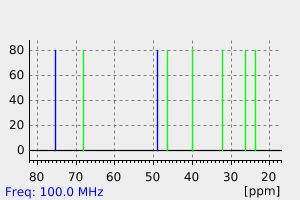
拉曼Raman
-
峰位数据
-
峰位匹配
-
表征信息
同类化合物
(3S,4R)-3-氟四氢-2H-吡喃-4-胺
鲁比前列素中间体
顺式-3-溴<2-(2)H>四氢吡喃
顺-4-氨基四氢吡喃-3-醇
顺-4-(四氢吡喃-2-氧)-2-丁烯-1-醇
顺-3-Boc-氨基-四氢吡喃-4-羧酸
锡烷,三丁基[3-[(四氢-2H-吡喃-2-基)氧代]-1-炔丙基]-
螺[金刚烷-2,2'-四氢吡喃]-4'-醇
蒿甲醚四氢呋喃乙酸酯
蒜味伞醇B
蒜味伞醇A
茉莉吡喃
苯基2,4-二氯-5-氨磺酰苯磺酸酯
苄基2,3-二-O-乙酰基-4-脱氧-4-C-硝基亚甲基-β-D-阿拉伯吡喃果糖苷
膜质菊内酯
红没药醇氧化物A
红没药醇氧化物
科立内酯
硅烷,(1,1-二甲基乙基)二甲基[[4-[(四氢-2H-吡喃-2-基)氧代]-5-壬炔基]氧代]-
甲磺酸酯-四聚乙二醇-四氢吡喃醚
甲基[(噁烷-3-基)甲基]胺
甲基6-氧杂双环[3.1.0]己烷-2-羧酸酯
甲基4-脱氧吡喃己糖苷
甲基3-脱氧-3-硝基-beta-L-核吡喃糖苷
甲基2,4,6-三脱氧-2,4-二-C-甲基吡喃葡己糖苷
甲基1,2-环戊烯环氧物
甲基-[2-吡咯烷-1-基-1-(四氢-吡喃-4-基)-乙基]-胺
甲基-(四氢吡喃-4-甲基)胺
甲基-(四氢吡喃-2-甲基)胺盐酸盐
甲基-(四氢吡喃-2-甲基)胺
甲基-(四氢-吡喃-3-基-胺
甲基-(四氢-吡喃-3-基)-胺盐酸盐
甲基-(4-吡咯烷-1-甲基四氢吡喃-4-基)-胺
甲基(5R)-3,4-二脱氧-4-氟-5-甲基-alpha-D-赤式-吡喃戊糖苷
环氧乙烷-2-醇乙酸酯
环己酮,6-[(丁基硫代)亚甲基]-2,2-二甲基-3-[(四氢-2H-吡喃-2-基)氧代]-,(3S)-
环丙基-(四氢-吡喃-4-基)-胺
玫瑰醚
独一味素B
溴-六聚乙二醇-四氢吡喃醚
氯菊素
氯丹环氧化物
氨甲酸,[[(四氢-2H-吡喃-2-基)氧代]甲基]-,乙基酯
氨甲酸,[(4-氨基四氢-2H-吡喃-4-基)甲基]-,1,1-二甲基乙基酯(9CI)
氧杂-3-碳酰肼
氧化氯丹
正-(四氢-4-苯基-2h-吡喃-4-基)乙酰胺
次甲霉素 A
桉叶油醇
无

联系我们


关注我们

公众号