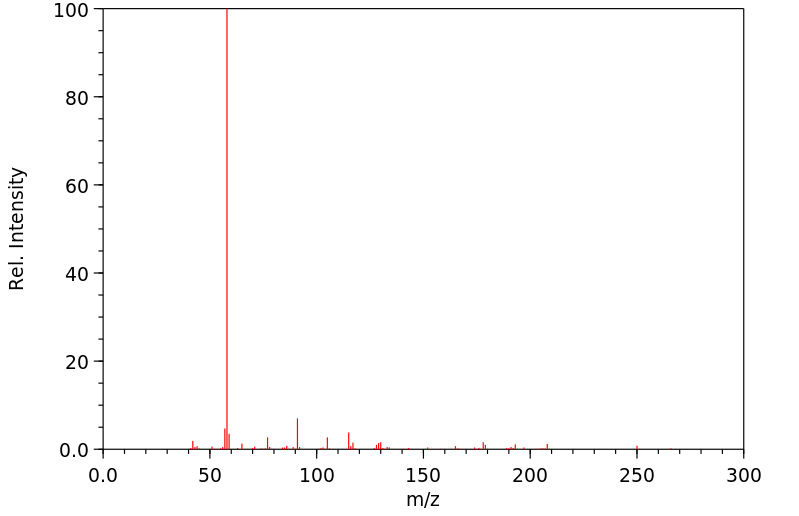
Propoxyphene undergoes extensive first-pass metabolism by intestinal and hepatic enzymes. Propoxyphene is metabolized mainly via N-demethylation (mediated by cytochrome P-450 (CYP) isoenzyme 3A4) to form norpropoxyphene. Ring hydroxylation and glucuronide formation appear to be minor metabolic pathways for the drug. Norpropoxyphene has an elimination half-life of 30-36 hours. Norpropoxyphene and unchanged propoxyphene are excreted mainly in urine. Approximately 20-25% of an orally administered 65-mg dose of propoxyphene hydrochloride may be recovered in urine as unchanged drug (trace amount) and free or conjugated norpropoxyphene within 48 hours.It appears that the unchanged drug is excreted mainly within 6 hours and the metabolite is excreted in the 6- to 48-hour period following administration. Renal clearance of propoxyphene is about 2.6 L/minute.
Formation of cytochrome p450 metabolic intermediate complexes in vivo occurred with propoxyphene in native & phenobarbital-induced rats. In vivo formation correlated with relative ability for it to form metabolic intermediate complexes & inhibit mixed function oxidation reactions in vitro.
Presystemic metabolism is believed to occur mainly in the liver with some minor intestinal participation. The aim of this study was to investigate the respective part of each of these two organs in the metabolism of the analgesic d-propoxyphene. Pharmacological doses of d-propoxyphene were given in the duodenum (ID), the portal vein (IP), and the femoral vein (IV) of male Wistar rats. A tracer dose of (14)C-d-propoxyphene was also administered either in IV, IP, or ID as well as in hepatectomized rats or rats with bile duct diversion. In vitro demethylation occurring in liver and intestinal microsomes was also studied. Absolute DP bioavailability obtained after oral administration was two times higher than that observed after portal administration (48.9% vs. 23.2%, respectively), an result opposite (i.e. a lower bioavailability) of that expected on the basis of the existence of a liver enzyme saturation phenomenon. The (14)C-d-propoxyphene cumulative excretion after (14)C-d-propoxyphene administration was significantly lower after IV or ID administration than after injection in the portal vein as a bolus or within 20 min. The biliary excretion of the labeled compound varied in the opposite direction, being greater after IV or ID than after IP administration, suggesting that the metabolism of d-propoxyphene in the liver is influenced by an extrahepatic transformation. This most likely occurs in the gut since the production of (14)C-d-propoxyphene after IV administration was similar to that after ID administration. This transformation did not prohibit d-propoxyphene detection in the systemic blood but was sufficient to increase the part eliminated with bile and to decrease the part demethylated NP. Demethylation mainly occurs in the liver since the production of (14)C-d-propoxyphene was nearly abolished in hepatectomized rats. Furthermore, microsomes of hepatic but not of intestinal origin were able to demethylate d-propoxyphene. Our data suggest that the transformation of d-propoxyphene occurring in gut after oral administration is responsible for changes in the hepatic metabolism of the drug.
参考文献:M Chen, V Vijay, Q Shi, Z Liu, H Fang, W Tong. 美国食品药品监督管理局批准的药物标签用于研究药物诱导的肝损伤,《药物发现今日》,16(15-16):697-703, 2011. PMID:21624500 DOI:10.1016/j.drudis.2011.05.007
M Chen, A Suzuki, S Thakkar, K Yu, C Hu, W Tong. DILIrank:按人类发展药物诱导肝损伤风险排名的最大参考药物清单。《药物发现今日》2016, 21(4): 648-653. PMID:26948801 DOI:10.1016/j.drudis.2016.02.015
References:M Chen, V Vijay, Q Shi, Z Liu, H Fang, W Tong. FDA-Approved Drug Labeling for the Study of Drug-Induced Liver Injury, Drug Discovery Today, 16(15-16):697-703, 2011. PMID:21624500 DOI:10.1016/j.drudis.2011.05.007
M Chen, A Suzuki, S Thakkar, K Yu, C Hu, W Tong. DILIrank: the largest reference drug list ranked by the risk for developing drug-induced liver injury in humans. Drug Discov Today 2016, 21(4): 648-653. PMID:26948801 DOI:10.1016/j.drudis.2016.02.015
The major route of metabolism is cytochrome CYP3A4 mediated N-demethylation to norpropoxyphene, which is excreted by the kidneys. In 48 hours, approximately 20% to 25% of the administered dose of propoxyphene is excreted via the urine, most of which is free or conjugated norpropoxyphene.
Following oral administration, propoxyphene hydrochloride and napsylate are absorbed principally in the upper small intestine. The napsylate salt appears to be absorbed more gradually than the hydrochloride salt. Equimolar doses of propoxyphene hydrochloride or napsylate provide similar plasma concentrations. The bioavailability of oral propoxyphene hydrochloride doses of 65, 130, or 195 mg is equivalent to that of oral propoxyphene napsylate doses of 100, 200, or 300 mg, respectively.
Peak plasma propoxyphene concentrations are usually achieved within 2-2.5 hours following oral administration of propoxyphene hydrochloride capsules or propoxyphene napsylate suspension (no longer commercially available in the US) and within 3 hours following oral administration of propoxyphene napsylate tablets. The analgesic effect occurs within 15 minutes to 1 hour and persists for 4-6 hours. Therapeutic plasma propoxyphene concentrations are 50 ng/mL or greater. Peak plasma concentrations achieved with the recommended 65-mg dose of propoxyphene hydrochloride may range from 50-120 ng/mL, while concentrations of the norpropoxyphene metabolite range from 100-200 ng/mL.
[EN] DIHYDROPYRROLONAPHTYRIDINONE COMPOUNDS AS INHIBITORS OF JAK<br/>[FR] COMPOSÉS DE DIHYDROPYRROLONAPHTYRIDINONE COMME INHIBITEURS DE JAK
申请人:TAKEDA PHARMACEUTICAL
公开号:WO2010144486A1
公开(公告)日:2010-12-16
Disclosed are JAK inhibitors of formula (I) where G1, R1, R2, R3, R4, R5, R6, and R7 are defined in the specification. Also disclosed are pharmaceutical compositions, kits and articles of manufacture which contain the compounds, methods and materials for making the compounds, and methods of using the compounds to treat diseases, disorders, and conditions involving the immune system and inflammation, including rheumatoid arthritis, hematological malignancies, epithelial cancers (i.e., carcinomas), and other diseases, disorders or conditions associated with JAK.
[EN] NOVEL COMPOUNDS AND PHARMACEUTICAL COMPOSITIONS THEREOF FOR THE TREATMENT OF INFLAMMATORY DISORDERS<br/>[FR] NOUVEAUX COMPOSÉS ET COMPOSITIONS PHARMACEUTIQUES LES COMPRENANT POUR LE TRAITEMENT DE TROUBLES INFLAMMATOIRES
申请人:GALAPAGOS NV
公开号:WO2017012647A1
公开(公告)日:2017-01-26
The present invention discloses compounds according to Formula (I), wherein R1, R3, R4, R5, L1, and Cy are as defined herein. The present invention also provides compounds, methods for the production of said compounds of the invention, pharmaceutical compositions comprising the same and their use in allergic or inflammatory conditions, autoimmune diseases, proliferative diseases, transplantation rejection, diseases involving impairment of cartilage turnover, congenital cartilage malformations, and/or diseases associated with hypersecretion of IL6 and/or interferons. The present invention also methods for the prevention and/or treatment of the aforementioned diseases by administering a compound of the invention.
[EN] NAPHTHALENE CARBOXAMIDE M1 RECEPTOR POSITIVE ALLOSTERIC MODULATORS<br/>[FR] COMPOSÉS DE NAPHTHALÈNE CARBOXAMIDE, MODULATEURS ALLOSTÉRIQUES POSITIFS DU RÉCEPTEUR M1
申请人:MERCK SHARP & DOHME
公开号:WO2011149801A1
公开(公告)日:2011-12-01
The present invention is directed to naphthalene carboxamide compounds of formula (I) which are M1 receptor positive allosteric modulators and that are useful in the treatment of diseases in which the M1 receptor is involved, such as Alzheimers disease, schizophrenia, pain or sleep disorders. The invention is also directed to pharmaceutical compositions comprising the compounds and to the use of the compounds and compositions in the treatment of diseases mediated by the M1 receptor.
[EN] QUINAZOLINE DERIVATIVES, COMPOSITIONS, AND USES RELATED THERETO<br/>[FR] DÉRIVÉS DE QUINAZOLINE, COMPOSITIONS ET UTILISATIONS ASSOCIÉES
申请人:UNIV EMORY
公开号:WO2013181135A1
公开(公告)日:2013-12-05
The disclosure relates to quinazoline derivatives, compositions, and methods related thereto. In certain embodiments, the disclosure relates to inhibitors of NADPH-oxidases (Nox enzymes) and/or myeloperoxidase.
[EN] SPIROLACTAM CGRP RECEPTOR ANTAGONISTS<br/>[FR] ANTAGONISTES DE RÉCEPTEUR DE CGRP À BASE DE SPIROLACTAME
申请人:MERCK SHARP & DOHME
公开号:WO2013169567A1
公开(公告)日:2013-11-14
The present invention is directed to spirolactam analogues which are antagonists of CGRP receptors and useful in the treatment or prevention of diseases in which CGRP is involved, such as migraine. The invention is also directed to pharmaceutical compositions comprising these compounds and the use of these compounds and compositions in the prevention or treatment of such diseases in which CGRP is involved.