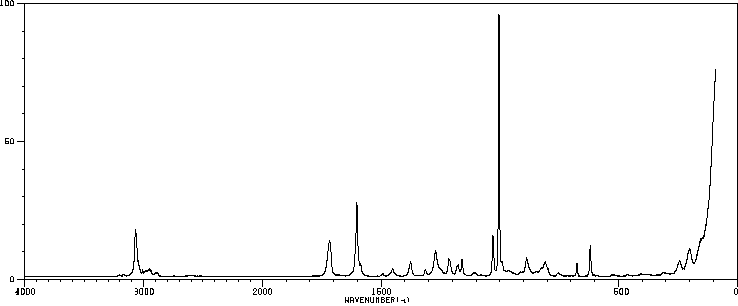
Rapidly hydrolyzed to benzoic acid and benzyl alcohol, which is further oxidized to benzoic acid. The benzoic acid is conjugated with glycine to form hippuric acid.
IDENTIFICATION AND USE: Benzyl benzoate is a liquid. It is used as solvent of cellulose acetate, nitrocellulose and artificial musk, substitute for camphor in celluloid and plastic pyroxylin compounds, perfume fixative, in confectionary and chewing gum flavors. As an insecticide/miticide, it was used to control dust mites in carpets, mattresses, upholstery, and on furniture. Benzyl benzoate is used as an alternative agent for the topical treatment of scabies and also has been used for the topical treatment of pediculosis (lice infestation). It is also used in veterinary medicine as acaricide and pediculicide, but is contraindicated in cats. It was used in the Vietnam War to eradicate and repel certain ticks and mites. HUMAN STUDIES: Direct contact may cause skin irritation. Liquid is irritating to eyes on direct contact, but no damage has been reported. There was no evidence of adverse effects on pregnancy outcome due to topical benzyl benzoate lotion. Benzyl benzoate gave estrogenic responses in a human breast cancer cell line in culture. ANIMAL STUDIES: 13-week study in rats demonstrated decreased body weight gain and mortality at 800 mg/kg/day. Neurotoxicity signs noted such as staggering, respiratory difficulty, and lethargy. Hemorrhages were found around the mouth and nose, and histologic lesions in the brain, thymus, skeletal muscle, and kidney. Benzyl benzoate was not tested for carcinogenicity, but the metabolite benzyl alcohol was tested in rats and mice. No evidence of carcinogenic activity was found in benzyl alcohol. The maternal and fetal toxicity of benzyl benzoate was evaluated in pregnant rats after a daily oral dose of 25 and 100 mg/kg. The results demonstrated that benzyl benzoate and its metabolites can transport to the placenta and eventually enter the fetuses. Benzyl benzoate was tested for mutagenicity and found to be negative in inducing unscheduled glycol nucleic acid synthesis in rat liver cells. The chemical did not cause damage to hormones nor did it cause mammalian cell mutations in vitro.
来源:Hazardous Substances Data Bank (HSDB)
毒理性
暴露途径
该物质可以通过吸入其气溶胶、通过皮肤接触以及摄入进入人体。
The substance can be absorbed into the body by inhalation of its aerosol, through the skin and by ingestion.
来源:ILO-WHO International Chemical Safety Cards (ICSCs)
毒理性
吸入症状
咳嗽。喉咙痛。
Cough. Sore throat.
来源:ILO-WHO International Chemical Safety Cards (ICSCs)
毒理性
皮肤症状
可能是被吸收了!干燥的皮肤。红斑。
MAY BE ABSORBED! Dry skin. Redness.
来源:ILO-WHO International Chemical Safety Cards (ICSCs)
毒理性
眼睛症状
红色。
Redness.
来源:ILO-WHO International Chemical Safety Cards (ICSCs)
No data are available on percutaneous absorption of benzyl benzoate. Some older studies have suggested some percutaneous absorption, however the amount was not quantified.
The maternal and fetal toxicity of benzyl benzoate, commonly used as antiparasitic insecticide, was evaluated in pregnant rats after a daily oral dose of 25 and 100 mg/kg. Biochemical, histopathological, and morphological examinations were performed. Dams were observed for maternal body weights and food and water consumption and subjected to caesarean section on (GD) 20. Maternal and fetal liver, kidney, heart, brain, and placenta were examined histopathologically under light microscope. Maternal and fetal liver and placenta were stained immunohistochemically for vascular endothelial growth factor (VEGF). Morphometric analysis of fetal body lengths, placental measurements, and fetal skeletal stainings was performed. Statistically significant alterations in biochemical parameters and placental and skeletal measurements were determined in treatment groups. In addition to histopathological changes, considerable differences were observed in the immunolocalization of VEGF in treatment groups. These results demonstrated that benzyl benzoate and its metabolites can transport to the placenta and eventually enter the fetuses.
The percutaneous absorption of benzyl benzoate measured in vivo in human and monkey studies. With the application sites occluded, 54% of the applied dose penetrated human skin in 24 hr compared with 69% absorption in the monkey skin.
1.周国泰,化学危险品安全技术全书,化学工业出版社,1997 2.国家环保局有毒化学品管理办公室、北京化工研究院合编,化学品毒性法规环境数据手册,中国环境科学出版社.1992 3.Canadian Centre for Occupational Health and Safety,CHEMINFO Database.1998 4.Canadian Centre for Occupational Health and Safety, RTECS Database, 1989
[EN] ACC INHIBITORS AND USES THEREOF<br/>[FR] INHIBITEURS DE L'ACC ET UTILISATIONS ASSOCIÉES
申请人:GILEAD APOLLO LLC
公开号:WO2017075056A1
公开(公告)日:2017-05-04
The present invention provides compounds I and II useful as inhibitors of Acetyl CoA Carboxylase (ACC), compositions thereof, and methods of using the same.
Cell adhesion-inhibiting antiinflammatory and immune-suppressive compounds
申请人:Abbott Laboratories
公开号:US20040116518A1
公开(公告)日:2004-06-17
The present invention relates to novel cinnamide compounds that are useful for treating inflammatory and immune diseases and cerebral vasospasm, to pharmaceutical compositions containing these compounds, and to methods of inhibiting inflammation or suppressing immune response in a mammal.
Compositions for Treatment of Cystic Fibrosis and Other Chronic Diseases
申请人:Vertex Pharmaceuticals Incorporated
公开号:US20150231142A1
公开(公告)日:2015-08-20
The present invention relates to pharmaceutical compositions comprising an inhibitor of epithelial sodium channel activity in combination with at least one ABC Transporter modulator compound of Formula A, Formula B, Formula C, or Formula D. The invention also relates to pharmaceutical formulations thereof, and to methods of using such compositions in the treatment of CFTR mediated diseases, particularly cystic fibrosis using the pharmaceutical combination compositions.
The present invention provides a cobalamin-drug conjugate suitable for the treatment of tumor related diseases. Cobalamin is indirectly covalently bound to an anti-tumor drug via a cleavable linker and one or more optional spacers. Cobalamin is covalently bound to a first spacer or the cleavable linker via the 5′-OH of the cobalamin ribose ring. The drug is bound to a second spacer of the cleavable linker via an existing or added functional group on the drug. After administration, the conjugate forms a complex with transcobalamin (any of its isoforms). The complex then binds to a receptor on a cell membrane and is taken up into the cell. Once in the cell, an intracellular enzyme cleaves the conjugate thereby releasing the drug. Depending upon the structure of the conjugate, a particular class or type of intracellular enzyme affects the cleavage. Due to the high demand for cobalamin in growing cells, tumor cells typically take up a higher percentage of the conjugate than do normal non-growing cells. The conjugate of the invention advantageously provides a reduced systemic toxicity and enhanced efficacy as compared to a corresponding free drug.
The present invention is concerned with novel hydroxy-methyl isoxazole derivatives of formula I
wherein R
1
, R
2
and R
3
are as described herein, as well as pharmaceutically acceptable salts and esters thereof. The active compounds of the present invention have affinity and selectivity for GABA A α5 receptor. Further the present invention is concerned with the manufacture of the active compounds of formula I, pharmaceutical compositions containing them and their use as pharmaceuticals.
本发明涉及一种新型的羟甲基异噁唑衍生物,其化学式为I,其中R1、R2和R3如本文所述,以及其药学上可接受的盐和酯。本发明的活性化合物具有对GABA A α5受体的亲和力和选择性。此外,本发明涉及制备化学式I的活性化合物、含有它们的药物组合物以及它们作为药物的用途。