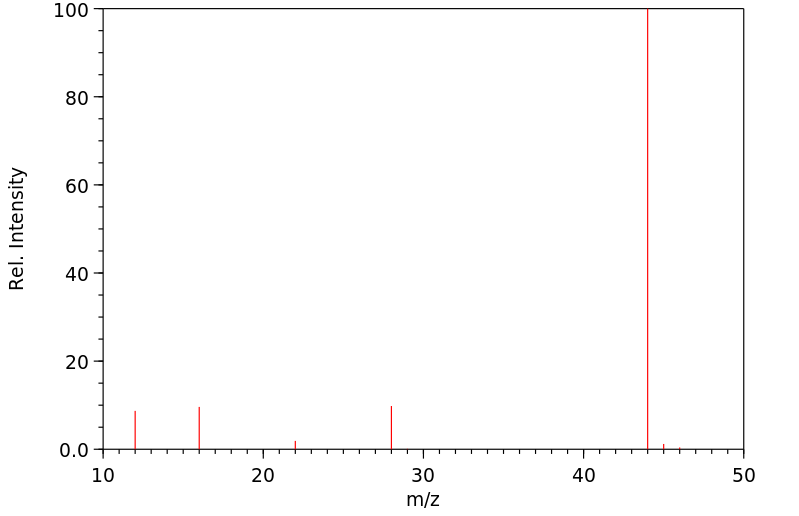
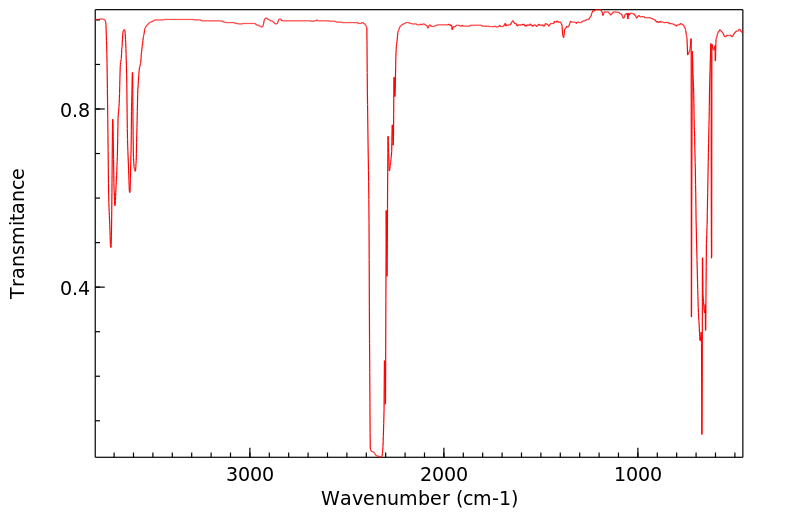
Carbon dioxide, solid appears as an odorless, white solid. Can cause damaging frostbite. Noncombustible and nontoxic. Liquefies at -109°F. Can asphyxiate by displacement of air. Used as a refrigerant.
Carbon dioxide is produced by the body's metabolism and is always present in the body at about 6% concentration. An average adult human will produce more than 500 g of carbon dioxide daily under resting conditions, and will produce much more when active. Additional carbon dioxide has several effects on the body, and responses are immediate. It stimulates breathing, which exhales the carbon dioxide carried to the lungs from the cells by the bloodstream. An increase in carbon dioxide concentration stimulates the heart rate, increases the blood pressure, increases adrenalin flow, and relaxes the vascular smooth muscles. In addition, carbon dioxide reacts with water in the body to form carbonic acid, which dissociates to hydrogen ion and bicarbonate. An increase in carbon dioxide in the body increases acidity, and then the kidneys act to restore normal acidity.
Perturbation of mitochondrial metabolism, oxidative phosphorylation or Krebs cycle affects embryogenesis. These studies assess the effects of altering pyruvate metabolism in 3-5 somite mouse embryos in whole embryo culture. ... To establish that pyruvate is metabolized during organogenesis the rates of (14)C-carbon dioxide production from 3-(14)C-pyruvate by conceptuses in vitro were measured on days 9-12. The rates of carbon dioxide production incr with incr gestational age. ... The rate of carbon dioxide production from pyruvate by day 10 yolk sac was 10 times greater than that by the embryo proper. Fluoroacetate produced a time and concn dependent reduction in carbon dioxide production in day 10 conceptuses. These studies demonstrate that pyruvate is metabolized by Krebs cycle during organogenesis. alpha-Cyano-4-hydroxycinnamate inhibits transport of pyruvate from cytosol to mitochondria. Embryos exposed to alpha-Cyano-4-hydroxycinnamate exhibited neural tube defects (11/12 at 1,000 uM). Thus, alterations of utilization of pyruvate is teratogenic to cultured embryos. Pyruvate dehydrogenase is inhibited via phosphorylation by E1-kinase. Dichloroacetate inhibits e1-kinase resulting incr pyruvate dehydrogenase activity and incr metabolism of pyruvate by Krebs cycle. Dichloroacetate produced neural tube defects in 0/12 embryos at 100 uM and 6/15 embryos at 500 uM. ... Pyruvate is metabolized during organogenesis and that proper regulation of pyruvate is metabolized during organogenesis and that proper regulation of pyruvate transport and metabolism is essential for normal development.
Carbon dioxide is transported in the blood in diverse forms: dissolved in the plasma, or linked to proteins independently of the PCO2. Carbone dioxide is transported by the hemoglobin back to the lungs, where it is exhaled (A320, L1147).
IDENTIFICATION AND USE: Carbon dioxide (CO2) is a colorless gas and liquid, or solid (dry ice): white, snow-like flakes or cubes. It is registered for pesticide use in the U.S. but approved pesticide uses may change periodically and so federal, state and local authorities must be consulted for currently approved uses. Carbon dioxide is used as a pesticide for insect control in stored grain under modified atmospheres containing approx. 60% carbon dioxide. It is also used as rodenticide (mice and rats). Other uses include refrigeration, carbonated beverages, aerosol propellant, chemical intermediate (carbonates, synthetic fibers, p-xylene, etc.), low-temperature testing, fire extinguishing, inert atmospheres, municipal water treatment, medicine, enrichment of air in greenhouses, fracturing and acidizing of oil wells, mining (Cardox method), miscible pressure source, hardening of foundry molds and cores, shielding gas for welding, cloud seeding, moderator in some types of nuclear reactors, immobilization for humane animal killing, special lasers, blowing agent, as demulsifier in tertiary oil recovery, possible source of methane, (liquid) carrier for powdered-coal slurry. Supercritical or liquid CO2 used in extraction of caffeine and hops aroma; dry cleaning; metal degreasing; cleaning semiconductor chips; paint spraying; polymer modification. Carbon dioxide is used in hydraulic fracturing. CO2 is also used as medication during surgical procedures. HUMAN EXPOSURE AND TOXICITY: Carbon dioxide is produced by the body's metabolism and is always present in the body at about 6% concentration. An average adult human will produce more than 500 g of carbon dioxide daily under resting conditions, and will produce much more when active. The gas is a weak CNS depressant at 30,000 ppm, giving rise to reduced acuity of hearing and increasing blood pressure and pulse. Exposure at 7%-10% produces unconsciousness within a few minutes. At low concentrations, gaseous carbon dioxide appears to have little toxicological effect. At higher concentrations it leads to an increased respiratory rate, tachycardia, cardiac arrhythmias and impaired consciousness. Concentrations >10% may cause convulsions, coma and death. Solid carbon dioxide may cause burns following direct contact. If it is warmed rapidly, large amounts of carbon dioxide are generated, which can be dangerous, particularly within confined areas. Carbon dioxide at high concentration in air causes stinging sensation in eyes, nose, and throat. Asphyxiation with CO2 is said to have induced temporary proptosis and mydriasis and caused yellow vision, with transient blindness. Severe damage of CNS and retinal ganglion cells has been reported. ANIMAL STUDIES: Inhalation of air containing 68% carbon dioxide for 5 min caused death from asphyxia in pigs. Dogs were given 30% carbon dioxide for 2 hr, then 40% carbon dioxide, and then abruptly returned to normal air. Eleven dogs died within 10 min with ventricular fibrillation. Four survived with cardiac arrhythmias, and two had no cardiac symptoms. Rats exposed to an atmosphere containing 50% carbon dioxide died within 6 hr. Rats exposed to 25% died within 36 hr. Deaths were a result of pulmonary injury. Atmospheres as low as 20% carbon dioxide caused cerebral depression. All rats exposed to 10% carbon dioxide survived. Guinea pigs exposed to 15% carbon dioxide for 7 days lost weight at first but later returned to normal weight. They also had higher blood corticosteroids, lower adrenal epinephrine, decreased adrenal cholesterol, higher arterial free fatty acids, and decreased lymphocytes in the first 3 days of exposure. No effects were seen in male rhesus monkeys that spent 93 days in an atmosphere with 3% carbon dioxide. Toxicity to fertility (morphological changes of spermatozoa in mice at 1% and testicular changes in rats at 2.5%) and teratogenicity (cardiac and skeletal abnormalities in rats at 6%; skeletal abnormalities in rabbits at 10%) were observed. ECOTOXICITY STUDIES: Harmful to some species of aquatic life in concentrations less than 20 mg/L. Adult and larval insects are rapidly anesthetized by carbon dioxide. Groups of caged, queenless Apis mellifera (honeybee) workers narcotized with CO(2) on consecutive days early in adult life showed a significantly lower level of ovary activation than did groups of untreated workers. This same experimental treatment, by contrast, is known to accelerate ovary activation and induce egg laying in virgin honey bee queens--an observation that suggests that CO(2) narcosis has contrasting effects in queen versus worker ovary activation. Elevated levels of atmospheric carbon dioxide, a consequence of anthropogenic global change, can profoundly affect the interactions between crop plants and insect pests and may promote yet another form of global change: the rapid establishment of invasive species.
Carbon dioxide causes widespread activation of the sympathetic nervous system and an increase in the plasma concentrations of epinephrine, norepinephrine, angiotensin, and other vasoactive peptides . The response is mediated by various subcortical centers in the hypothalamus, brainstem reticular formation and medulla. These areas can be excited locally by carbon dioxide, but they also receive afferents from the carotid and aortic chemoreceptors that are sensitive to changes in carbon dioxide in the blood. The results of sympathetic nervous system activation are, in general, opposite to the local effects of carbon dioxide. The sympathetic effects consist of an increase in cardiac contractility and heart rate and vasoconstriction (A628).
来源:Toxin and Toxin Target Database (T3DB)
毒理性
致癌物分类
无致癌性迹象(未被国际癌症研究机构IARC列名)。
No indication of carcinogenicity (not listed by IARC). (L135)
Carbon dioxide poisoning (Hypercapnia) can induce increased cardiac output, an elevation in arterial blood pressure, and a propensity toward arrhythmias (L1145).
来源:Toxin and Toxin Target Database (T3DB)
毒理性
暴露途径
这种物质可以通过吸入被身体吸收。
The substance can be absorbed into the body by inhalation.
来源:ILO-WHO International Chemical Safety Cards (ICSCs)