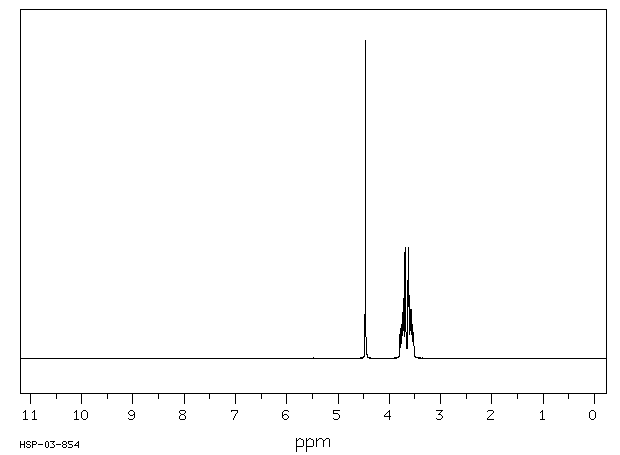
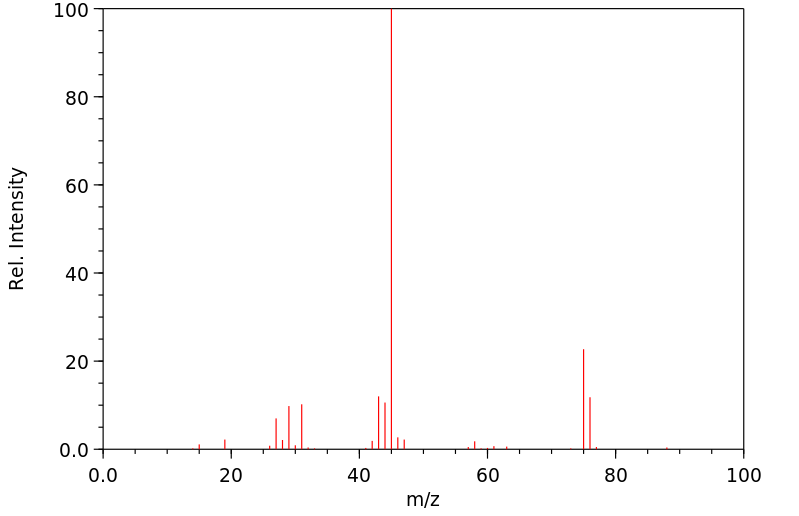
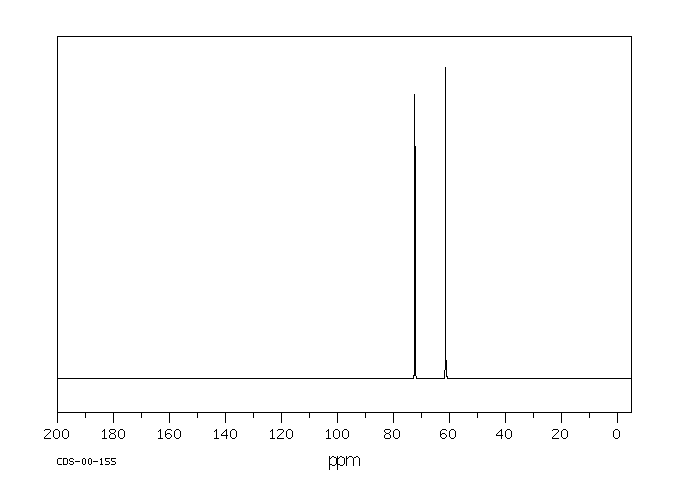
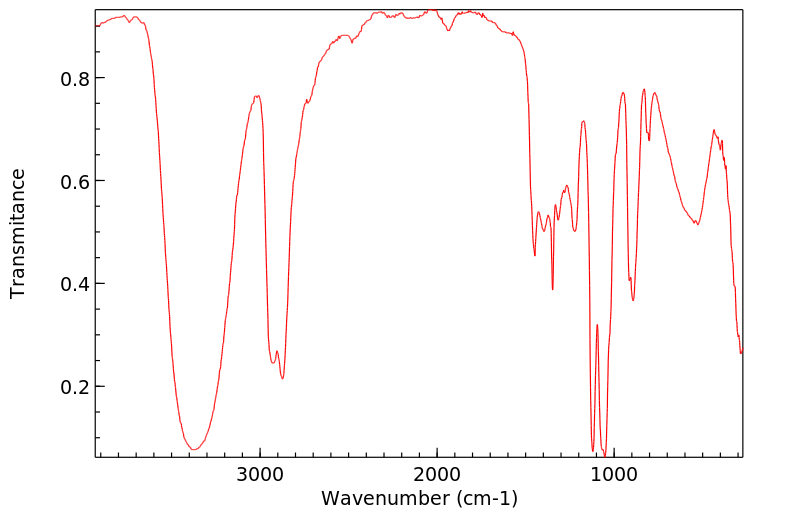
Diethylene glycol appears as a colorless liquid. Denser than water. Contact may slightly irritate skin, eyes and mucous membranes. May be slightly toxic by ingestion. Used to make other chemicals.
颜色/状态:
Colorless syrupy liquid
气味:
Practically odorless
味道:
Sharply sweetish taste
蒸汽密度:
3.66 (NTP, 1992) (Relative to Air)
蒸汽压力:
5.7X10⁻³ mm Hg at 25 °C
亨利常数:
Henry's Law constant = 2.0X10⁻⁹ atm-cu m/mol at 25 °C (est)
Diethylene glycol is metabolized in the liver by two consecutive oxidized form of nicotinamide adenine dinucleotide-dependent reactions. First, diethylene glycol is metabolized by ADH to (2-hydroxyethoxy)acetaldehyde, which is then rapidly metabolized by aldehyde dehydrogenase to (2-hydroxyethoxy)acetate.
... /Diethylene glycol (DEG) is/ initially metabolized by /alcohol dehydrogenase/ and subsequently by /aldehyde dehydrogenase/. The ether linkage of DEG is not cleaved and no appreciable amounts of EG or EG metabolites are formed from DEG, although small amounts of /oxalic acid/ have occasionally been reported ...
... Based on studies in rats and dogs, unchanged diethylene glycol recovered in urine constitutes the majority of oral doses, with a single urinary metabolite, (2-hydroxyethoxy) acetic acid, accounting for most of the remainder .
Although the metabolism of diethylene glycol is not known, the presence of calcium oxalate crystals in the kidneys and urine of treated rats suggests that the metabolic pathway follows that of monoethylene glycerol, ie, to glycoaldehyde, which is further metabolized glycolate and then to oxalate, carbon dioxide, glycerine and serine.
◉ Summary of Use during Lactation:No published experience exists with polyethylene glycol during breastfeeding. However, the drug is very poorly absorbed from the gastrointestinal tract, so it cannot enter the breastmilk in important amounts. No special precautions are required.
◉ Effects in Breastfed Infants:Relevant published information was not found as of the revision date.
◉ Effects on Lactation and Breastmilk:Relevant published information was not found as of the revision date.
来源:Drugs and Lactation Database (LactMed)
毒理性
暴露途径
该物质可以通过摄入被身体吸收。
The substance can be absorbed into the body by ingestion.
来源:ILO-WHO International Chemical Safety Cards (ICSCs)
Neurotoxin - Other CNS neurotoxin
Occupational hepatotoxin - Secondary hepatotoxins: the potential for toxic effect in the occupational setting is based on cases of poisoning by human ingestion or animal experimentation.
Nephrotoxin - The chemical is potentially toxic to the kidneys in the occupational setting.
来源:Haz-Map, Information on Hazardous Chemicals and Occupational Diseases
毒理性
毒性数据
大鼠LC50 > 4,600毫克/立方米/4小时
LC50 (rat) > 4,600 mg/m3/4h
来源:Haz-Map, Information on Hazardous Chemicals and Occupational Diseases
Half-logarithmic plots of urinary 14C excretion rates versus time indicated zero-order elimination for the first 9 and 18 hr after oral doses of 5 and 10 mL of 14C-DEG/kg, respectively. 14C-DEG urinary elimination kinetics changed into first-order 6, 9, and 18 hr after oral doses of 1, 5, and 10 mL/kg, with a half-life of 3 hr. 2. ... The urinary concentrations of non-metabolized DEG and its metabolite, 2-hydroxyethoxyacetic acid (2-HEAA), determined by high-resolution nmr spectroscopy in the urine of rats doses with DEG were 61-68% and 16-31% dose, respectively. ... Oxidation of DEG ... in rats was accompanied by a change of urinary pH, reflecting metabolic acidosis.
Oral doses of 1 and 5 mL/kg (14)C-diethylene glycol (DEG) given to rats were rapidly and almost completely absorbed, the invasion constants being 2.95/ hr and 4.24/ hr ... (14)C-DEG was rapidly distributed from the blood into the organs and tissues in the order kidneys > brain > spleen > liver > muscle > fat, i.e. the same order as the blood flow. The relative volume of distribution, app. VD, was determined at 298 mL, indicating distribution over the whole body. After oral doses of 1, 5, and 10 mL (14)C-DEG/kg 64, 87, and 91% of (14)C activity in rat blood disappeared in 12-16 hr with a half-life of 3.4 hr and the remaining 9, 5, and 4% with half-lives of 39 hr, 45 hr, and 49 hr. A total of 73-96% of (14)C activity in blood was excreted with the urine and 0.7-2.2% with the feces. From the cumulative urinary excretion kinetics half-lives of 6 hr were determined for doses of 1 and 5 mL/kg and 10 hr for the dose of 10 mL/kg. After doses of 5 mL/kg and 10 mL/kg (14)C-DEG semi-logarithmic plots of elimination rate versus time were constant for 5 and 9 hr, respectively, indicating that DEG accelerated its renal elimination by inducing osmotic diuresis. Thereafter urinary excretion followed first order kinetics with elimination half-lives of 3.6 hr. After oral doses of 5 ml/kg (14)C-DEG given to rats of 336 g body weight with an app. VD of 297 mL, the total clearance of (14)C activity was determined at 63 mL/hr, and the renal clearance of unmetabolized DEG was 66 mL/hr. The ratio of ClDEG to Cl (inulin) = 0.64 indicated that DEG and its metabolite 2-hydroxyethoxyacetate (2-HEAA) were reabsorbed from the tubuli into the blood capillaries.
Like /ethylene glycol/, diethylene glycol is well absorbed in the GI tract, distributed throughout total body water and organs on the basis of blood flow ...
1.周国泰,化学危险品安全技术全书,化学工业出版社,1997 2.国家环保局有毒化学品管理办公室、北京化工研究院合编,化学品毒性法规环境数据手册,中国环境科学出版社.1992 3.Canadian Centre for Occupational Health and Safety,CHEMINFO Database.1998 4.Canadian Centre for Occupational Health and Safety, RTECS Database, 1989
Cyclooctyne [60]fullerene hexakis adducts: a globular scaffold for copper-free click chemistry
作者:Javier Ramos-Soriano、José J. Reina、Alfonso Pérez-Sánchez、Beatriz M. Illescas、Javier Rojo、Nazario Martín
DOI:10.1039/c6cc05484f
日期:——
The synthesis of a new highly symmetric hexakis adduct of C60 appended with 12 cyclooctyne moieties has been carried out. This compound has been used for the copper-free strain-promoted cycloaddition...
The invention relates to a process for preparing alkylene glycols by hydration of alkylene oxides in the presence of polyalkylene glycol dialkyl ethers of the formula
R
1
—O—[—(CH
2
CH
2
O)
m
(CH(CH
3
)CH
2
)—O]
n
—R
2
in which m=0-100, n=0-100, where n+m is at least equal to 1,
R
1
is a C
1
- to C
6
-alkyl radical,
R
2
is a C
1
- to C
6
-alkyl radical, where R
2
may be different from R
1
, with the proviso that for at least 50 mol % of the polyalkylene glycol dialkyl ether m+n is greater than or equal to 11.
该发明涉及一种制备烷基二醇的方法,通过在多烷基乙二醚的存在下水合烷基氧化物来实现,该多烷基乙二醚的化学式为
R
1
—O—[—(CH
2
CH
2
O)
m
(CH(CH
3
)CH
2
)—O]
n
—R
2
其中m=0-100,n=0-100,其中n+m至少等于1,
R
1
是C
1
-到C
6
-烷基基团,
R
2
是C
1
-到C
6
-烷基基团,其中R
2
可能与R
1
不同,但至少对于50摩尔%的多烷基乙二醚,m+n大于或等于11。
Synthesis of New Phospholipids Linked to Steroid-Hormone Derivatives Designed for Two-Dimensional Crystallization of Proteins
作者:Luc Lebeau、Pierre Oudet、Charles Mioskowski
DOI:10.1002/hlca.19910740810
日期:1991.12.11
The synthesis of phospholipids 1n–3n, rationally designed for two-dimensionalcrystallization of progesterone and estradiol receptors, is reported. The structure of these lipids provides them with essential properties such as fluidity and stability when spread into monolayers at the air/H2O interface, affinity for the protein to be crystallized, and accessibility of the ligand under the lipid monolayer
据报道,合理设计用于孕酮和雌二醇受体的二维结晶的磷脂1 n - 3 n的合成。这些脂质的结构为它们提供了必要的特性,例如当在空气/ H 2 O界面扩散为单层时的流动性和稳定性,对要结晶的蛋白质的亲和力以及脂质单层下配体的可及性。
Probing the Existence of a Metastable Binding Site at the β<sub>2</sub>-Adrenergic Receptor with Homobivalent Bitopic Ligands
作者:Birgit I. Gaiser、Mia Danielsen、Emil Marcher-Rørsted、Kira Røpke Jørgensen、Tomasz M. Wróbel、Mikael Frykman、Henrik Johansson、Hans Bräuner-Osborne、David E. Gloriam、Jesper Mosolff Mathiesen、Daniel Sejer Pedersen
DOI:10.1021/acs.jmedchem.9b00595
日期:2019.9.12
development of bitopicligands aimed at targeting the orthosteric binding site (OBS) and a metastable binding site (MBS) within the same receptor unit. Previous molecular dynamics studies on ligand binding to the β2-adrenergic receptor (β2AR) suggested that ligands pause at transient, less-conserved MBSs. We envisioned that MBSs can be regarded as allosteric binding sites and targeted by homobivalent bitopic